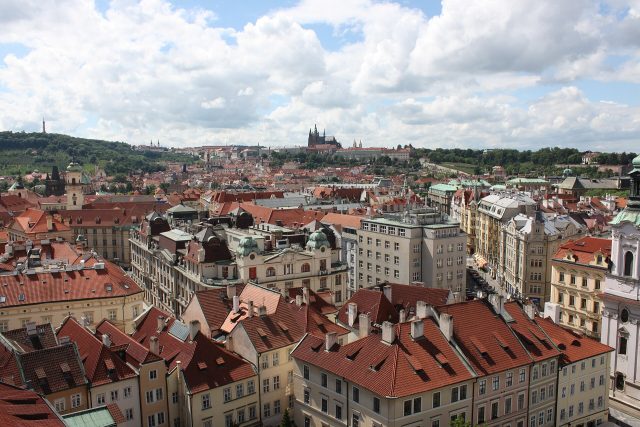
Old Town Square is where Prague’s past feels almost tangible, as if the centuries have settled into the cobblestones beneath your feet. Tucked in the heart of the historic center, it’s surrounded by buildings that have witnessed everything from medieval markets to the rise and fall of empires. The square is always alive—tourists snap photos of the Gothic spires, street musicians play snippets of Dvořák or Smetana, and locals occasionally pause as if checking whether the place has changed since the last time they passed through. It’s not just a landmark; it’s a living space that breathes with the city.
The square’s origins trace back to the 12th century, when it was little more than a bustling marketplace outside the city walls. Over time, it grew into the social and political core of Prague. By the 14th century, it had earned its name and become the stage for the city’s most pivotal moments—guild meetings, public trials, and even executions. The most infamous of these took place in 1621, when 27 Czech nobles were beheaded after the Battle of White Mountain. Their names are now etched into a memorial plaque at the base of the Old Town Hall, a quiet reminder of the square’s darker history.
Dominating the square is the Old Town Hall, its tower looming over the scene since the 14th century. The real draw, though, is the astronomical clock, installed in 1410. More than just a timekeeper, it tracks the positions of the sun, moon, and zodiac signs, its intricate mechanics a marvel of medieval engineering. Every hour, crowds gather to watch the small procession of apostles appear in the clock’s windows, followed by the figure of Death ringing a bell. The clock has been repaired countless times over the centuries, but it still feels like a relic of a time when craftsmanship was measured in patience and precision.
Beside the town hall stands the Church of Our Lady before Týn, a Gothic masterpiece recognizable by its twin spires piercing the skyline. Construction began in the 14th century but dragged on for two hundred years, leaving behind a structure that blends different architectural styles. Inside, the church holds treasures like the altar by Peter Parler and the tomb of Tycho Brahe, the Danish astronomer who spent his final years in Prague. The church was also a center of intellectual life—Jan Hus preached here in the early 15th century, his sermons sparking the Hussite Wars that would reshape Bohemia.
Across the square, the Kinský Palace stands out with its elegant Baroque facade, adorned with statues and ornate stucco. Today, it houses part of the National Gallery, hosting exhibitions of Czech and international art. Nearby, the Church of St. Nicholas offers another glimpse of Baroque grandeur, built on the site of an earlier Gothic church. Its dome and bell tower dominate the skyline, while the interior dazzles with gilded altars, frescoes, and a massive chandelier—a gift from a Russian tsar.
Old Town Square isn’t just an open-air museum. It’s a place where daily life unfolds in real time. In summer, outdoor cafés spill onto the pavement, while winter brings a Christmas market with mulled wine and traditional treats. Street performers draw crowds in warmer months, and occasional open-air concerts fill the air with music. Locals come here not just for the tourists—some browse the small shops for souvenirs, others sit on benches, watching the world go by.
The square has a way of changing with the light. In the early morning, it feels sleepy and quiet, the buildings bathed in soft golden hues. By midday, it’s a swirl of activity, with voices and footsteps echoing off the cobblestones. As evening falls, the streetlamps cast a warm glow, and the spires of the town hall stretch long shadows across the pavement. On rainy days, the square takes on a particularly romantic air—umbrellas bobbing, reflections shimmering in puddles, the whole scene softened by the mist.
There’s always something new to notice if you take the time to look. Some buildings still bear faded inscriptions or coats of arms from their original owners. On one corner, a modest monument to Jan Hus stands as a quiet tribute to the reformer whose ideas shaped Czech history. Even the cobblestones hold stories—metal markers embedded in the ground trace the outline of a medieval gallows that once stood here.
Old Town Square isn’t just a box to tick on a tourist checklist. It’s where Prague’s layers—its history, its contradictions, its enduring charm—come together. Whether you visit once or a dozen times, it always has another angle to reveal, another detail to catch your eye. That’s the magic of the place: it doesn’t just show you the past. It lets you feel it.