The Astronomical Clock Tower, known locally as Orloj, is one of those rare places in Prague that feels suspended between eras. It stands on Old Town Square, a quiet witness to centuries of change, though most visitors simply call it the Prague Astronomical Clock. The tower itself is far more than just its famous timepiece—it’s a sixty-meter structure that has loomed over the city since the 14th century, its gears and dials marking not just the hours but the passage of history itself.
The tower’s architecture tells its own story. The lower portion is a sturdy block of Gothic stonework, while the upper levels unfold with delicate tracery and sculptural details. The real fascination lies in the clock’s animated figures. Every hour, the twelve apostles emerge from small windows above the dial, their procession framed by other moving statues: Death tolling a bell, a Turk shaking his head, a Miser clutching his bag, and Vanity admiring himself in a mirror. For tourists, this mechanical spectacle is a highlight, but for Praguers, it’s just part of the city’s rhythm, as familiar as the chime of church bells.
The Orloj’s origins are as layered as its design. Installed in 1410, the clock is often credited to a master clockmaker named Hanuš, though historians still debate whether he was the sole creator. A persistent legend claims that after completing the clock, Hanuš was blinded to prevent him from replicating his work elsewhere. While the tale is almost certainly apocryphal, it adds to the clock’s mystique. What’s undeniable is its technical ambition—beyond telling time, the Orloj tracks the positions of the sun, moon, and zodiac signs, a marvel of medieval engineering.
Over the centuries, the clock has been expanded and restored. In the 16th century, an astronomical dial was added, followed in the 19th century by a calendar disc adorned with medallions representing the months. During World War II, the clock suffered significant damage but was painstakingly repaired. Today, its mechanism runs with remarkable reliability, though occasional maintenance pauses can disappoint visitors. For those who appreciate craftsmanship, however, it’s a reminder of how durable even the oldest technologies can be.
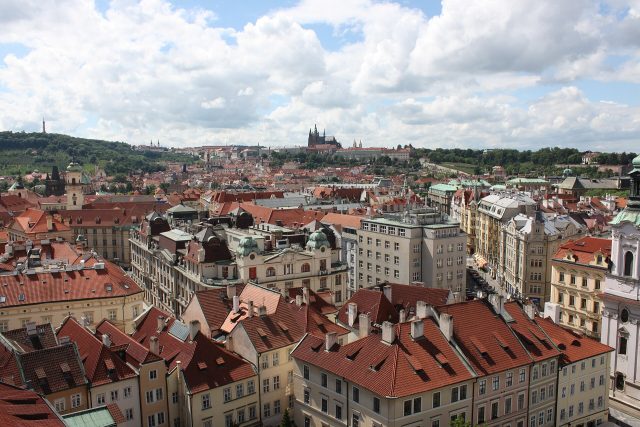
Climbing the tower offers more than just a closer look at the clock’s inner workings. From the viewing gallery, the city unfolds in all directions—red-tiled rooftops, church spires piercing the sky, and the Vltava River winding through the landscape. On clear days, the distant hills blur into the horizon. Below, the square buzzes with life: street musicians play, artists sketch portraits, and tourists cluster around the fountain or the statue of Jan Hus. The Orloj isn’t just a relic; it’s a vantage point where past and present overlap, where the city’s history feels tangible.
For locals, the clock is woven into daily life. Praguers might not always stop to watch the hourly procession, but many still glance up as they pass, checking the time or simply acknowledging the familiar rhythm. The Orloj marks more than hours—it’s a meeting point, a reference, a quiet constant in a changing city. On New Year’s Eve, crowds gather to watch the clock strike midnight, but on ordinary days, it blends into the background, a silent companion to conversations and strolls.
The Orloj hasn’t always been a beloved landmark. In the 18th century, some considered it an outdated curiosity and even proposed dismantling it. Fortunately, the clock endured, and today it’s one of Prague’s most recognizable symbols. Its appeal lies in how it merges art, science, and myth. The astronomical dial, with its intricate symbols, the animated figures that seem to come alive, and the tower itself, standing as a monument to time—all of it creates an atmosphere that’s both grand and intimate.
If you find yourself on Old Town Square, take a moment before reaching for your camera. Listen to the chime of the bells, study the details of the dial, or watch the people around you. You might notice a local pausing to check the time, or a child transfixed by the moving figures. The Orloj isn’t just a historical artifact; it’s a place where time feels visible, where the past isn’t just remembered but experienced. In a city full of wonders, it’s one of the few that still manages to surprise.