St. Vitus Cathedral isn’t just Prague’s most famous landmark—it’s a place where history, faith, and art converge in a way that feels both monumental and deeply personal. Rising above Prague Castle, it dominates the city’s skyline, serving as both a spiritual center and a symbol of Czech statehood. Construction began in the 14th century and stretched across centuries, absorbing different architectural styles and eras. Today, it stands as one of Europe’s most recognizable Gothic structures, though its design also carries traces of Neo-Gothic and Renaissance influences.
The foundation stone was laid in 1344 by King Charles IV, marking the moment Prague became an archbishopric. The project was entrusted to the French architect Matthias of Arras, who brought with him the ideals of Northern Gothic architecture. He managed to complete only part of the choir before his death, leaving his vision unfinished. His successor, Peter Parler, a Czech master of German origin, became the name most closely tied to the cathedral’s history. Parler not only finished the choir but also built the famous Golden Gate, adorned with a mosaic of the Last Judgment, and began work on the tower. His engineering boldness and decorative elegance set the cathedral apart in its time.
Construction proceeded in fits and starts, with the building’s appearance evolving over the centuries. During the Renaissance and Baroque periods, new elements were added to the Gothic core, but in the 19th century, as Czech national identity surged, there was a push to complete the cathedral in its original style. Restorers and architects sought to revive the Gothic vision, and in 1929, nearly six hundred years after work began, the cathedral was finally consecrated. Its spire, reaching 96 meters, remains one of Prague’s highest points, while the stained glass windows, created across different eras, bathe the interior in soft, colored light.
Inside, the cathedral’s scale is breathtaking. The main nave soars upward, supported by slender columns, while the vaults are adorned with intricate ribbed patterns. The Chapel of St. Wenceslas draws particular attention, housing the tomb of Bohemia’s patron saint. The chapel is lined with semi-precious stones and frescoes depicting scenes from the saint’s life, its walls shimmering in the dim light. Nearby lies the coronation treasury, where relics of Czech kings are displayed, including the crown of St. Wenceslas, worn by monarchs during coronation ceremonies.
St. Vitus Cathedral is more than an architectural masterpiece—it’s a living record of history. Czech kings were crowned here, and many are buried within its walls, alongside saints and notable figures. The crypt holds the tombs of Charles IV, Wenceslas IV, George of Poděbrady, and other rulers whose names are woven into the fabric of Czech history. The cathedral has endured wars, fires, and reconstructions, yet it has always remained the heart of Prague, a place where spiritual and secular power intersected.
The exterior is as striking as the interior. The facades are adorned with stone carvings, statues of saints, and mythological figures, while the flying buttresses lend the structure a sense of lightness and movement. The view from the south side is especially beautiful, offering a perspective toward Golden Lane and the Old Royal Palace. At night, when the cathedral is illuminated, its silhouette becomes even more majestic, with light and shadow accentuating the Gothic details.
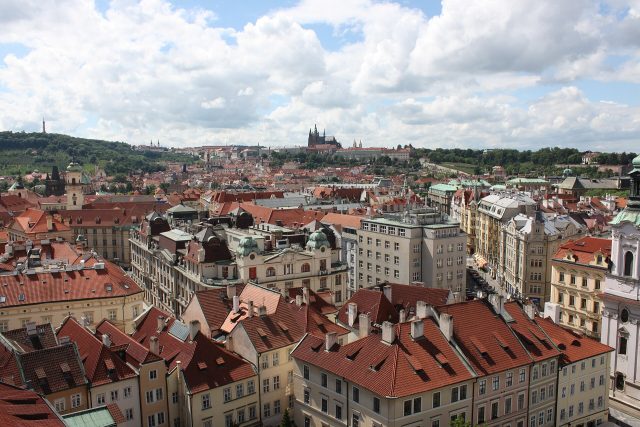
Visiting the cathedral is like stepping into the Middle Ages, though it never feels like a museum. Services, organ concerts, and other events fill the space with sound, bringing it to life. The cathedral’s organ, one of the largest in Europe, resonates powerfully, its tone perfectly suited to the vast acoustics. For many visitors, climbing the tower is the highlight—from the top, Prague unfolds in a panoramic view, where rooftops, bridges, and spires blend into a single, picturesque landscape.
St. Vitus Cathedral is a place that can’t be taken in with a single glance. Every corner holds a story, from the carved choir stalls to the stained glass by Alphonse Mucha and the tombs in the side chapels. You could spend hours examining the details or simply stand in silence, feeling the weight of centuries. For Prague, this cathedral is more than an architectural monument—it embodies the city’s spirit, its resilience, and its enduring beauty.