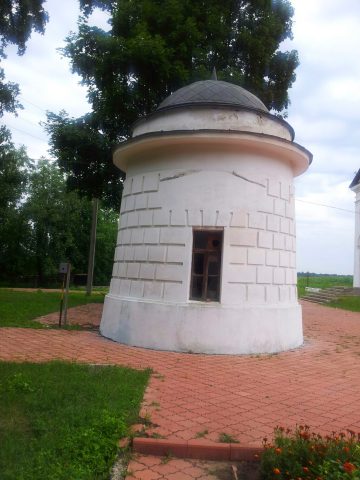
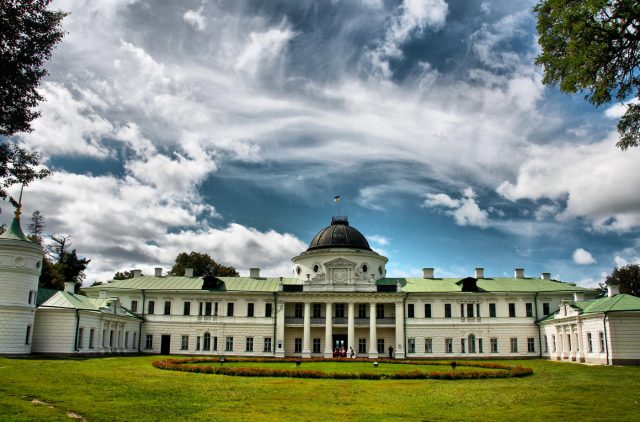
Perched on a gentle hill above the village of Kachanivka, the Holy Trinity Church feels like a place where time moves at its own unhurried pace. Built in the early nineteenth century, its white walls and traditional dome rise above the surrounding landscape, visible from afar when the morning or evening sun casts a soft glow over them. The church isn’t grand in scale, but there’s a quiet harmony in its proportions, as if every stone was placed with care. It stands not just as a spiritual center but as a defining feature of this part of Chernihiv region, blending seamlessly into the countryside.
The church’s history is closely tied to the Kachanivka estate, once owned by Grigory Tarnovsky, a prominent patron of the arts and a public figure. In its heyday, the estate was a cultural hub, drawing artists, musicians, and writers who shaped much of Ukraine’s intellectual life at the time. The church was conceived as part of this estate, initially intended as a family mausoleum for the Tarnovskys, though it later became a parish church. Like many religious sites in the region, it endured a turbulent twentieth century—closed during the Soviet era, repurposed as a warehouse, and eventually returned to the faithful. Today, it remains an active place of worship, its walls holding the echoes of generations who have prayed beneath its vaulted ceilings.
Architecturally, the Holy Trinity Church is a fine example of provincial ecclesiastical design from the early 1800s. Built in the late neoclassical style with touches of Empire influence, it features clean lines, a symmetrical facade, and porticos supported by columns. Inside, the decor is understated yet striking. The iconostasis, painted by local craftsmen, and the surviving pre-revolutionary icons lend the space a sense of continuity. The carved wooden altar is particularly noteworthy, a testament to skilled craftsmanship that avoids excess in favor of quiet elegance.
Kachanivka itself is a place of understated beauty. The village sits amid rolling fields and forests, and the estate’s park, designed around the former Tarnovsky residence, is considered one of Ukraine’s finest examples of landscape gardening. The church feels like a natural extension of this setting, its white walls and dome complementing the greenery of the park. In summer, the trees cast dappled shade over the paths leading to the church, and the air is thick with the scent of flowers and grass. Winter transforms the scene—snow dusts the domes, and the entire landscape takes on a hushed, expectant quality, as if waiting for spring to return.
Visiting the Holy Trinity Church is more than just a step into history; it’s a chance to reflect on how faith and tradition have evolved over centuries. The church has weathered wars, political upheavals, neglect, and revival, yet it remains a place where people come not only to pray but to find a moment of stillness. There’s no tourist bustle here, no crowds—just a sense of quiet that feels increasingly rare in the modern world.
If you find yourself in this part of Ukraine, it’s worth lingering in Kachanivka. Walk through the park, step inside the church, or simply sit on a bench outside, gazing at the fields stretching beyond the village. This isn’t a place that dazzles at first glance, but it has a quiet allure. Perhaps it’s the authenticity of it all—the weathered stones of the church, the ancient trees in the park, the unhurried rhythm of life in the village. Time moves differently here, and once you’ve spent a little while in this corner of the world, it’s easy to see why it holds such meaning for those who know it.