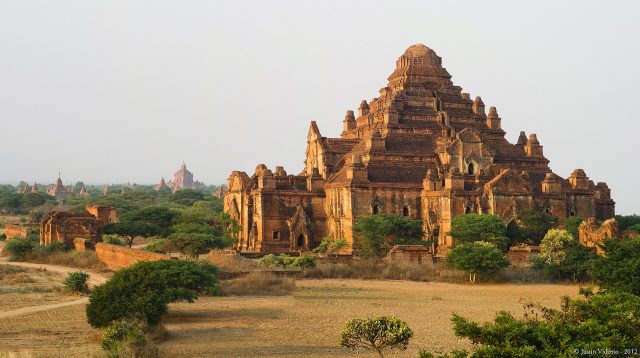
Sulamani is one of those temples in Bagan that doesn’t just stand against the endless plains—it carries the weight of an entire era. Built in the late 12th century under King Narapatisithu, it became a symbol of Bagan’s golden age, when the city was the heart of Buddhist culture and political power in the region. This was a time when art and architecture had reached their peak, blending Indian Buddhist traditions with local craftsmanship to create something entirely its own. Sulamani isn’t the largest or the oldest temple in Bagan, but its design captures what made this land extraordinary: the quiet balance between the earthly and the divine.
The architecture of Sulamani reflects the late Bagan period, yet it has details that set it apart from the hundreds of other temples scattered across the plain. A two-story structure with a square base, it’s crowned by a spire that was once gilded. Entrances on all four sides lead to a central hall, where traces of faded murals and Buddha statues still remain. What makes the temple striking is its proportions—despite its size, it doesn’t feel heavy. Light filters through narrow windows, playing across the walls in a way that makes the stone seem almost weightless, as if it might dissolve into the air. Inside, the corridors are lined with terracotta tiles depicting jataka tales—stories of the Buddha’s past lives—which once served as both decoration and lessons for pilgrims.
Like many of Bagan’s temples, Sulamani has weathered earthquakes, each leaving its mark. The most devastating struck in 1975, when part of the spire and several walls collapsed. Restoration work has since brought it back to life, though cracks and signs of repair remain, like scars that tell a story. These imperfections don’t detract from the temple’s beauty; if anything, they add to its character. Sulamani doesn’t feel like a perfectly preserved museum piece—it retains the spirit of a place that has endured for eight centuries, adapting and surviving.
Bagan is a city where every temple has its purpose and its legend. According to local lore, Sulamani was built on the spot where a precious gem, glowing like the sun, was once discovered. The name itself means Jewel Shining in the Sun, and while the story may be just that—a story—it reflects how the people of Bagan saw this place. For them, the temple wasn’t merely a building but a bridge between heaven and earth, a space where mortals could draw closer to the divine. Even now, with fields stretching out in every direction and only the occasional tree breaking the horizon, Sulamani holds onto that sense of quiet reverence. There’s a stillness here that makes you slow down, as if the wind itself is carrying something older than words.
Unlike some of Bagan’s more famous temples, Sulamani rarely feels crowded. It’s a place where you can spend an hour or two alone, watching how the light shifts across the walls or simply sitting on the stone steps, gazing out at the plain. In the early morning, the temple takes on a soft pink hue; by midday, its walls appear almost white. As the sun sets, painting the sky in shades of orange and violet, Sulamani seems to glow from within. Time moves differently here—not in a rush, but at the unhurried pace of a place built for contemplation rather than haste.
Bagan isn’t just an open-air architectural museum; it’s a living tradition. Though most of its temples no longer function as active monasteries, monks still visit to meditate or rest in the shade of their walls. Sulamani is no exception. Sometimes, locals gather at its base to pray or leave offerings, turning the temple back into a part of daily life rather than just a historical monument. It’s a reminder that Bagan isn’t frozen in the past—it continues to exist, even if under different rules.
For first-time visitors to Bagan, Sulamani often serves as an introduction to the place. It’s not as grand as Ananda or as mysterious as Gawdawpalin, but it captures the essence of what makes this landscape special. There are no crowds here, no hustle, no pushy guides—just the temple, the plain, and the sky. You can climb to the upper terrace and take in the view: endless fields dotted with temples, the distant silhouettes of hills. In moments like these, it’s easy to understand why Bagan is called one of Myanmar’s most magical places. It’s not just a collection of ancient structures but a world that operates by its own rhythm, where every stone holds the memory of those who built, prayed, and dreamed here centuries ago.
Sulamani isn’t the kind of temple that overwhelms you at first sight. Its beauty reveals itself slowly, like a story that demands to be read without rushing. There are no bright colors or lavish decorations, but there’s something harder to put into words: the sense of time standing still, of a place where you can feel part of something larger than yourself. Maybe that’s why those who visit often return—not for photographs or souvenirs, but for that quiet moment of clarity that only places like this can offer.