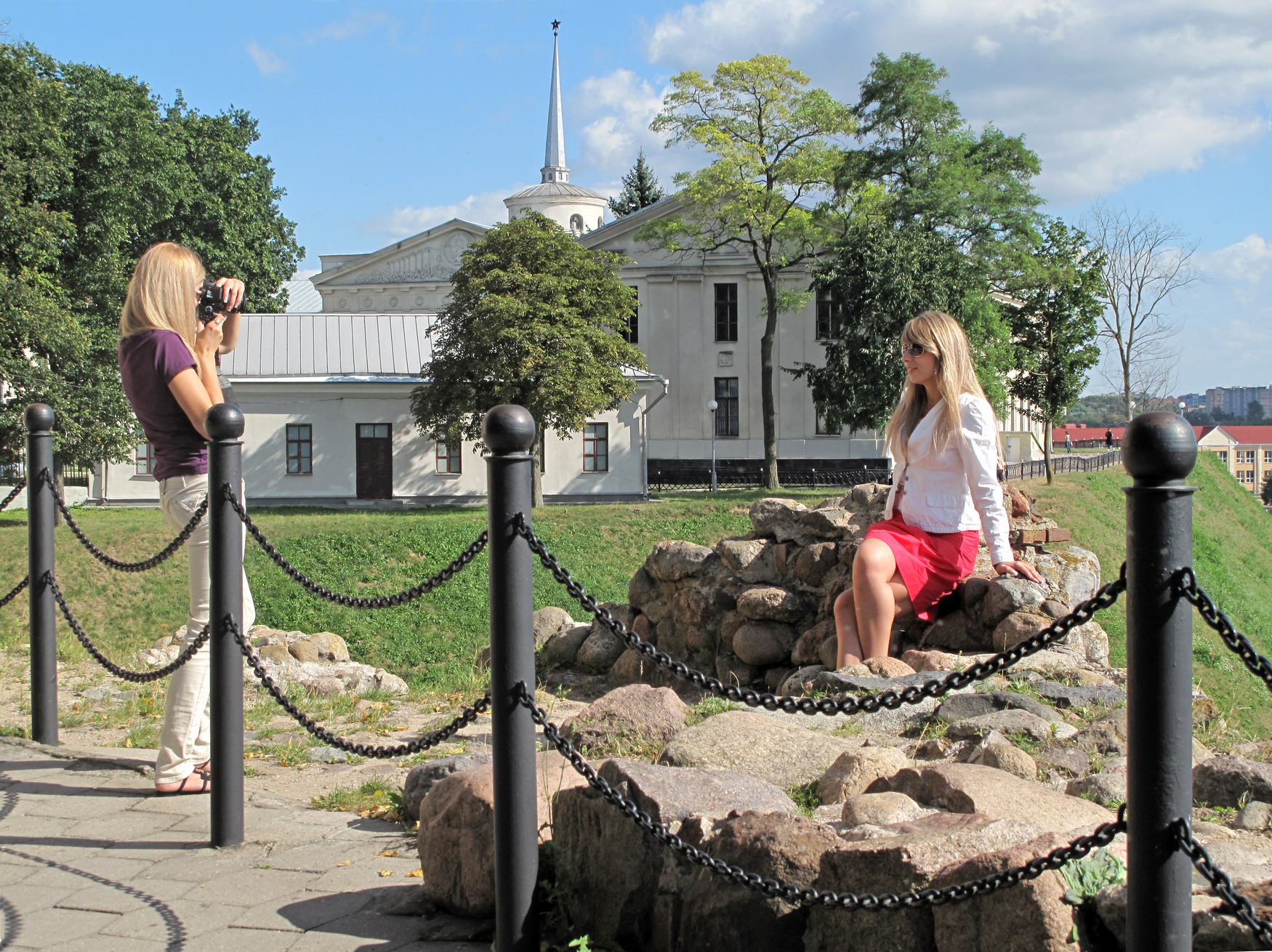
Grodno’s Old Castle is one of those places where history feels almost tangible, as if the stones themselves remember the centuries they’ve witnessed. Perched on a hill overlooking the Neman River, this fortress has stood here since the Middle Ages, though its exact origins are lost in the mists of time. The first written records mention it in the 12th century, but archaeologists suggest that a wooden fortification may have existed here even earlier, serving as a strategic outpost for the Principality of Polotsk. Over the centuries, the castle evolved from a defensive stronghold into a royal residence, its walls bearing the marks of wars, fires, and reconstructions that shaped not just the building, but the fate of the entire region.
The castle’s architecture is a patchwork of styles, each layer telling a different story. The oldest surviving parts date back to the 14th century, when Grand Duke Vytautas of Lithuania reinforced the fortress with stone, transforming it into a formidable bastion. Later, in the 16th century, the castle was rebuilt in the Renaissance style under the Polish King Stephen Báthory, who made Grodno one of his royal residences. The grand halls, arched windows, and decorative details from that era still peek through the later additions, though much of the original splendor was lost during the Swedish invasion in the early 18th century. What remains today is a mix of medieval robustness and Renaissance elegance, a testament to the castle’s ability to adapt and survive.
Walking through the castle’s courtyard, it’s easy to imagine the bustle of life that once filled these spaces. In its heyday, the Old Castle was not just a military stronghold but a center of political power. It hosted royal courts, diplomatic negotiations, and even the sessions of the Polish-Lithuanian Sejm, where nobles gathered to debate the fate of the Commonwealth. The castle’s halls echoed with the voices of kings, hetmans, and foreign ambassadors, while its dungeons held prisoners of war and political rivals. One of the most famous episodes in its history was the 1793 Grodno Sejm, where the last king of Poland, Stanisław August Poniatowski, was forced to sign the Second Partition of Poland, effectively sealing the fate of the Polish-Lithuanian state. The castle, once a symbol of strength, became a witness to its downfall.
The 19th century brought new challenges. After the partitions of Poland, Grodno found itself under Russian rule, and the Old Castle lost its political significance. It was repurposed as a barracks, then a prison, and later even a warehouse, its interiors altered to serve the needs of the day. By the early 20th century, the castle was in a state of neglect, its walls crumbling, its history nearly forgotten. It wasn’t until the mid-20th century that restoration efforts began, slowly peeling back the layers of time to reveal the castle’s former glory. Today, the Old Castle houses a museum, its exhibits tracing the history of Grodno from its earliest days to the present, though the building itself remains the most compelling artifact.
What makes the Old Castle particularly intriguing is its ability to evoke the past without relying on grand reconstructions. Unlike some restored fortresses that feel like theme park versions of history, this one retains a sense of authenticity. The scars of time are visible in the uneven stones, the faded frescoes, and the worn steps that have been trodden by countless feet over the centuries. The castle’s location adds to its atmosphere—standing on the hill, you can see the Neman River winding through the city below, just as it did when the castle was first built. The view hasn’t changed much, even if the world around it has.
The museum inside the castle offers a deeper dive into Grodno’s history, with exhibits ranging from medieval weaponry to artifacts from the city’s Jewish, Polish, and Belarusian communities. One of the most striking displays is the collection of coins minted in Grodno during the 16th and 17th centuries, when the city was a major economic hub. There are also remnants of the castle’s royal past, including fragments of decorative tiles and carved stonework that once adorned the interiors. But perhaps the most moving part of the visit is the castle’s underground passages, where the air feels cooler and the weight of history heavier. These tunnels, once used for storage and escape, now lead visitors through the darker chapters of the castle’s past.
Beyond its historical significance, the Old Castle is also a place where the city’s modern life intersects with its heritage. Locals often come here to walk along the riverbank, take photos, or simply enjoy the view. In the summer, the castle grounds host open-air concerts and festivals, blending the old with the new. The contrast between the ancient stones and the lively atmosphere of the city below is striking—it’s a reminder that history isn’t just something that happened long ago, but a living part of the present.
Visiting the Old Castle isn’t just about ticking off a historical site; it’s about stepping into a story that’s still unfolding. The castle has survived wars, occupations, and neglect, yet it endures, a silent witness to the passage of time. Whether you’re drawn by its architecture, its history, or simply the chance to stand where kings once walked, the Old Castle offers a glimpse into a past that feels both distant and strangely familiar. And as you leave, it’s worth pausing one last time to look out over the Neman River, where the water flows just as it did centuries ago, carrying the echoes of Grodno’s long and complicated history.