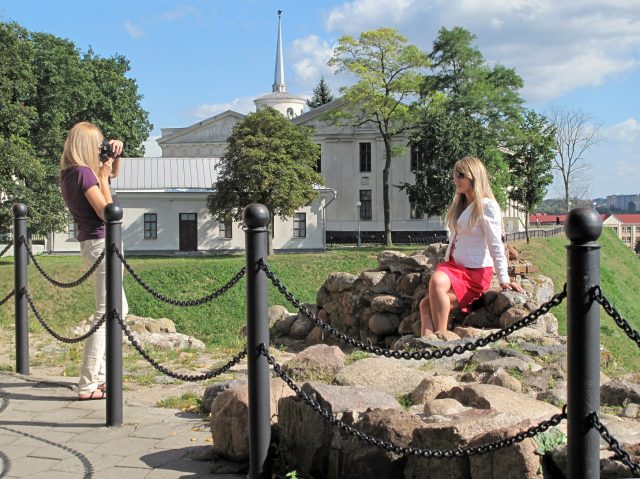
St. John’s Lutheran Church in Grodno is one of those quiet places that doesn’t demand attention but lingers in the memory long after you’ve passed by. Tucked away on a narrow street in the heart of the city, it stands among buildings that have witnessed centuries of change, its unassuming presence easy to overlook. Yet there’s something enduring about its simple facade—tall, narrow windows, clean lines, and a restraint that speaks to the Protestant tradition it represents. It doesn’t try to impress with grandeur, but there’s a quiet dignity in its design, a reflection of the faith it was built to serve.
The church was constructed in the mid-19th century, a time when Grodno had grown far beyond its origins as a small border town. By then, it was a thriving center of trade and administration, a city where different cultures and communities had long coexisted. The Lutheran congregation in Grodno dated back even further, to the 16th century, when German merchants, craftsmen, and soldiers began settling in the Grand Duchy of Lithuania. They brought with them their language, customs, and religion, gradually forming a community that, by the 1800s, was established enough to build its own place of worship. St. John’s wasn’t just a church—it was a statement of their place in the city, a physical marker of their presence and beliefs.
Like most Lutheran churches, St. John’s was designed with purpose over ornamentation. There are no elaborate frescoes, gilded iconostases, or dramatic stained glass here. Instead, the interior is bright and airy, with high ceilings and minimal decoration. The focus is on the word, on the sermon, rather than visual spectacle. Wooden pews, a modest pulpit, and an organ fill the space, arranged to keep distractions at a minimum. Even the bell tower, added later, blends seamlessly with the rest of the building, maintaining the same understated elegance. It’s a space meant for reflection, where the simplicity of the architecture encourages a direct connection to faith.
The church has seen its share of upheaval. During the Soviet era, like many religious buildings, it was repurposed—first as an archive, later as a gymnasium. The years took their toll: some of the original interior details were lost, and the layout was altered to suit new needs. But in the late 20th century, the building was returned to the Lutheran community, and a slow process of restoration began. Today, it functions as a place of worship once again, though services are less frequent than they once were. The Lutheran population in Grodno has dwindled, but those who do attend do so with a quiet devotion, keeping the tradition alive.
Grodno has always been a city of many voices. Walk its streets, and you’ll find Catholic churches, Orthodox cathedrals, synagogues, and mosques standing side by side. St. John’s Lutheran Church is part of that tapestry, a reminder of the city’s long history of openness to different peoples and faiths. Even now, if you pass by on a quiet day, you might hear the faint sound of an organ or a choir rehearsing drifting through the open windows. It’s not the kind of music that demands attention—just a soft, steady presence, as if inviting you to step inside and pause for a moment.
The area around the church is lively in its own way. Nearby, old houses with intricate balconies line the streets, small cafés serve coffee to locals and visitors, and the hum of daily life fills the air. But cross the threshold of St. John’s, and the noise of the city fades. Inside, it’s cool and still, a space where time seems to move differently. That contrast is part of what makes places like this special—they offer a moment of respite, a chance to step away from the rush and connect with something deeper.
St. John’s isn’t the kind of landmark that draws crowds or makes it onto postcards. It doesn’t compete with the grander churches of Grodno in scale or opulence. But there’s a strength in its simplicity. This is a place where history isn’t just preserved in stone; it’s still alive in the quiet rituals of worship, in the gatherings of the faithful, in the hush that settles over the space. For those who seek more than just sights—who want to feel the layers of a city’s past—this unassuming church might just be the kind of discovery that stays with you.