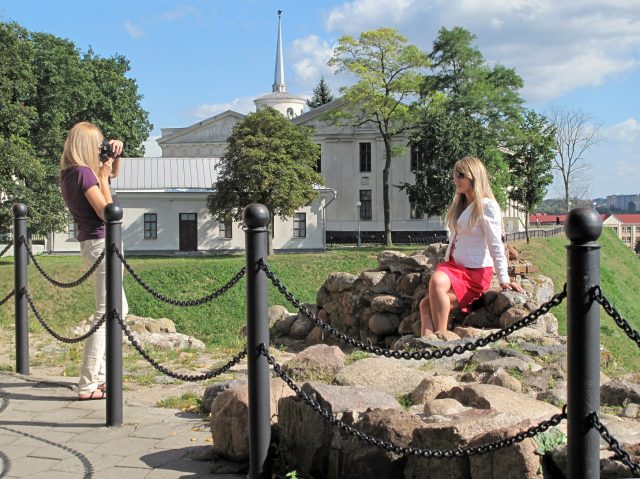
Grodno’s New Castle is one of those places where history doesn’t just linger in the past—it quietly shapes the present. Perched on a bluff overlooking the Neman River, the building watches over the city like a silent witness to centuries of change. The river flows slowly below, its currents carrying the weight of time, while the castle itself stands as a reminder of the ambitions, conflicts, and quiet resilience that have defined this corner of Belarus. Unlike the towering fortresses of fairy tales, the New Castle doesn’t dominate the skyline with battlements or drawbridges. Instead, its restrained Baroque lines and generous windows suggest a different kind of power—one rooted in diplomacy, culture, and the everyday lives of those who once walked its halls.
The castle’s origins trace back to the mid-18th century, when Grodno was a vital city in the Polish-Lithuanian Commonwealth. King Augustus III envisioned it not just as a royal residence but as a statement of authority, a physical embodiment of the Commonwealth’s influence in an era of shifting borders and political rivalries. The architect, Johann Sigismund Deybel, designed the building in the late Baroque style that was fashionable across Europe at the time. The façade was adorned with pilasters, pediments, and intricate stucco work, while the interiors were fitted with the kind of opulence expected of a royal court. It rose on the site of an older wooden palace, one that had burned and been rebuilt multiple times, never quite matching the aspirations of its rulers. The New Castle, by contrast, was meant to last.
For all its grandeur, the castle’s history is marked by upheaval. By the late 18th century, it had become a stage for some of the most consequential moments in the Commonwealth’s decline. The Sejm, the Polish parliament, convened here in 1793 to ratify the Second Partition of Poland, a decision that stripped the country of vast territories and set the stage for its eventual disappearance from the map. The castle’s halls, once filled with the voices of nobles and diplomats, bore witness to the end of an era. When Grodno was absorbed into the Russian Empire, the building’s purpose shifted dramatically. It was repurposed as military barracks, then left to decay. By the 19th century, parts of it had been converted into a military hospital, and much of its original splendor was lost to time and neglect.
Today, the New Castle functions as a museum, though not in the way one might expect. There are no glass cases filled with dusty relics here; instead, the building itself is the exhibit, its walls and halls telling stories of the people who shaped Grodno’s past. The collections span centuries, from ancient artifacts to 20th-century memorabilia, offering glimpses into the daily lives of the city’s inhabitants. One of the most compelling sections focuses on the Commonwealth era, when Grodno was a cultural hub, its streets alive with the exchange of ideas, languages, and traditions. Original fragments of the castle’s decoration—traces of frescoes, moldings, and parquet floors—survive in places, hinting at the grandeur that once filled these rooms. The grand staircase, though worn by time, still evokes the balls and receptions that once took place on its steps.
The architecture of the New Castle is a study in contrasts. Despite the alterations it has undergone, the building retains a sense of dignity. The main façade faces the Neman, offering a view of the river and the old town beyond. The inner courtyard, once adorned with fountains and sculptures, is now quiet, its emptiness almost meditative. Some of the original stucco work and ceiling paintings have survived, their faded beauty a testament to the craftsmanship of the era. The castle’s design reflects the Baroque ideal of harmony between form and function, where every detail served both an aesthetic and a practical purpose. Even in its current state, it’s easy to imagine how the building must have impressed visitors in its heyday.
Beyond its role as a museum, the New Castle has become a living part of Grodno’s cultural scene. The halls that once hosted political debates now echo with music, lectures, and the occasional theatrical performance. Exhibitions rotate regularly, drawing locals and visitors alike, while the courtyard serves as a gathering place in warmer months. There’s a sense of continuity here, as if the castle has found a new purpose in bringing people together. On summer evenings, it’s not uncommon to see groups sitting on benches by the river, chatting or simply enjoying the view. The past feels close in moments like these, not as something distant and untouchable, but as a thread woven into the fabric of the present.
Grodno is a city where history is never far from the surface, and the New Castle is one of its most compelling landmarks. It may not have the fame of Mir Castle or Nesvizh, but that’s part of its charm. There are no crowds here, no hurried tours or selfie sticks—just the quiet rhythm of a place that has seen empires rise and fall. Walking through its halls, you can take your time, lingering over details that might go unnoticed elsewhere. The castle doesn’t just invite you to look back; it reminds you that history isn’t confined to textbooks or monuments. It’s in the stones beneath your feet, the river flowing past, and the stories that still unfold in the city around it. The New Castle stands as a bridge between then and now, a place where the past isn’t just remembered—it’s lived.