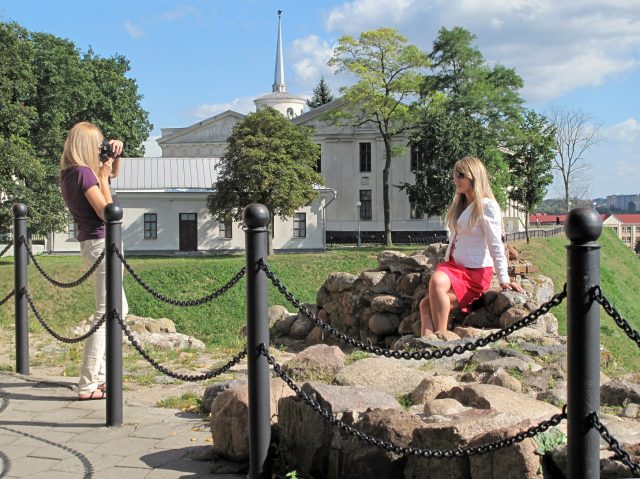
Grodno is often called the city of churches, and among its most striking landmarks is the Church of the Finding of the Holy Cross, standing quietly on the banks of the Neman River. Its story begins in the early 17th century, when the Bernardine monks arrived in the city. Known for their strict asceticism and fervent preaching, the Bernardines quickly established a monastery here in 1621. Over time, it grew into more than just a spiritual center—it became a place of learning, where books were copied by hand, and later, one of the region’s first pharmacies, where monks prepared medicines according to their own recipes.
The church’s architecture tells a tale of shifting tastes and influences. Originally built of wood, it was reconstructed in stone by the mid-17th century, adopting the restrained elegance of early Baroque. The façade is unassuming, almost austere, but inside, the space feels light and expansive. High vaults, clean lines of columns, and minimal ornamentation create a sense of solemn simplicity. The main altar is particularly striking, designed with trompe-l'œil painting that gives the illusion of depth, as if the wooden figures open into another world beyond.
The Bernardine monastery has stood at the heart of many historical turning points. In the 18th century, when Grodno briefly served as the capital of the Polish-Lithuanian Commonwealth, kings and diplomats passed through its doors. After the partitions of Poland in the 19th century, the monastery was closed, and the building was handed over to the Orthodox Church. The church became a cathedral, while the monks’ cells were repurposed for government offices. The Bernardines returned only in the 20th century, when Grodno was once again under Polish rule, though their stay was short-lived—World War II and the subsequent Soviet era reshaped the monastery’s fate once more.
Today, the church remains an active Catholic parish, its walls bearing the marks of centuries past. In the cellars, fragments of old masonry still stand, and traces of faded frescoes can be spotted on the walls, remnants of what was once a fully painted interior. The decor is understated, yet every detail carries weight—from the carved wooden pews to the stained glass windows that filter soft light into the nave. Side chapels hold old confessionals, and in one, a revered icon of the Mother of God still draws the faithful.
The monastery courtyard, enclosed by low buildings, feels like a quiet refuge in the middle of the city. Even on feast days, the atmosphere remains calm. In summer, monks can be seen going about their daily tasks under the shade of trees, while in winter, snow settles on the old tiled roofs, accentuating their timeless stillness. Beside the church, a small bell tower offers a view of the Neman River and the old town—a panorama that has changed little over the centuries.
What makes the Bernardine monastery in Grodno special is not grand legends or lavish decorations, but its quiet authenticity. The stones and beams here have witnessed generations of people who built, prayed, and lived within these walls. It doesn’t seek to impress; it simply endures, holding onto the past while remaining firmly rooted in the present. That, perhaps, is its greatest value—a place where history and faith are not just remembered, but still felt.