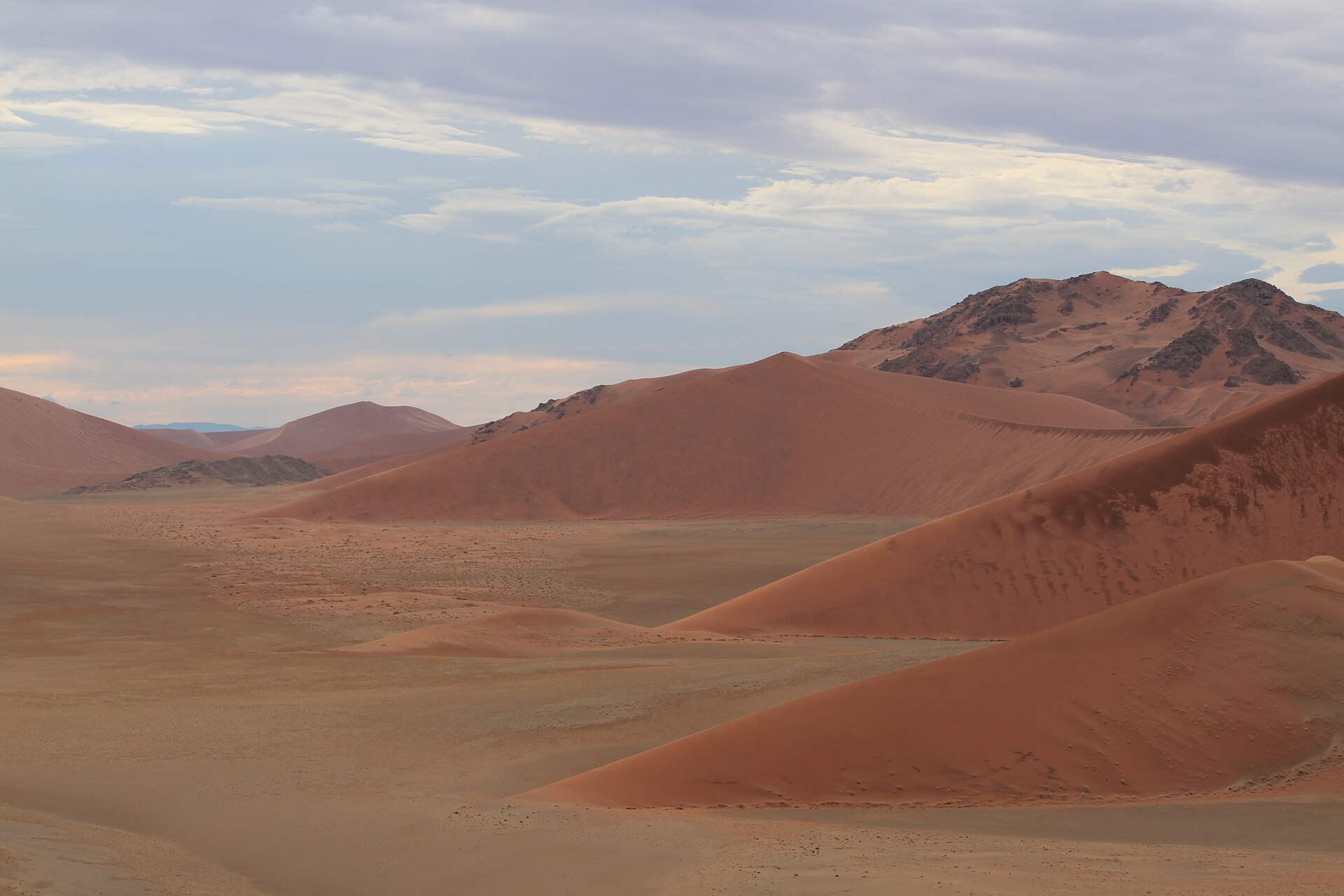
Sesriem Canyon and the towering dunes of Sossusvlei are where the Namib Desert reveals its most dramatic face. This is a landscape shaped by time, wind, and the slow patience of geology—one of the oldest deserts on Earth, with sands that have shifted and settled for at least eighty million years. The colors here aren’t just red; they’re a spectrum of ochre, rust, and deep crimson, shifting with the angle of the sun. At dawn and dusk, the light stretches long and soft, turning the dunes into something almost liquid, their curves and ridges catching the glow like embers. The sand isn’t static. It moves, grain by grain, reshaping the contours of the land with every gust, as if the desert itself is breathing.
The Namib is often called a desert of extremes, but it’s also a place of quiet adaptation. Rain is rare—sometimes years pass without a drop—but life persists in ways that feel almost deliberate. In the early morning, when the air is still cool, tiny fog droplets drift inland from the Atlantic, settling on the sand. Black beetles known as tok-tokkies stand on their heads, angling their bodies to catch the moisture on their shells, a survival trick perfected over millennia. Then there’s the welwitschia, a plant so ancient it’s often called a living fossil. Some specimens have been growing for over a thousand years, their twisted, leathery leaves drinking in the mist. Larger creatures, like the oryx with its striking black-and-white face, roam the dunes, their bodies evolved to go weeks without water. At night, the desert’s silence is broken only by the occasional rustle of a sidewinder snake or the distant call of a jackal.
Long before tourists arrived, this land was a crossroads. Ancient trade routes once cut through the Namib, used by nomadic herders moving between the interior and the coast. Rock paintings in nearby mountains hint at human presence stretching back thousands of years, long before borders or nations existed. Later, during the colonial era, prospectors and adventurers came searching for diamonds and gold, only to be humbled by the desert’s indifference. Today, Sossusvlei is part of the Namib-Naukluft National Park, a protected area where access is controlled through the small outpost of Sesriem. The checkpoint here is the last trace of the outside world before the landscape opens up into something vast and untamed.
The drive into the park is a slow unraveling of expectations. The road is unpaved, a rough ribbon of gravel cutting through stony plains dotted with sparse, hardy shrubs. In the distance, the dunes rise like walls, their sheer scale only becoming apparent as you draw closer. The contrast is striking—the stillness of the sand against the restless sky, where clouds drift and reform, casting shifting shadows over the dunes. After rare rains, the desert briefly blooms, wildflowers erupting in fleeting bursts of color, and shallow pools form in the lowlands, drawing birds and animals. But these moments are exceptions. Most of the time, the land is dry, its rhythms dictated by the wind and the sun.
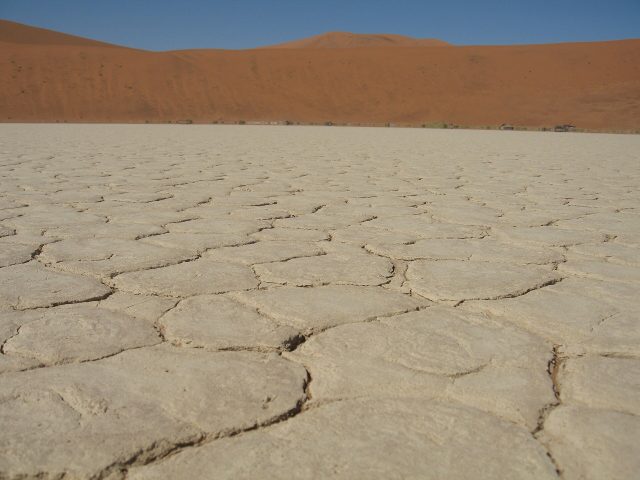
Dune 45 is the most famous of Sossusvlei’s sand mountains, not because it’s the tallest, but because it’s the most accessible. Climbing it is a rite of passage for visitors, a half-hour scramble up steep, shifting slopes where every step sinks slightly, the sand giving way beneath your feet. The effort is worth it. From the top, the view stretches endlessly—row upon row of dunes, their ridges sharp against the horizon, the light turning them from gold to pink as the sun climbs higher. But Sossusvlei is more than just its dunes. Nearby, Deadvlei is a stark contrast: a white clay pan surrounded by towering dunes, its surface littered with the skeletal remains of ancient camelthorn trees, their blackened trunks preserved by the dry air. The scene feels like something from another planet, a place where time has stopped.
What makes Sossusvlei unforgettable isn’t just its beauty, but the way it makes you feel. There are no crowds here, no noise beyond the whisper of the wind. Even in peak season, it’s possible to find a quiet spot where the only sound is the crunch of sand underfoot. The silence is thick, almost tangible, broken only by the occasional cry of a bird or the distant rumble of a vehicle. At night, the desert transforms. The temperature drops sharply, the sand growing cold underfoot, and the sky becomes a dazzling display of stars. The Milky Way is so bright it casts shadows, and the sense of isolation is profound. Many visitors stay overnight in one of the park’s campsites or lodges, waking before dawn to watch the light change over the dunes, or venturing out after dark to stand beneath a sky that feels impossibly close.
This is a place that resists easy description. Photographs capture the colors, but not the scale. Words can’t convey the way the air smells—dry, with a faint metallic tang—or the way the sand feels under bare feet, hot in the day and cool at night. It’s a landscape that demands presence. You have to walk it, breathe it, let the wind sting your face and the sun warm your back. There’s a humility in standing at the base of a dune that’s older than human civilization, knowing that it will still be here long after you’re gone. The desert isn’t hostile, but it doesn’t bend to your expectations. It moves at its own pace, indifferent to schedules or plans.
For those who come, Sossusvlei offers a rare kind of stillness. There’s no rush here, no need to fill the silence with chatter or the hours with activity. The days unfold slowly, marked by the changing light and the shifting shadows. Some visitors return year after year, drawn by the way the place seems to reveal something new each time—the way a particular dune catches the light at sunset, or the unexpected sight of an oryx picking its way across the sand. It’s a reminder that the world is far older and stranger than we often remember, and that some places exist beyond the reach of time. The desert doesn’t care if you stay or go. It was here long before you arrived, and it will remain long after you leave. All you can do is stand in its presence and let it change you.