St. Mary’s Cathedral in Bogor is one of those places that doesn’t demand attention but lingers in the mind long after you’ve left. Tucked away from the city’s streets, surrounded by low-rise houses and greenery, it feels like a quiet reminder that Bogor—known for its botanical gardens and cool mountain air—has corners where time moves at its own pace. The cathedral isn’t large, but its architecture and history give it a significance in the city’s cultural landscape.
Built in the early 20th century, when Indonesia was still the Dutch East Indies, the cathedral reflects an era when Bogor, then called Buitenzorg, was a favored retreat for colonial officials escaping the heat of Jakarta. The Catholic community here was small but active, and the need for a place of worship grew over time. Construction began in the 1920s, and by the mid-decade, the cathedral was already serving its congregation. The building’s design blends European traditions with local influences—details in the ornamentation hint at the adaptations made for an Indonesian setting.
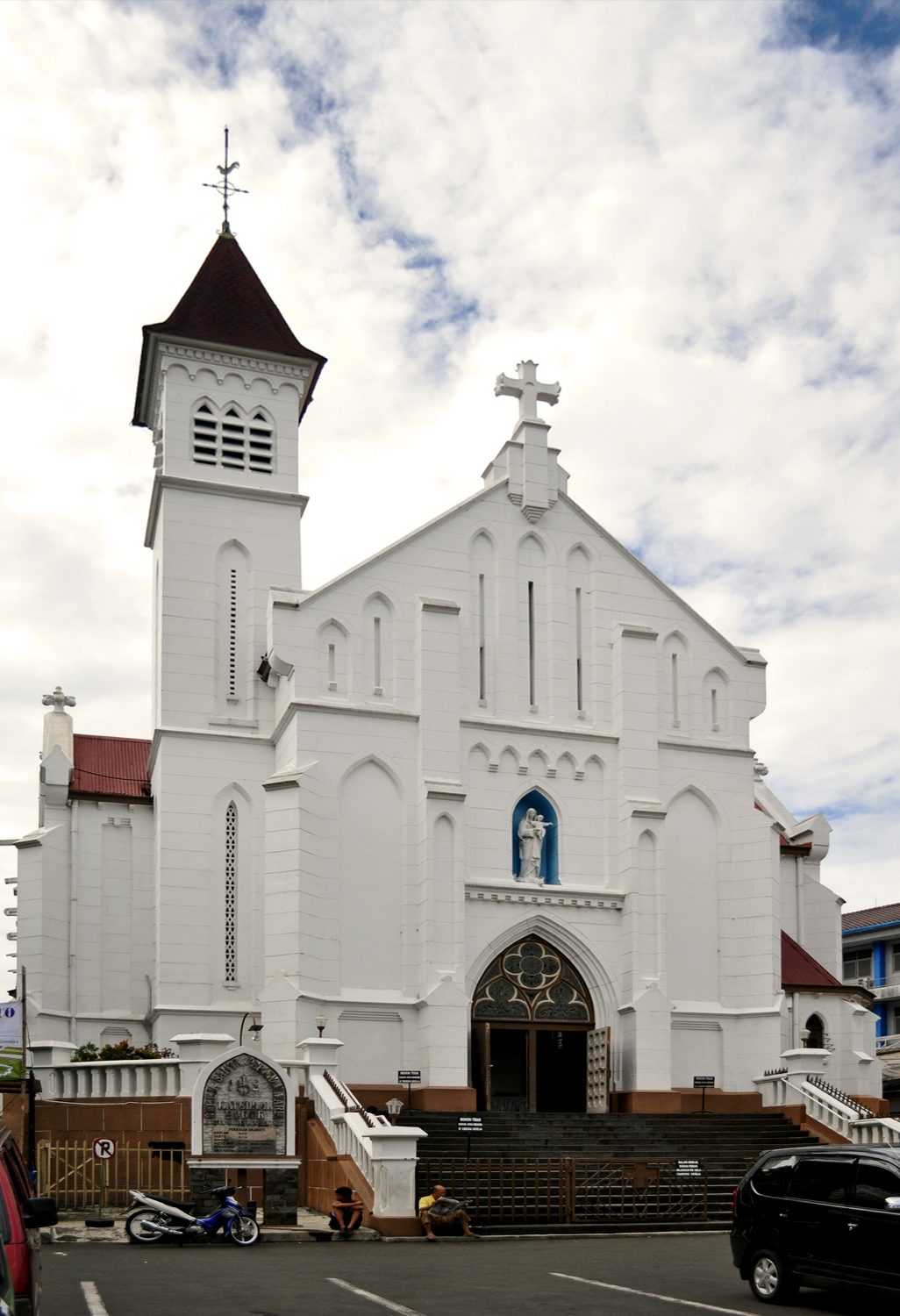
From the outside, St. Mary’s appears modest: white walls, tall narrow windows with stained glass, and a small bell tower. The entrance is framed by a portico with a triangular pediment, giving it the familiar silhouette of a European church. Inside, the space feels different. The nave is narrow but high, with wooden beams across the ceiling that create a sense of warmth. The altar is simple, and the stained glass bathes the interior in soft light.
The cathedral was never a major pilgrimage site, but for Bogor’s Catholic community, it has always been a spiritual anchor. In a city where Islam is the dominant faith, Christian places of worship are rare, yet St. Mary’s has remained open to anyone seeking quiet reflection or a place to pray. During holidays like Christmas and Easter, the congregation grows as worshippers from nearby towns gather to celebrate.
The cathedral has endured political upheavals and changing times. During Indonesia’s struggle for independence, many Europeans left the country, and Bogor’s Catholic community shrank. Yet the building survived, and in the decades that followed, it was gradually restored. Today, it stands well-maintained. A small garden with flowers and trees surrounds it, offering a peaceful spot to sit in the shade, listening to birdsong and the distant hum of the city.
For visitors, St. Mary’s is a place to pause and absorb the atmosphere of old Bogor. There are no crowds, no guides—just a quiet corner where history and everyday life intersect. Locals sometimes stop by to pray or rest in the cool interior, while travelers occasionally wander in by chance. The cathedral doesn’t aim to impress, and that’s part of its charm.
If you find yourself in Bogor, step inside for a few minutes. Walk across the stone courtyard, glance through the open doors if they’re unlocked, and listen to the stillness. In a city so full of greenery and fresh air, St. Mary’s feels like another kind of sanctuary—not one of nature, but of human hands. It won’t tell dramatic stories, but it might remind you that even in a place like this, there are moments where time slows, and the mind finds clarity.