Bogor Botanical Gardens is one of those rare places where nature and history intertwine so seamlessly that time seems to move at its own pace. Nestled in the heart of Bogor, a city on the island of Java, this sprawling green space is far more than a collection of plants—it’s a living museum, a scientific hub, and a sanctuary that has inspired visitors for nearly two centuries. Its origins trace back to 1817, when it was established under the direction of Sir Stamford Raffles, the British lieutenant-governor of Java. Yet it was under Dutch colonial rule that the gardens truly flourished, becoming a vital part of a network that connected the tropical colonies of the Netherlands with Europe, serving as both a research center and a symbol of botanical ambition.
Covering over eighty hectares, the gardens feel less like a curated exhibit and more like a self-sustaining ecosystem. Towering trees, some planted in the 19th century, dominate the landscape, their gnarled trunks draped in vines while ferns and orchids thrive in their shade. The sheer variety of plant life is staggering—over two hundred species of palms alone, from the regal royal palm to the ancient-looking sago palm, whose thick trunks resemble the columns of forgotten temples. During the rainy season, the gardens transform into a lush, humid jungle, where moisture hangs in the air and leaves glisten with raindrops. Even in the drier months, the gardens retain a cool, almost misty atmosphere, as if the plants themselves regulate the climate.
Among the most famous residents of the gardens is the giant rafflesia, a parasitic flower notorious for its enormous size and pungent odor. Spotting one in the wild is nearly impossible, but here, in a dedicated nursery, visitors might catch a glimpse of this botanical marvel if they’re lucky enough to visit during its brief blooming period—just a few days every few years. The gardens are also home to other rare specimens: carnivorous plants that trap unsuspecting insects, prehistoric-looking tree ferns, and an extensive orchid collection featuring species found nowhere else but Java. Each corner of the gardens offers something unexpected, whether it’s a cluster of vibrant bougainvillea or the strange, umbrella-like fungi that sprout in the damp undergrowth.
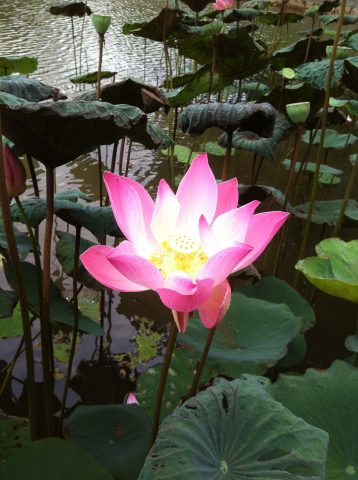
The architecture of the gardens is as much a part of their charm as the flora. The main avenue, lined with towering trees, leads to an elegant colonial-era palace that once served as the residence of Dutch governors. Today, the building houses a museum of botany, where visitors can explore antique herbariums, maps of historic expeditions, and the tools used by 19th-century scientists. Nearby, a tranquil lotus pond reflects the surrounding greenery, its banks a favorite spot for locals to gather in the mornings, feeding the fish or simply enjoying the quiet. The gardens were designed not just for study but for leisure, and that dual purpose is still evident today.
In the 19th century, the gardens were a social hub where colonial officials and local elites gathered for picnics, boat rides along the canals, and even open-air balls. That tradition of relaxation continues today. On weekends, the gardens buzz with activity—families picnic near the playground, students sprawl on the grass with textbooks, and tourists wander the winding paths in search of the perfect photograph. Small cafes dot the grounds, selling fresh tropical fruit and cool drinks, while vendors offer everything from coconut water to traditional snacks. Despite the crowds, the gardens never feel overrun; there’s always a quiet corner to escape to, a hidden bench beneath a flowering tree, or a secluded path leading to a lesser-known collection.
What makes the Bogor Botanical Gardens so special is their ability to feel both timeless and alive. Unlike a static museum, the gardens are constantly evolving—new blooms appear, seasons shift, and the landscape subtly changes from one visit to the next. In the rainy season, the gardens are at their most vibrant, with water filling the ponds and leaves glowing an almost unnatural shade of green. But even in the dry season, there’s a quiet beauty to the place, as trees shed their leaves to reveal intricate branch patterns and the air fills with the scent of flowering trees. The gardens are a reminder of how nature adapts, thrives, and surprises, even in a carefully managed space.
Beyond their beauty, the gardens hold deep scientific and historical significance. They were a key site for botanical research during the colonial era, where scientists documented new plant species and conducted expeditions that reshaped the understanding of tropical flora. Many of the discoveries made here laid the groundwork for botanical studies across Southeast Asia. Even today, researchers continue to work within the gardens, studying rare species and developing conservation programs. The gardens are also a living archive, with some of the oldest trees standing as silent witnesses to Indonesia’s colonial past and its journey toward independence.
For the people of Bogor, the gardens are more than just a tourist attraction—they’re a vital green lung in a city that grows more urbanized with each passing year. Bogor itself is known for its cooler climate, a rarity in tropical Indonesia, and the gardens amplify that refreshing quality. They offer a respite from the noise and heat of the city, a place where time slows down and the only sounds are the rustling of leaves and the occasional call of a bird. Whether you spend an hour or an entire day here, the gardens have a way of making you forget the outside world, even if just for a little while.
Walking through the Bogor Botanical Gardens is like stepping into a different era. Some of the trees here were planted when Java was still under colonial rule, their roots stretching deep into the past. Yet the gardens are far from a relic—they’re a dynamic, breathing space that continues to grow and change, much like the country itself. There’s nothing artificial or staged about them; everything feels organic, from the way the light filters through the canopy to the way the paths wind through the undergrowth. It’s that authenticity, that sense of being part of something alive and enduring, that makes the gardens so unforgettable. Whether you come for the science, the history, or simply the peace, the gardens have a way of leaving a lasting impression.