Catania’s Cathedral of Saint Agatha isn’t just a church—it’s a place where history, faith, and the spirit of Sicily come together in a way that feels both grand and deeply personal. Standing in the heart of the city on Piazza del Duomo, its facade immediately draws the eye: a striking contrast of white marble and dark volcanic stone, a reminder of the land’s fiery origins. The cathedral is dedicated to Saint Agatha, Catania’s patron saint, whose life story—one of resilience and sacrifice—has made her a symbol of the city itself. Her relics rest in the crypt below, drawing pilgrims from across Sicily and beyond, who come to pay their respects in the quiet, candlelit space.
The cathedral’s history is as layered as the city it watches over. The first church on this site was built in the 11th century, not long after the Norman conquest of Sicily, when Catania was still a small but strategically important settlement. Back then, the cathedral wasn’t just a place of worship; it was a political and social hub, a marker of the city’s growing influence. But in 1693, a devastating earthquake—one of the worst in Sicily’s history—leveled much of Catania, including the cathedral. Only fragments of the original structure survived: parts of the apse and a few columns, which can still be seen in the inner courtyard today. The building we see now rose in the early 18th century, as Catania was rebuilt under the guidance of Giovanni Battista Vaccarini, a master of Sicilian Baroque. His design gave the cathedral its current grandeur, blending drama and elegance in a way that feels distinctly Sicilian.
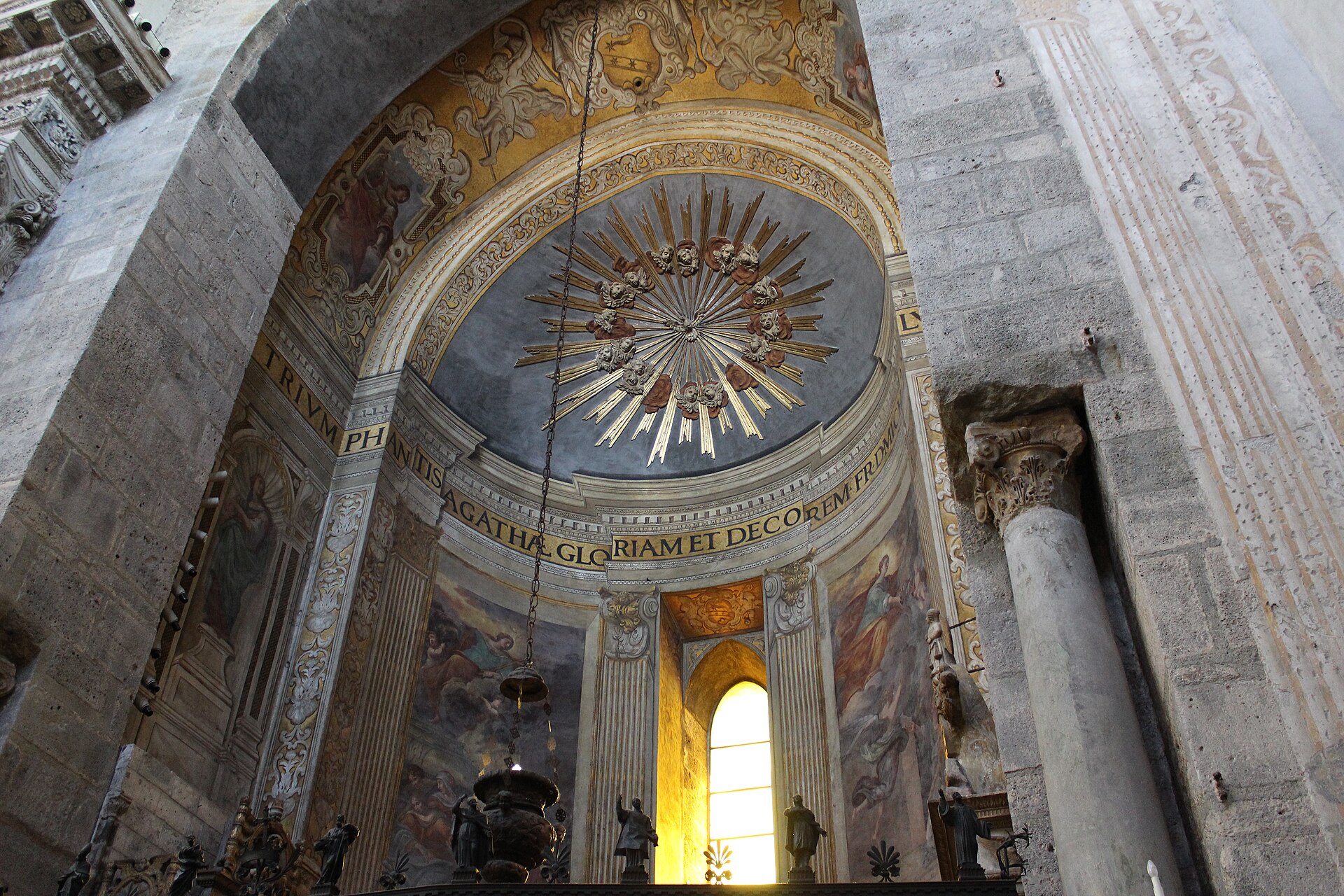
What makes the cathedral’s architecture so compelling is how it balances opposing forces. The facade, with its ornate Baroque curves, statues, and columns, is a celebration of artistry, yet the rough volcanic stone embedded in its walls grounds it in the raw reality of the land. Inside, the space feels vast and luminous, with high vaulted ceilings adorned with frescoes, marble altars, and stained glass that filters the light into soft hues. The Chapel of Saint Agatha is the emotional core of the cathedral, housing her silver reliquary—a masterpiece of 18th-century craftsmanship that holds her remains. Every February, during the city’s grand festival in her honor, the reliquary is carried through the streets in a procession that draws thousands, turning the cathedral into the center of a citywide celebration.
Beyond its religious significance, the cathedral is a living part of Catania’s daily rhythm. It’s where the city gathers not just for Mass, but for concerts, civic events, and moments of collective joy or sorrow. The February festival of Saint Agatha is the most vivid example of this. For days, the streets around the cathedral pulse with music, color, and the scent of traditional sweets like cassata and olive oil pastries. Locals and visitors alike line the sidewalks, waiting for the reliquary to pass, its silver surface gleaming under the Sicilian sun. The festival is more than a religious observance; it’s a testament to how deeply faith and tradition are woven into the fabric of the city.
Inside, the cathedral invites slow exploration. The floor is a mosaic of intricate patterns in the Cosmatesque style, salvaged from older churches and reassembled here like a puzzle of history. The 18th-century organ still fills the space with music during services, its deep notes resonating through the nave. Down in the crypt, the air is cool and still, the only light coming from flickering candles that cast shadows on the silver reliquary. It’s a place of quiet reflection, where the noise of the city outside feels distant. Some come to pray, others to sit in silence, but all are touched by the weight of centuries that lingers in the stone.
The cathedral is also a mirror of Catania’s own story. Every corner holds traces of the past: the Norman kings who first built here, the earthquakes that destroyed and reshaped the city, and the generations of Sicilians who rebuilt it time and again. Even the volcanic stone in the facade isn’t just decorative—it’s a reminder of the land’s power, of Mount Etna looming on the horizon, both a provider and a threat. Life in Catania has always been a balance between beauty and danger, between holding on to tradition and adapting to change. The cathedral embodies that duality, standing as a monument to resilience.
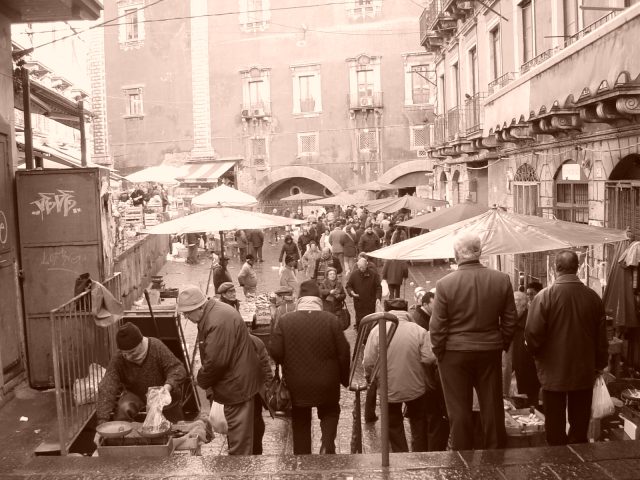
Today, the cathedral remains one of Catania’s most visited landmarks, but it’s more than just a tourist attraction. For pilgrims, it’s a sacred destination; for locals, it’s a familiar presence, as much a part of their daily lives as the fish market or the cafes on Via Etnea. You might see an elderly man lighting a candle before the altar, or a group of students sketching the facade, or a couple pausing to take in the view from the steps. The cathedral doesn’t just occupy space in the city—it lives alongside it, evolving with the years while remaining a constant.
If you find yourself in Catania, take the time to step inside. Walk slowly through the nave, let your eyes wander over the frescoes, and listen to the echoes of footsteps on the marble floor. You may not immediately grasp why this place matters so much to the city, but the atmosphere will make itself felt. Time moves differently here—slower, deeper—and for a little while, you become part of something larger than yourself. The cathedral doesn’t just tell the story of Saint Agatha or the history of Catania; it lets you feel it.