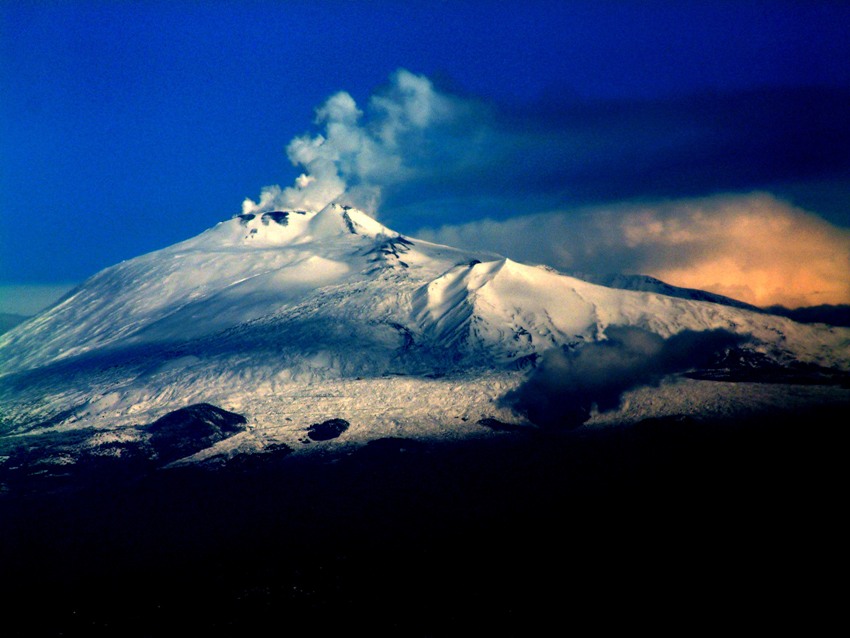
Mount Etna isn’t just a volcano—it’s the beating heart of Sicily, a force that has shaped the island for hundreds of thousands of years. Rising above the Ionian Sea on the island’s eastern coast, it looms over Catania like a silent guardian, its slopes a patchwork of black lava fields, vineyards, forests, and snow that lingers even in summer. The landscape here is a living contradiction: raw power and delicate beauty, destruction and renewal, all existing side by side. Every step across its terrain is a reminder that the earth beneath your feet is alive, shifting, breathing.
The history of Etna stretches back to antiquity, woven into myths and legends long before science could explain its fury. The ancient Greeks believed the volcano housed the forges of Hephaestus, the god of fire and craftsmanship, where he hammered out weapons for the gods. The Romans called it Aetna and told stories of giants imprisoned beneath its slopes by Zeus, their struggles fueling the mountain’s eruptions. In the Middle Ages, its outbursts were seen as divine punishment, while the Renaissance turned it into a subject of scientific curiosity. Today, Etna is more than a geological wonder—it’s a cultural landmark, a symbol of Sicily’s defiance and resilience.
There are no grand cathedrals or palaces here, but the mountain itself is a monument, sculpted by time and fire. Crater rims jagged against the sky, lava caves hollowed out by ancient flows, and frozen rivers of rock tell the story of Etna’s restless nature. Yet alongside this raw wilderness, human hands have left their mark. Terraced vineyards cling to the lower slopes, their vines rooted in soil enriched by volcanic ash. In places, life pushes through the blackened earth—wildflowers, shrubs, even entire forests reclaiming what the lava once took. The contrast is striking: the barren and the fertile, the stillness of stone and the slow creep of green.
For the people who live in Etna’s shadow, the volcano is both provider and threat. Farmers cultivate grapes that produce some of Sicily’s most celebrated wines, while shepherds graze their flocks on high-altitude pastures. The soil here is rich, but it can vanish in an instant, buried under molten rock. This cycle of loss and renewal has shaped the character of the locals—patient, stubborn, and fatalistic. They know the mountain could wake at any moment, yet they stay, as their ancestors did, bound to the land by something deeper than fear.
Reaching Etna’s heights is an experience in itself, with each path offering a different perspective. The easiest way is by cable car or off-road vehicle to around 3,000 meters, where the view opens up to smoking craters and vast valleys. For those who want a closer encounter, hiking trails wind through lava fields, or you can descend into caves formed by ancient flows. In winter, the slopes become a ski resort, the snow-dusted peaks framed by the distant sea. No matter how you arrive, the mountain leaves its mark—whether in the crunch of volcanic gravel underfoot or the sight of steam rising from a vent.
The mood on Etna shifts with the seasons. Summer brings heat and the scent of wild herbs, the air shimmering under a relentless sun. Autumn paints the vineyards in gold and crimson, the harvest a time of hard work and celebration. Winter wraps the summit in snow, the black lava fields stark against the white, a reminder of the fire beneath. Spring is the season of rebirth, when almond trees bloom and wildflowers carpet the slopes. Yet no matter the time of year, the mountain retains its presence—imposing, unpredictable, alive.
Etna’s eruptions are frequent but rarely catastrophic. Most are small, Strombolian-style bursts of lava and ash, more spectacle than danger. Still, history records moments when the volcano’s wrath was undeniable. In 1669, lava flowed all the way to Catania’s walls, and in 1992, entire villages were evacuated. Today, scientists monitor its activity closely, and warning systems are in place, but the mountain remains untamed. For locals, living with Etna means accepting its risks—and its gifts. The same ash that buries fields also enriches the soil, making it possible to grow grapes, pistachios, and citrus unlike anywhere else.
Beyond its natural drama, Etna is a place where history, culture, and science intersect. Ruins of villages swallowed by lava stand as silent witnesses to past eruptions, while observatories track the mountain’s every tremor. Nearby towns and villages preserve traditions that have endured for centuries—festivals, crafts, and a way of life that revolves around the volcano. The people here speak of Etna with a mix of pride and wariness, as if it were both a neighbor and a force of nature. It’s a relationship built on respect, one that has shaped not just the landscape, but the identity of the island itself.
Visiting Etna is more than a trip—it’s an encounter with something elemental. There are no crowds, no artificial attractions, just the raw beauty of earth, sky, and fire. The mountain doesn’t offer easy answers or comforting illusions. It simply is: ancient, powerful, indifferent to human concerns. Some leave awed by its grandeur, others humbled by its indifference. But no one walks away unchanged. Etna forces you to confront the fragility of life and the relentless power of the natural world—a reminder that we are, after all, just passing through.