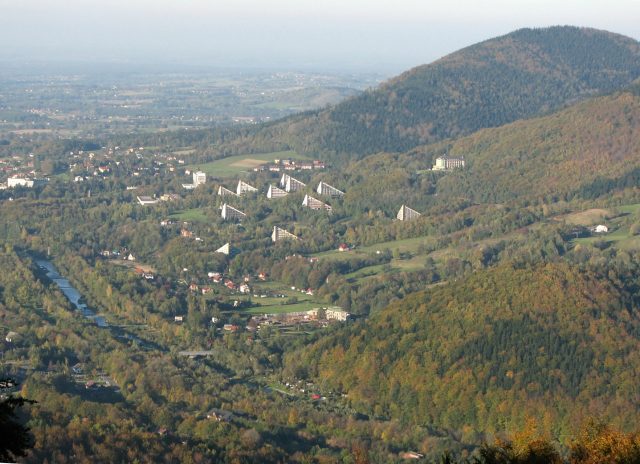
Perched above the quiet town of Ustroń in southern Poland, the viewing platform on Żar Mountain offers more than just a scenic overlook—it’s a place where the rhythm of the Beskidy foothills slows to a natural pace. The mountain itself isn’t the tallest in the region, standing at just 688 meters, but its position makes it one of the most rewarding. From the summit, the valley unfolds in layers: the red-roofed houses of Ustroń nestled along the Wisła River, the rolling green slopes of the surrounding hills, and, on clear days, the distant silhouette of the Tatra Mountains, their jagged peaks cutting into the horizon. The climb up isn’t strenuous—well-marked trails wind through forests of spruce and beech, and for those who prefer to skip the hike, a year-round chairlift carries visitors to the top in minutes.
The platform itself is unassuming, designed to blend rather than dominate. A simple metal structure with railings provides safety without obstructing the view, while informational boards point out landmarks in the distance, from nearby villages to the curve of the river below. Benches are scattered across the area, inviting visitors to linger, whether with a thermos of tea in summer or a flask of something warmer in winter. In colder months, the mountain transforms—the trees dusted with snow, the air crisp and still, the valley below a patchwork of white and evergreen. It’s a place where the only agenda is to watch the light change over the landscape.
Żar Mountain has long been part of Ustroń’s identity, its slopes woven into the town’s history as a retreat. In the 19th century, when the region first gained popularity among travelers from Kraków and Vienna seeking fresh air and quiet, the mountain became a natural focal point. Early hikers carved out the first trails, and later, the chairlift made the summit accessible to everyone. Today, the mountain sits at the heart of a network of paths that connect not just to other peaks but to the cultural fabric of the area—wooden churches, thermal baths, and small museums that tell the story of the Beskidy people. Yet for many, the real draw remains the view from the top, a moment of stillness that lingers long after the descent.
The architecture of the platform is deliberately understated. There are no grand structures, no attempts to overshadow the surroundings. Instead, the design serves a single purpose: to frame the landscape. Nearby, a small wooden building houses a café in the warmer months and a sled rental in winter, its presence unobtrusive but practical. Inside, the scent of coffee or the crackle of a wood stove offers a brief respite from the elements, though most visitors don’t stay long—the real attraction is outside, where the wind carries the scent of pine and the vastness of the valley stretches in every direction.
What makes this place special isn’t just the panorama but the way it makes you feel. There’s no rush here, no need to fill the silence with chatter. The mountains have a way of putting things in perspective, reminding you that some views are worth the effort, that some moments are meant to be savored. Whether you arrive at dawn to watch the mist rise from the valley or in the late afternoon when the setting sun turns the hills gold, the experience is quietly profound. It’s the kind of place that stays with you, not because it’s grand or famous, but because it feels like a secret shared between the land and those who take the time to look.