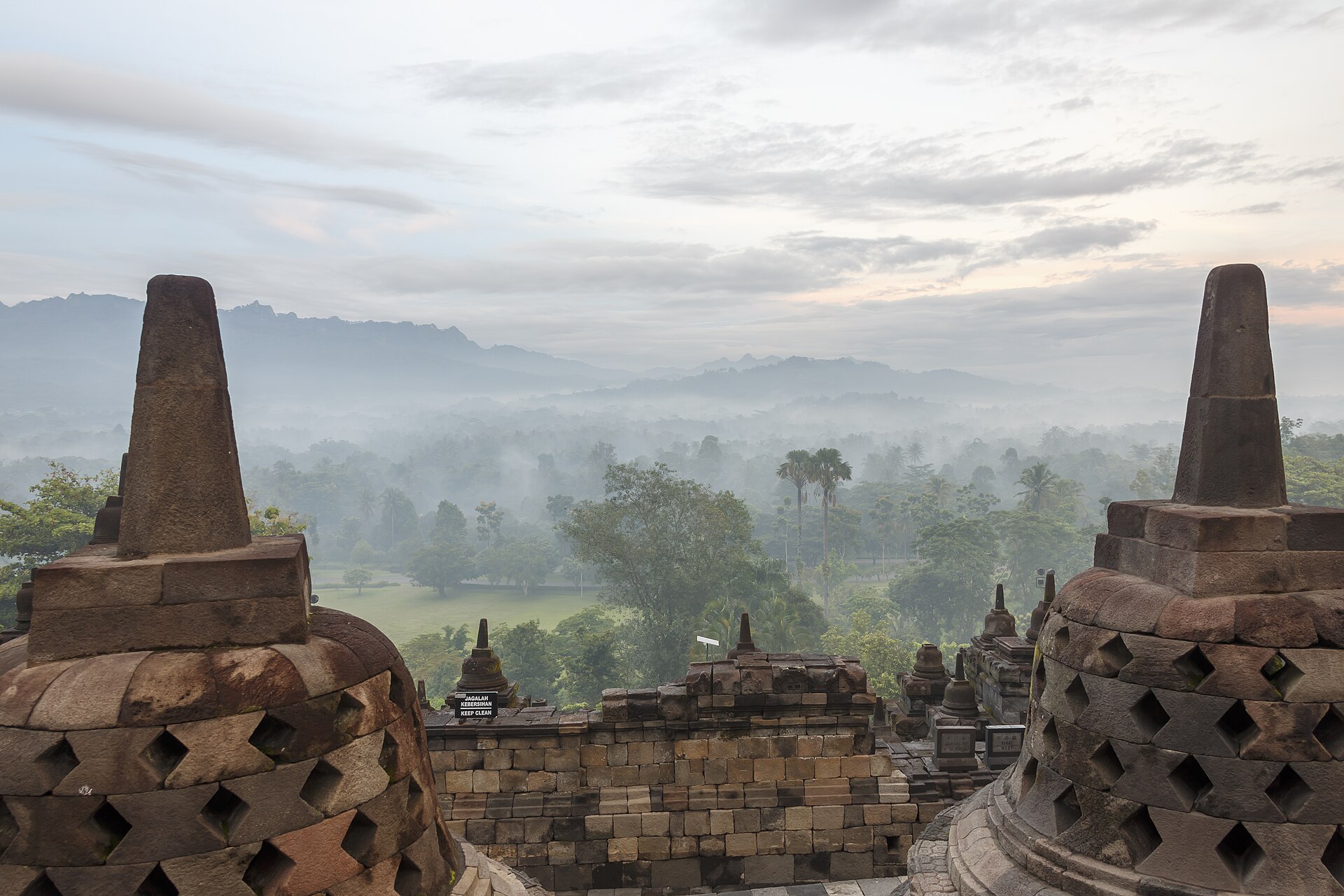
Perched atop the ancient stone terraces of Borobudur, the viewpoint isn’t just a place to take in the scenery—it’s where the temple’s purpose and the landscape around it finally make sense. From here, the vast structure unfolds like a story, its concentric rings of stupas leading the eye outward toward the distant volcanoes Merapi and Merbabu, their slopes softened by morning mist. The temple itself seems to float above the treetops, its weathered stone glowing in the early light. There’s no grand monument or towering spire to frame the view; instead, the simplicity of the setting lets the surroundings speak for themselves. The jungle hums with life below, while the wind carries the faint scent of damp earth and frangipani from the nearby villages.
Borobudur was built not just as a place of worship but as a physical representation of Buddhist cosmology. Each level of the temple corresponds to a stage on the path to enlightenment, from the earthly realm of desire at the base to the formless void at the summit. The lower terraces are lined with intricate bas-reliefs depicting the life of the Buddha, their stories carved into the stone with such detail that they feel almost alive. As you climb higher, the reliefs give way to open-air galleries, where rows of bell-shaped stupas guide the way upward. The viewpoint sits at the very top, where the central stupa crowns the structure. It’s the culmination of the journey, a place where pilgrims and visitors alike have paused for centuries to reflect on what they’ve seen and where they’re headed.
The temple’s origins are as layered as its architecture. Constructed between the 8th and 9th centuries under the Sailendra dynasty, Borobudur was abandoned by the 14th century, its purpose and even its existence fading from memory. Some theories suggest a volcanic eruption buried it under ash, while others point to the rise of Islam in Java as the reason for its decline. Whatever the cause, the temple remained hidden beneath jungle and sediment until 1814, when it was rediscovered by British colonial officials. The restoration that followed was painstaking, uncovering a monument that had been lost to time. Today, Borobudur stands as the world’s largest Buddhist temple, a quiet giant in a country where Buddhism is no longer the dominant faith.
The atmosphere here shifts with the hours. At dawn, when the first light spills over the horizon, the temple is nearly empty. The stone is cool to the touch, and the only sounds are the rustling of leaves and the distant call of birds. By midday, the crowds arrive, but even then, the place doesn’t feel crowded—just alive with the murmur of voices and the occasional click of a camera. As the sun dips below the horizon, the temple takes on a golden hue, and the shadows stretch long across the stupas. It’s easy to imagine the rituals that once took place here, the chanting of monks and the slow procession of pilgrims making their way up the steps. The viewpoint, in particular, feels like a threshold, a place where the sacred and the everyday briefly overlap.
Borobudur isn’t a place that demands attention with flashy details or ornate decorations. Instead, it draws you in quietly, inviting you to look closer at the carvings, to trace the lines of a Buddha’s face worn smooth by centuries of touch, or to sit for a while on one of the stone benches and watch the light change over the landscape. The viewpoint at the top isn’t just about the view—it’s about the sense of arrival. From here, you can see how the temple fits into the land, how its curves echo the shape of the hills around it. It’s a reminder that this place was never meant to dominate the landscape but to exist within it, a bridge between the human and the divine.
Beyond the temple grounds, life moves at a different pace. The villages nearby are small and unassuming, their streets lined with houses built in the traditional Javanese style. In the mornings, women balance baskets of fruit on their heads as they walk to the market, while children play near the temple’s outer walls. The locals are used to visitors, but their daily routines haven’t changed much over the years. A few simple cafes serve strong Javanese coffee and simple meals, their tables shaded by trees. Occasionally, a festival or ceremony might be taking place, though these are rare and often tied to the lunar calendar. Even without such events, the area has a timeless quality, a glimpse of Java as it was long before tourism became part of the landscape.
What makes Borobudur different from other ancient sites is its ability to feel both monumental and intimate. There’s no sense of grandeur for grandeur’s sake here—just a quiet, enduring presence. The temple doesn’t overwhelm you with its size; instead, it invites you to slow down, to walk its paths at your own pace, and to consider the journey as much as the destination. The viewpoint at the top isn’t just a place to admire the scenery; it’s where you realize why this temple has endured. It’s not just about the past or the architecture or even the religion—it’s about the way the place makes you feel, as if for a moment, you’re part of something much larger than yourself.