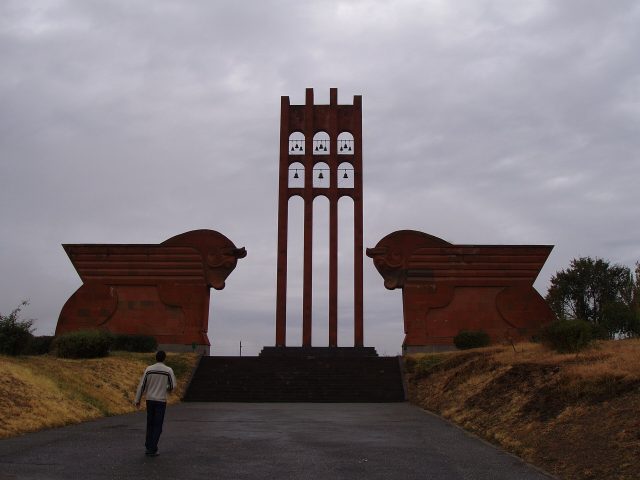
The Sardarapat Bell Tower rises from the Ararat Plain like a quiet sentinel, marking the ground where Armenia’s fate was decided in May 1918. This was no ordinary battlefield—it was the last stand of a nation on the brink. After the collapse of the Russian Empire, Ottoman forces surged into the Caucasus, aiming to erase what remained of Armenian statehood. Against overwhelming odds, a ragtag army of volunteers, led by generals Movses Silikyan and Daniel Bek-Pirumyan, turned the tide in a desperate three-day battle. The victory didn’t just halt an invasion; it made the First Republic of Armenia possible, a fragile but defiant declaration of survival when the world seemed determined to forget this land existed.
The tower itself is deceptively simple—a tall, slender structure of pale tuff stone, crowned with an open belfry where the bells ring out on national holidays and days of remembrance. There’s no ornate flourish to its design, just clean, deliberate lines that feel both solemn and resilient. It doesn’t dominate the landscape so much as emerge from it, as if the earth itself had pushed up this monument to those who refused to surrender. Around it, the memorial complex unfolds in careful symmetry: stone reliefs depicting the battle, an eternal flame flickering in the wind, and pathways that guide visitors through the weight of history. The architecture doesn’t shout; it endures.
What happened here wasn’t just a military triumph—it was a miracle of timing and will. By 1918, Armenia had been carved up, its people scattered by war and genocide. The Ottoman advance into Sardarapat threatened to finish what had begun years earlier. Yet in those critical days, a mix of seasoned soldiers, farmers, and even children managed to repel an army far larger and better equipped. The victory bought just enough time to declare independence on May 28, though the new republic would be small, poor, and constantly under threat. The bell tower, built fifty years later, stands as a testament to that narrow window of hope—a reminder that nations aren’t just born from grand declarations, but from moments when ordinary people choose to stand their ground.
Today, the memorial is more than a historical site; it’s a living space where the past and present intersect. School groups wander the paths, their voices mixing with the rustle of leaves in the surrounding park. Families come to point out the names on the monuments, to explain to children why this patch of land matters. On national holidays, the crowds swell, and the air fills with the sound of the bells, their deep tones carrying across the plain. The tower is visible for miles, its silhouette a familiar landmark against the backdrop of the Ararat Valley. There’s no hushed reverence here, no museum-like stillness—just the hum of life continuing, even in a place built to honor those who gave everything to make it possible.
The park around the tower is dotted with memorials, each telling a fragment of the story. The most striking is the statue of a lion, its massive form crouched as if ready to spring—a symbol of Armenian statehood that predates even this battle. Nearby, a small museum houses relics of the fight: faded photographs, handwritten orders, the personal effects of soldiers who never returned. The exhibits are modest, but they carry the weight of real lives—letters scribbled in haste before battle, maps with commanders’ notes, the kind of details that make history feel immediate. One display shows a soldier’s diary, its pages filled with the mundane and the profound: a list of supplies, a prayer, a final message to his family.
For Armenians, Sardarapat is more than a memorial—it’s a touchstone. The country has faced its share of hardships since 1918, from Soviet rule to the struggles of independence, and the lessons of this place still resonate. The bell tower doesn’t just commemorate a victory; it serves as a reminder of how easily history can unravel, and how fiercely it must be defended. The bells ring for the fallen, but also for the living, a call to remember that the past isn’t just something to look back on—it’s something that shapes every step forward. In a world where borders shift and memories fade, this patch of earth remains a fixed point, a place where the weight of what was saved can still be felt.
Visiting Sardarapat leaves an odd mix of emotions. There’s pride, of course—pride in the resilience of those who fought, in the fact that a nation refused to disappear. But there’s also a quiet sorrow, an awareness of the cost. The fields around the memorial are peaceful now, stretching out under the vast Armenian sky, but it’s impossible to stand here and not think of the lives lost, the families torn apart, the sheer fragility of the moment when everything hung in the balance. The place doesn’t demand reverence; it earns it. Even if you don’t know the details of the battle, the atmosphere seeps in—the sense of something larger than yourself, something worth preserving.
The tower stands as a kind of watchman, not just over the past, but over the idea of memory itself. In a country where history is often contested, where the stories of survival and loss are woven into the very landscape, Sardarapat is a place where those stories are kept alive. The bells, the stone, the names etched into monuments—none of it is just for show. It’s a conversation between generations, a way of saying: *This happened. We remember. We are still here.* The wind carries the sound of the bells across the plain, and for a moment, it’s as if the voices of 1918 are still answering.