St. Gevorg Church in Sardarapat is one of those places where Armenia’s history feels almost tangible. It stands on land that has witnessed some of the nation’s most pivotal moments, a quiet witness to both faith and resilience. Built in the early 20th century, the church carries the weight of its time—a period when Armenia was fighting for its very existence. Its architecture reflects the enduring traditions of Armenian design, yet there’s something unmistakably modern about it, as if the struggles of the era left their mark on its stones.
The church is simple in its construction but striking in its presence. Like many Armenian churches, it follows the classic cross-domed style, with a central cupola resting on four sturdy pillars. The walls are made of local tuff, a volcanic stone that gives the building its warm, rosy hue, blending seamlessly with the surrounding landscape. The facades are adorned with traditional Armenian carvings, though without excessive ornamentation. Inside, the space feels larger than it is, with narrow windows filtering light in a way that softens the atmosphere, inviting quiet reflection.
Sardarapat is best known for the 1918 battle where Armenian forces halted the advance of the Ottoman army, securing a brief but crucial moment of independence that led to the First Republic of Armenia. St. Gevorg Church wasn’t built until later, but it became part of that legacy. It stands on ground that, for many Armenians, symbolizes not just victory but the memory of those who sacrificed everything for the country’s future. Nearby, the Sardarapat Memorial Complex honors the battle, and visitors often come here to pay their respects, connecting the past with the present.
For locals, the church is more than a place of worship—it’s a living part of their history. Services, baptisms, and weddings take place here, but so do commemorations tied to Sardarapat’s past. On feast days, the church fills with people, its walls echoing with prayers and songs, a reminder that faith and memory are threads that bind generations together. The connection between the church and the land is deeply personal, a place where individual stories and national history intertwine.
The surroundings add to the church’s quiet significance. Sardarapat lies in the Ararat Valley, one of Armenia’s most fertile and picturesque regions. From here, Mount Ararat looms in the distance—a symbol of both hope and loss for Armenians. The landscape is one of endless fields, vineyards, and small villages where life moves at a slower pace. On clear days, the air is crisp, and the only sounds are the distant toll of church bells or the call of birds. It’s a place where time seems to stand still, where the weight of history feels lighter, carried by the land itself.
Unlike some of Armenia’s more famous churches, St. Gevorg doesn’t draw crowds of tourists. It lacks the grandeur of Etchmiadzin or the dramatic setting of Geghard, but that’s part of its charm. There’s no rush here, no need to hurry through. Visitors can take their time, sit on a bench, or walk the paths around the church, watching how the light shifts across the stones. For those who want to understand Armenia beyond textbooks, this place offers something deeper—a sense of connection to the land and its people.
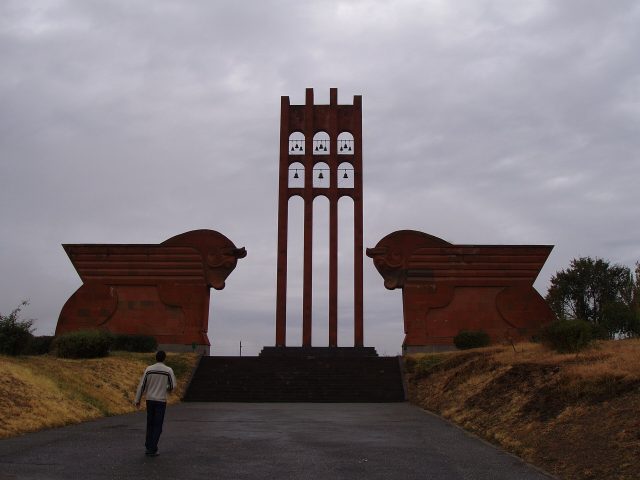
Many who visit the church also explore the Sardarapat Memorial Complex, opened in 1968. The complex includes towering sculptures, a museum, and an eternal flame, honoring not just the 1918 victory but the broader story of Armenian survival and cultural resilience. Together, the church and the memorial create a space for reflection, where history isn’t just remembered but felt. The two sites complement each other, one rooted in faith, the other in remembrance, both speaking to the same enduring spirit.
Time moves differently here. An hour or an afternoon spent at the church doesn’t feel wasted. You might sit on a bench, gazing toward Ararat, or wander the paths, noticing how the stones change color in the sunlight. In moments like these, it becomes clear why this place matters so much to Armenians. It doesn’t demand attention, but it holds it effortlessly—through the weathered carvings, the faint traces of frescoes, the rustle of leaves in the nearby garden.
St. Gevorg Church is more than a relic of the past; it’s a living part of Armenia’s present. It reminds visitors that history isn’t confined to books—it lives in the people who come here to pray, to remember, or simply to be still. That’s where its quiet power lies. It doesn’t need to shout its significance; it speaks softly, through the details that make it real.