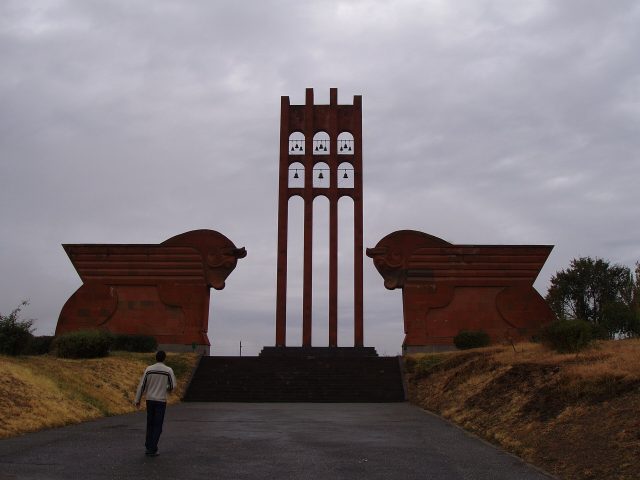
The Sardarapat Ethnography and Liberation Struggle Museum stands where history was written in blood and resilience. This is the ground where, in May 1918, Armenian forces turned the tide against an advancing Ottoman army, securing a victory that preserved the possibility of an independent Armenia. The battle was not just a military triumph but a defining moment for a nation on the brink, and the museum was built to honor those who fought here while also preserving the broader story of Armenian culture across centuries. The very land beneath the museum’s foundations carries the weight of that struggle, making it more than a collection of artifacts—it is a place where the past feels immediate.
The museum’s architecture is impossible to ignore. Its main building stretches outward like a great eagle with wings unfurled, a deliberate symbol of freedom and national identity. The design is both imposing and graceful, blending into the landscape while commanding attention from miles away. At the entrance, a towering memorial rises above the plaza, its eternal flame flanked by statues of warriors and national emblems. The entire complex is arranged to guide visitors through a journey—from the open fields where the battle raged to the halls where its memory is kept alive. Even the way the buildings sit against the horizon, framed by the vast Ararat plain, reinforces the sense of scale and significance.
Inside, the museum unfolds in layers, each room dedicated to a different chapter of Armenia’s story. The halls devoted to the liberation struggle hold the tangible remnants of 1918: faded maps of troop movements, soldiers’ letters home, rusted weapons, and personal belongings that survived the chaos. Some displays reconstruct trenches, giving a visceral sense of the conditions under which the battle was fought. Beyond the military history, the ethnographic exhibits offer a quieter but equally powerful narrative. Here, everyday objects—woven textiles, hand-forged tools, intricately carved jewelry—reveal the rhythms of Armenian life over generations. The displays are arranged not as sterile relics but as fragments of a living culture, with traditional costumes draped as if worn yesterday and pottery stacked as it might have been in a village home.
One of the museum’s strengths is its ability to connect the past with the present. Temporary exhibitions often explore contemporary themes, whether through modern art that reinterprets historical events or scholarly research that sheds new light on old questions. Occasionally, descendants of those who fought at Sardarapat share their stories, or historians lead discussions on the battle’s legacy. These moments make the museum feel dynamic, a place where history is not just remembered but actively engaged with. For visitors unfamiliar with Armenian history, these connections help bridge the gap between then and now, showing how the events of 1918 still resonate today.
The grounds surrounding the museum are as much a part of the experience as the exhibits inside. Memorials dot the landscape, each one marking a name, a sacrifice, or a moment of defiance. Sculptures depict figures in motion—soldiers charging, mothers mourning, workers rebuilding—while the open space invites reflection. Walking the paths, it’s easy to imagine the battlefield as it once was, the air thick with dust and the sounds of conflict. The contrast between the quiet of the present and the violence of the past is striking, and the museum does not shy away from that tension. Instead, it uses the landscape to deepen the emotional impact, letting the land itself tell part of the story.
For many Armenians, Sardarapat is more than a museum; it is a pilgrimage site. The battle here was not just a military victory but a turning point in a period of unimaginable loss, and the museum honors that duality. Visitors often move through the halls in silence, their expressions a mix of pride and sorrow. The atmosphere is one of reverence, not because the museum demands it, but because the weight of history does. This is a place where the past is not abstract—it is personal, tied to family stories, national identity, and the unspoken understanding of what was at stake in 1918.
Yet the museum is not trapped in nostalgia. It actively shapes how Armenians and visitors alike understand the country’s history and culture. Educational programs bring students here to learn about the battle and its context, while collaborations with artists and researchers keep the exhibits fresh. For outsiders, the museum offers a way into Armenia’s complex narrative, explaining why memory here is not just about the past but about survival. The exhibits on ethnography, in particular, show how culture endured even in the face of displacement and destruction, with traditions in craft, music, and storytelling acting as threads that connect generations.
The location of Sardarapat adds another layer of meaning. The museum sits in the Ararat plain, with the snow-capped peak of Mount Ararat visible in the distance. For Armenians, the mountain is a national symbol, a silent witness to centuries of history. Seeing it from the battlefield where independence was won creates a powerful juxtaposition—nature and history intertwined. The view alone is worth the visit, but it also serves as a reminder of how geography has shaped Armenia’s story, from ancient kingdoms to modern struggles. The museum doesn’t just tell that story; it places you inside it, on the very land where it unfolded.