Sardarapat is one of those rare places where history feels tangible, where the past isn’t just remembered but physically present. Located about an hour’s drive from Yerevan, this memorial park stands on the very field where, in May 1918, Armenian forces under General Movses Silikyan turned the tide against an advancing Ottoman army. The battle wasn’t just a military victory—it was a moment that preserved what remained of Armenian statehood, paving the way for the First Republic. Today, the site is more than a monument; it’s a space where memory and modernity coexist, a quiet testament to resilience.
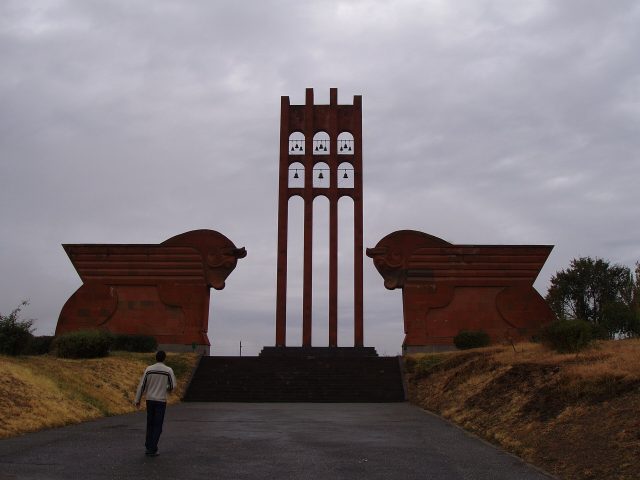
The heart of the park is the memorial complex, unveiled in 1968. Its design is unmistakably Soviet in its monumental scale, yet it carries a deeper symbolism. At the entrance, two massive winged bulls carved from local tuff stand guard, their imposing forms both protective and solemn. Beyond them, a wide staircase leads to an eternal flame, surrounded by granite slabs bearing the names of the fallen. The layout isn’t just architectural—it’s a journey, each step drawing visitors closer to the weight of what happened here.
Beneath the memorial lies the Museum of Ethnography and the Liberation Movement, a subterranean space that tells a broader story. Its exhibits don’t just focus on the 1918 battle but trace the arc of Armenian life across centuries—everyday objects, weapons, documents, and photographs that ground history in reality. There’s no attempt to romanticize the past; instead, the museum presents it as it was, with all its struggles and triumphs. For many visitors, the experience shifts history from abstract dates to something lived and felt.
The park extends far beyond the memorial and museum. Wide pathways wind through open spaces, shaded by trees, where locals and travelers walk without the usual urban rush. The atmosphere is contemplative rather than somber, a place where time slows. On clear days, Mount Ararat looms in the distance, a silent witness to the passage of centuries. In summer, the park hosts festivals and concerts, while winter transforms it into a quiet retreat, a space for reflection.
Sardarapat is more than a historical site—it’s a symbol of national identity. During the Soviet era, the battle was downplayed, but after independence, its significance was reclaimed. Today, school groups, veterans, and families visit, each finding their own connection to the place. For many Armenians, it’s a pilgrimage, a way to honor the past and feel part of something larger. Yet it’s not a closed-off monument; it remains a living space, open to anyone who wants to understand what it means to be Armenian.
The architecture itself is worth lingering over. Designed by Rafael Israelyan and Jim Torosyan, the complex blends Soviet grandeur with Armenian motifs. The winged bulls at the entrance, for instance, echo ancient Urartian symbols, tying the site to the region’s deeper past. The bell tower, while modern in its simplicity, evokes traditional Armenian churches. Even the materials—local tuff, with its warm, earthy tones—create a sense of harmony with the landscape.
Visiting Sardarapat isn’t just about seeing a historical site; it’s about experiencing context. There’s no forced grandeur or theatricality here, just space, silence, and a quiet sense of belonging. You can wander the paths for hours, study the museum’s exhibits, or simply sit on a bench with Ararat in the distance. For those interested in Armenian history, it’s an essential stop, but even casual visitors often leave with something intangible—a feeling that lingers long after.
In recent years, the park has become a hub for national events. Independence Day celebrations, classical and folk music concerts, and exhibitions are held here, all carefully balanced to remain meaningful without becoming mere formalities. Locals come with their families for weekend outings, while tourists use the space to connect with Armenian culture. In this way, Sardarapat serves multiple roles: memorial, museum, park, and gathering place.
The site continues to evolve. New interactive exhibits in the museum make history more accessible to younger generations, and ongoing landscaping projects aim to improve the visitor experience. Yet the core remains unchanged—Sardarapat is a place where the past isn’t just preserved but made relevant, a reminder that history isn’t just written in books but carried in the memories of those who walk its paths.