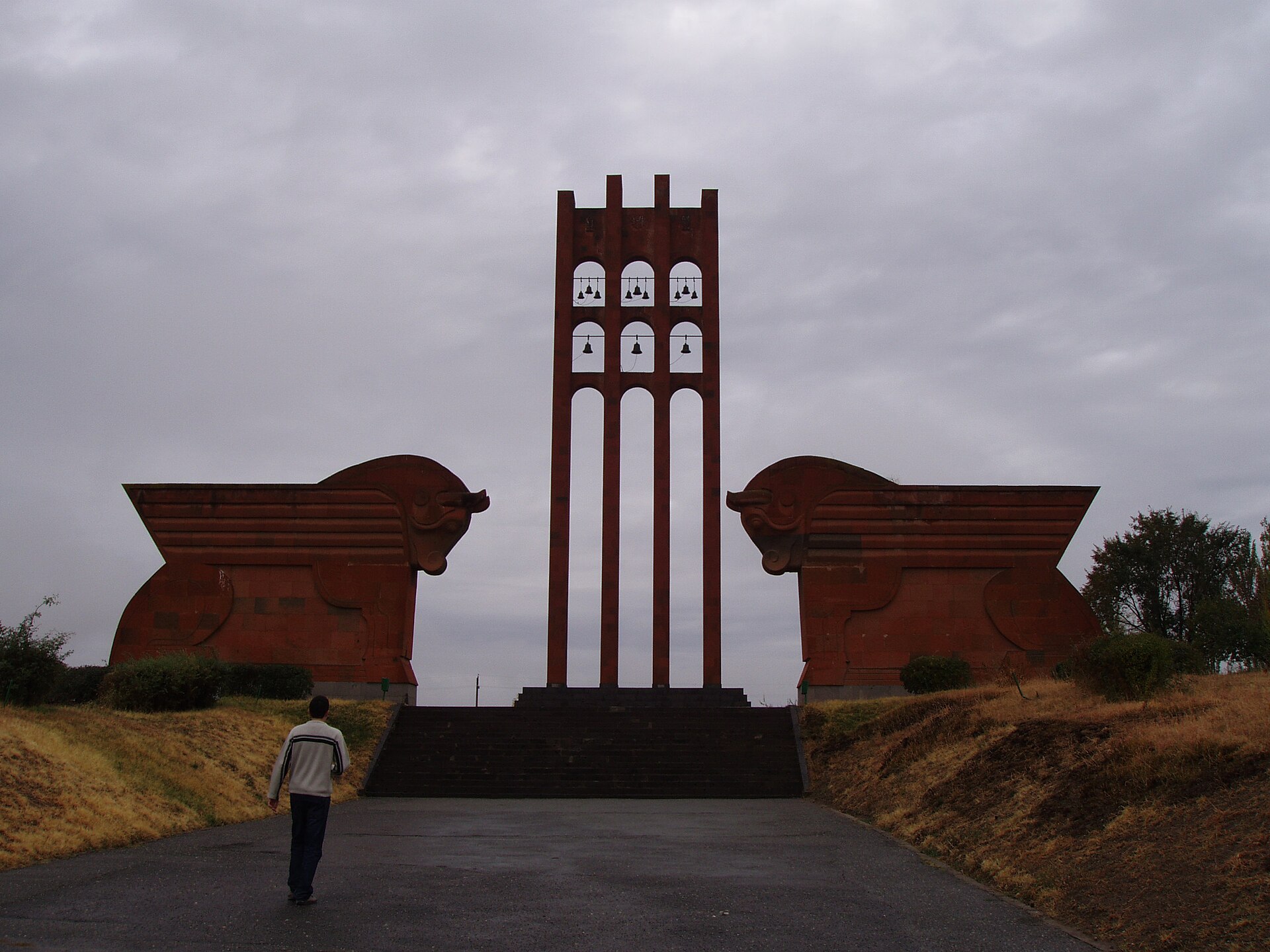
Sardarapat Memorial marks the spot where Armenian volunteers stopped the Ottoman army in May 1918. The victory saved Yerevan and gave Armenia a brief chance at independence. The land here is quiet, but the weight of that moment lingers in the wind and the stones beneath your feet.
The complex opened in 1968, fifty years after the battle. Architect Rafael Israelyan and sculptor Ara Harutyunyan shaped it to reflect both heroism and sorrow. At the entrance, winged bulls stand—symbols of resilience, their expressions carrying grief for the cost of survival.
A staircase leads to the central square, where a towering bell hangs. Its toll carries across the fields, echoing the voices of those who never returned. Nearby, an eternal flame flickers behind granite slabs with the names of the fallen. Visitors leave flowers, especially in May when crowds gather for the battle’s anniversary.
The museum behind the bell tells the story of 1918. Exhibits show the collapse of the Russian Empire, the Armenian Genocide, and the struggle of a people caught between empires. Photographs, documents, weapons, and personal belongings fill the halls. Soldiers’ letters, written before combat, are among the most moving items.
The memorial’s architecture is simple, built from local stone that blends with the landscape. The steppe stretches endlessly, open and uncluttered. On clear days, Mount Ararat rises in the distance, its peak a silent witness to Armenian history.
Near the museum, khachkars—traditional Armenian cross-stones—stand in remembrance. Each is carved with patterns as individual as fingerprints. Though not as old as those in Etchmiadzin or Geghard, they bridge past and present. They remind you that history is made of real lives and choices.
The grounds invite slow walks. There’s no rush, only the wind and the occasional chime of the bell. Sometimes the silence feels so deep it’s as if time has paused.
May 28, Armenia’s First Republic Day, is the busiest day. People gather to lay flowers, listen to speeches, and honor those who fought. But even on ordinary days, the memorial isn’t empty. School groups come for history lessons, travelers seek quiet, and others stand where their ancestors once stood.
Sardarapat remains part of Armenian identity. It hosts cultural events, veteran gatherings, and concerts. The battle ended over a century ago, but its spirit endures in the stones and the people who visit. For many, coming here isn’t just about remembering—it’s about feeling part of something larger.