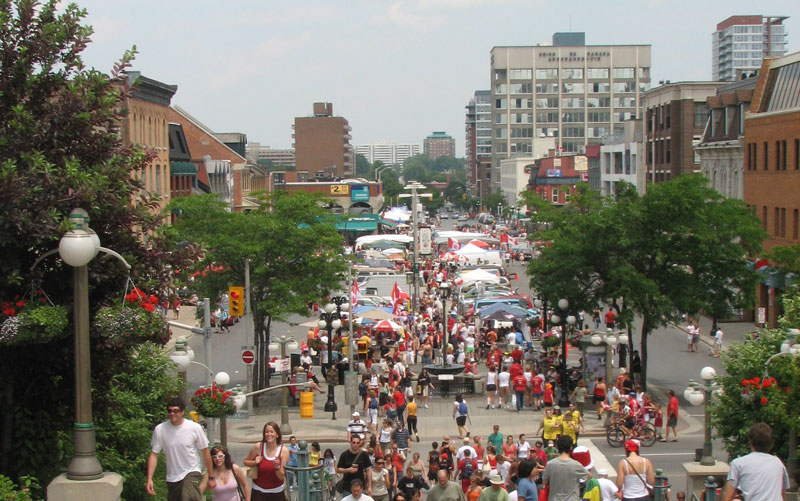
Byward Market isn’t just a place to shop—it’s where Ottawa reveals itself in all its unfiltered, everyday charm. For over two hundred years, this spot by the Rideau River has been a hub of local life, starting as a simple patch of land where farmers from nearby villages sold their harvest. What began as a modest trading post grew into a sprawling market, first with wooden stalls and later with the sturdy stone and brick buildings that still anchor its heart today. More than just a marketplace, Byward has become a living record of the city, where every corner carries traces of the past.
The market’s architecture tells its own story, a patchwork of eras and styles. The oldest building, dating back to 1846, is a classic example of early Canadian construction—thick walls of local stone, low ceilings, and narrow windows that hint at a time when buildings were built to last. Nearby, red-brick structures from the late 1800s reflect the industrial boom, their taller, more utilitarian design contrasting with the older, squatter buildings. Even after renovations in the mid-20th century, the market retained its open-air stalls under broad canopies, where shoppers can wander between vendors without worrying about rain. There’s no grandiosity here, just the quiet authenticity of a place that has grown organically over generations.
Mornings at Byward Market start early. Before dawn, farmers from Ontario and Quebec arrive to set up their stands, and by seven, the market is already bustling. Fresh greens, just-picked berries, wild mushrooms, jars of honey, artisanal cheeses, and cured meats spill across the tables. Seasonal produce dominates—spring brings asparagus and radishes, summer bursts with strawberries and raspberries, autumn overflows with pumpkins and apples, and winter offers pickled cabbage and preserves. But it’s not just food on display. Potted plants, seedlings, and cut flowers add splashes of color, while the air fills with the mingling scents of freshly baked bread, smoked fish, and roasting coffee.
Beyond the food stalls, Byward Market feels like a village within the city. Small shops and stands sell handmade candles, pottery, vintage postcards, and old vinyl records. Local artists often display their work—paintings and photographs that capture the market’s energy, its weathered buildings, and the faces of the people who keep it running. These pieces add another layer to the market’s character, turning it into more than just a place to buy groceries. It’s a space where creativity and commerce intersect, where the act of selling becomes part of the city’s cultural fabric.
The market thrives year-round, but summer brings a special kind of energy. On weekends, families, tourists, and locals crowd the aisles, browsing not just for necessities but for the experience. Street musicians play near the entrances, and artists sketch portraits for passersby. Winter transforms the market into a different kind of gathering place. In the weeks leading up to Christmas, festive stalls sell ornaments, gingerbread, and mulled wine, while strings of lights glint off the snow. The crisp air carries the scent of cinnamon and roasted chestnuts, turning the market into a cozy refuge from the cold.
Byward Market is one of those rare places where you can feel the pulse of a city. There are no guided tours, no scripted narratives—just the quiet rhythm of daily life unfolding. Listen closely, and you’ll hear a mix of accents—English, French, and others—reflecting Ottawa’s history as a city of immigrants. Many of the vendors come from families who have sold here for generations, their stalls passed down like heirlooms. This sense of continuity gives the market a timeless quality, as if the past and present exist side by side.
For all its central location, Byward Market retains a small-town warmth. There’s no sterile efficiency of a supermarket here—just the messy, tactile reality of food as it’s meant to be. Vegetables still have traces of soil clinging to them, bread arrives warm from the oven, and cheese can be sampled before buying. Vendors often recognize regular customers by name, sharing stories about how a particular crop was grown or offering tips on how to prepare it. It’s a place where food isn’t just a commodity but a connection between people.
Over time, the market has evolved into more than just a trading post. It’s now a community space where festivals, concerts, and workshops take place. In summer, the square in front of the market hosts outdoor movie nights, while in winter, an ice rink draws skaters. Byward has become a gathering spot for locals, a place to linger even when there’s nothing specific to buy. It’s woven into the fabric of Ottawa’s daily life, a destination people visit out of habit, because it feels like home.
Today, Byward Market is more than just a market—it’s a living entity that grows and adapts alongside the city while holding onto its essence. It’s a reminder that even in a modern urban landscape, there are still places where time moves at its own pace, where people know each other by name, and where food carries the scent of earth and fire rather than plastic. That’s why, after all these years, it remains one of Ottawa’s most beloved spots—a place where the city doesn’t just put on a show but lets you see it as it truly is.