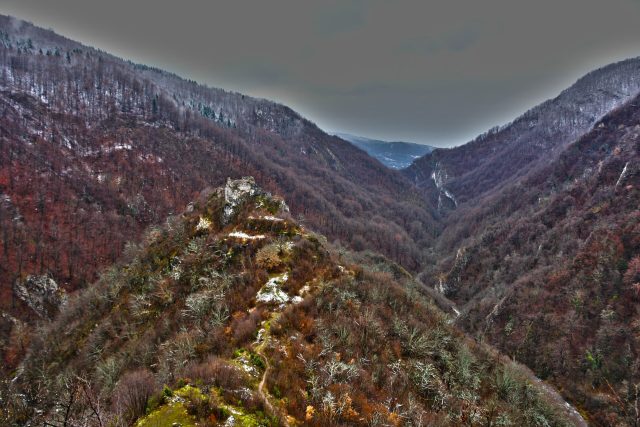
Dobranja Mine is one of those places in Bosnia and Herzegovina where history isn’t just preserved in documents—it seeps through the ground itself. Tucked near the small town of Vareš, this abandoned mining complex was once the beating heart of local industry. Now, it stands as a quiet witness to the changes the country has undergone over centuries. There are no crowds of tourists here, no guided tours with loudspeakers, no bright signs pointing the way. Just silence, rusted structures, and the unmistakable sense that time froze somewhere in the middle of the last century.
The story of Dobranja is tied to iron ore, a resource that shaped this region long before modern borders were drawn. The first traces of mining here date back to Roman times, when metal was a strategic commodity for the empire. But the mine’s golden age came much later, under Austro-Hungarian rule in the late 19th and early 20th centuries. That’s when the main shafts, railway lines, and infrastructure were built—some of which still stand today. The Austrians brought in technology that was cutting-edge for its time, turning Dobranja into one of the region’s key industrial sites.
After World War II, the mine came under Yugoslav control and continued operating, though at a slower pace. Vareš became a typical working-class town, its rhythm dictated by shift changes and factory whistles. Miners, many of whom lived in nearby settlements, descended into the earth daily, extracting ore that fed the steel mills of Sarajevo and Zenica. But by the late 20th century, the deposits were depleted, and the economic upheavals of Yugoslavia’s collapse sealed Dobranja’s fate. The mine closed in the 1990s, left to slowly decay as nature reclaimed it.
Today, Dobranja feels suspended between past and present. Rusty rails, once used to transport ore, disappear into tunnels overgrown with shrubs. The skeletal remains of mine carts lie scattered across the site, like the exoskeletons of giant insects. Towering above it all are the metal frames of the mine’s headframes—tall structures used to hoist ore to the surface. Their silhouettes stand stark against the surrounding mountains, a reminder that industry was once as much a part of this landscape as the hills themselves.
Visiting Dobranja isn’t so much a tour as it is a step into another era. There are no marked paths or informational plaques, and that’s part of what makes the place special. Walking through the site, it’s impossible not to think about the people who worked here for decades. The miners who descended into dark, dangerous shafts. The engineers who kept the machinery running. The families who lived in the shadow of this massive operation. Their stories aren’t written in guidebooks, but they linger in every rusted bolt and crumbling brick.
Despite its abandonment, Dobranja doesn’t feel desolate. There’s an odd sense of peace here, as if nature and industry have finally reached a kind of balance. In spring and summer, wildflowers blanket the ground, and birds nest in the metal structures. In winter, snow softens the jagged edges of rusted machinery, turning them into part of the landscape. Even the rain sounds different here—its drops hitting metal with a dull, almost musical resonance.
For those interested in industrial heritage, Dobranja is a hidden gem. It offers a glimpse into mid-20th-century mining, a time when automation hadn’t yet replaced manual labor and workplace safety was more exception than rule. The remnants of hoisting mechanisms, ventilation systems, and even miners’ living quarters still stand in varying states of decay, allowing visitors to imagine how the mine functioned in its prime. Old photographs of Vareš and Dobranja, sometimes found in local archives or among longtime residents, make for a striking contrast with what remains today.
It’s worth remembering that Dobranja isn’t an open-air museum—it’s an abandoned industrial site, and exploring it requires caution. The area isn’t fenced off, and some structures may be unstable. It’s best to avoid entering tunnels or climbing onto decaying platforms, as they could be dangerous. Still, even a walk around the perimeter offers plenty to see, and the photographs taken here will serve as a reminder of an unusual journey into the past.
Vareš itself is a quiet town now, where life moves at a slower pace, and memories of its industrial past are fading. Dobranja Mine is one of the few reminders of the time when this region was part of a larger industrial world. Maybe someday there will be guided tours or a museum here, but for now, Dobranja belongs to those who see it not just as a pile of scrap metal, but as a living piece of history—one that speaks without words.