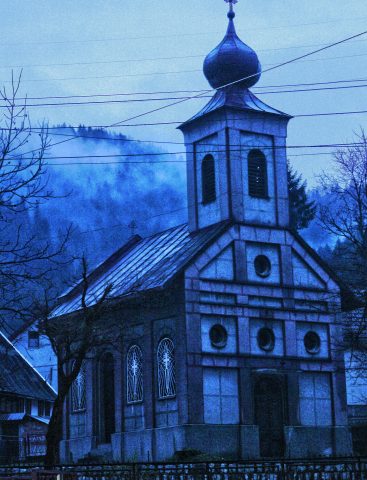
Nestled in the quiet valley of Vareš, the Church of the Intercession of the Holy Virgin stands as a quiet witness to the town’s layered past. Vareš itself is one of those places that feels suspended in time, a former mining settlement where life once revolved around the rhythm of the shafts and the clatter of ore carts. The church, unassuming in its appearance, is more than just a place of worship—it’s a symbol of endurance for the community that has called this town home through decades of change.
Built in the late 19th century, the church arrived during a period of prosperity for Vareš, when the mining industry brought workers from across the region. The town’s Orthodox Serb population, a significant part of the local fabric, needed a spiritual home, and so the church was constructed in a style typical of the Balkans—modest in scale, with a single dome, stone walls, and a wooden iconostasis. There’s no grandiosity here, just a quiet dignity that feels entirely in keeping with the town’s character.
Inside, the church carries the warmth of a place that has been lived in rather than merely visited. The icons, some brought by parishioners from elsewhere, others painted by local hands, aren’t masterpieces in the traditional sense. Instead, they possess a sincerity that makes them feel personal, almost intimate. The wooden iconostasis, though unadorned by gilding, has a solid, welcoming presence, as if inviting visitors to linger. The dim light filtering through the oil lamps softens the space, slowing time just enough to let the outside world fade away.
The church’s history is intertwined with the fortunes of Vareš and its people. The 20th century brought its share of upheavals—world wars, shifting borders, the collapse of Yugoslavia, and the brutal conflict of the 1990s. During the Bosnian War, the church found itself in the midst of fighting, yet somehow survived when so much around it was damaged. After the war, the community slowly restored the building, piecing back together not just its structure but its role as a gathering place. Today, the walls hold more than just the echoes of prayers; they carry the weight of memory, of lives lived through turmoil and quiet resilience.
Vareš isn’t a town that draws crowds. There are no bustling tourist streets or grand hotels, just a quiet rhythm of daily life. The Church of the Intercession of the Holy Virgin isn’t a museum exhibit but a living part of that life. On Sundays, the congregation gathers—many of them descendants of the miners who once worked the nearby pits. The services, conducted in Church Slavonic, have a familiarity that feels almost like a shared language, passed down through generations. It’s the kind of place where you might find an elderly woman lighting a candle for a long-gone relative or a young family bringing their children to be blessed.
The church sits in an older part of town, where the streets are narrow and paved with cobblestones, winding past houses built during the Austro-Hungarian era. The architecture here is unpretentious—two-story buildings with worn facades, a few former administrative offices, and the occasional shop that’s been in the same family for decades. It’s the kind of place where history isn’t just preserved in monuments but lives in the stories of the people who still call it home. If you’re lucky, you might meet someone willing to share those stories—a retired miner recalling the days when the town thrived, or an old-timer reminiscing about the engineers who came from abroad to work in the mines.
Beyond its religious significance, the church serves as a focal point for the community. On feast days, processions wind through the streets, drawing not just the faithful but neighbors of all backgrounds. In those moments, the church becomes more than a building; it’s a place where people come together, where differences fade into the background. That, perhaps, is its greatest value—not in its architectural details or historical milestones, but in the way it binds the town’s past to its present.
Vareš today is a quiet place, far removed from the industrial bustle that once defined it. The mines have long since closed, and the town has settled into a slower pace. Yet the church remains, a steady presence amid the changes. For visitors, it’s not just a stop on a map but a reminder of how fragile and yet how enduring human stories can be. Within its walls, the voices of the past are still audible, if you listen closely enough. They speak not just of faith, but of the people who built their lives here, in this small corner of Bosnia.