Prague’s Loreta is one of those places where the weight of history lingers in the air, not as a distant echo but as something almost tangible. Tucked away on the slopes of Hradčany, just steps from the bustle of Prague Castle and the quiet grandeur of Strahov Monastery, it feels like a world apart. The approach is unassuming—narrow cobblestone streets winding past old houses, the kind that have stood here for centuries without drawing much attention. Then, suddenly, the complex appears, its Baroque beauty unfolding like a carefully preserved secret. For hundreds of years, this has been a place of pilgrimage, where faith and architecture merge into something both humble and extraordinary.
The story of Loreta begins in the 17th century, when a noblewoman, Kateřina of Lobkowicz, sought to recreate the revered Santa Casa of Loreto in Italy. According to legend, the original shrine housed the house where the Virgin Mary had lived, miraculously transported by angels from Nazareth. The Czech version was meant to offer believers a local sanctuary, sparing them the long journey to Italy. Construction started in 1626, and over the decades, the complex grew into the form we see today—a harmonious blend of chapels, cloisters, and courtyards, each element carefully designed to inspire devotion.
At the heart of Loreta is the small chapel itself, built to resemble a simple rural dwelling. Its facade is adorned with frescoes depicting scenes from the life of the Virgin Mary, while inside, a Black Madonna statue, brought from Italy, draws the eye. The chapel is surrounded by an arcaded courtyard, where pilgrims once gathered in prayer. A well in the center was said to hold healing waters, and nearby, several smaller chapels honor different saints. Among them, the Chapel of St. Francis stands out, its walls covered in vivid frescoes illustrating his life—a quiet testament to the power of faith expressed through art.
Yet the true marvel of Loreta lies in its treasury. Behind glass, an astonishing collection of religious artifacts glows with gold, silver, and precious stones. These were gifts from noble families across Bohemia and beyond—monstrances, reliquaries, and vestments so intricate they seem almost weightless. The most famous piece is the Prague Sun, a monstrance crafted from pure gold and encrusted with over six thousand diamonds. Weighing more than three kilograms, it is one of the most valuable liturgical objects in the world. Even through the protective display, its brilliance is impossible to ignore, a reminder of the lengths to which faith and craftsmanship could once reach.
The bell tower, added in 1694, is another highlight. It houses a carillon of thirty bells, which chime every hour with the melody of *We Fly to Thy Protection*, a hymn to the Virgin Mary. The sound carries across Hradčany, a gentle but insistent reminder of the passage of time. The carillon, one of the oldest in Europe, was made in Amsterdam and originally served not just as a call to prayer but as a warning system for the city—its tones signaling fires or other emergencies. Today, the music feels like a bridge between past and present, a tradition that has outlasted the reasons it was first created.
For much of its history, Loreta was a closed space, accessible only to nuns and pilgrims. That changed in the 19th century, when the monastery was secularized and its buildings came under state control. Now, while it remains under the care of the Prague Archdiocese, the complex is open to all. Inside, the atmosphere is one of quiet reverence—dimly lit corridors, the scent of wax and aged wood, the faint creak of floorboards underfoot. It’s easy to imagine the countless prayers offered here over the centuries, the footsteps of those who came seeking solace or miracles.
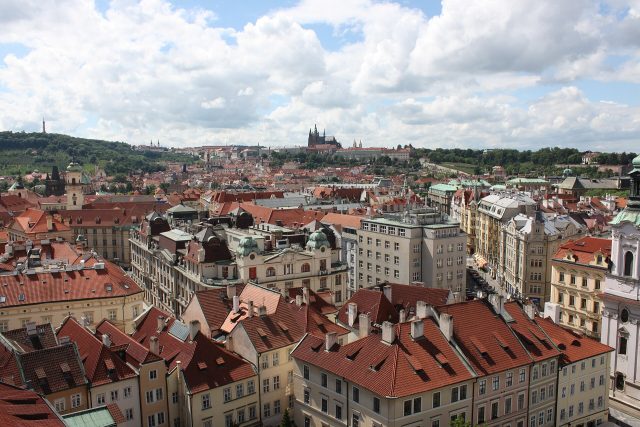
Beyond its spiritual significance, Loreta offers a different perspective on Prague. From its courtyards, the city unfolds below—red-tiled roofs, church spires, the winding Vltava River. On clear days, the view stretches as far as Petřín Hill and the Žižkov Television Tower, a mix of old and new that defines the city. Here, above the tourist crowds, Prague feels like more than just a collection of postcard sights. It’s a place where history, faith, and culture have layered themselves over time, each era leaving its mark without erasing what came before.
Though Loreta remains an active religious site, with services and occasional concerts of sacred music, it doesn’t feel like a museum. There are no crowds pressing against the displays, no souvenir stalls breaking the spell. Instead, there’s space to wander, to sit in the courtyard and listen to the carillon, or to step into the chapel and let the silence settle around you. During Christmas and Easter, the complex is especially beautiful, adorned with candles and flowers, but even on ordinary days, it retains a sense of timelessness. This is Prague as it might have been centuries ago—unhurried, contemplative, and deeply human.