Caesarea is one of those rare places where history doesn’t just linger in the past—it breathes alongside the present. Perched on the Mediterranean coast of Israel, this ancient port city was once the grand vision of King Herod the Great, who in the 1st century BCE set out to build a harbor that would rival the greatest of the Roman world. What remains today isn’t just a collection of ruins but a living testament to ambition, engineering, and the relentless passage of time. The port of Caesarea wasn’t merely a functional hub for trade; it was a statement, a declaration that this corner of the empire could stand shoulder to shoulder with Alexandria or Rome itself.
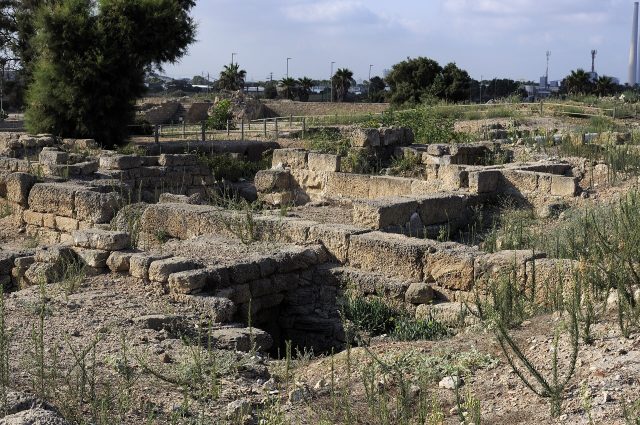
The harbor itself was an engineering marvel of its time. Herod’s builders constructed an artificial breakwater by sinking wooden frames into the sea and filling them with concrete that hardened underwater—a technique so advanced it wouldn’t be replicated for centuries. The result was a sheltered anchorage divided into sections: an outer harbor for larger ships, an inner basin for smaller vessels, and a secure, enclosed area where goods could be unloaded safely. Around it stretched warehouses, customs houses, and administrative buildings, their foundations still visible today. The most striking remnant of this era is the theater, one of the oldest in the region, which still hosts performances. Sitting on its stone seats as the sun sets over the sea, it’s easy to imagine the echoes of ancient plays and political debates that once filled the air.
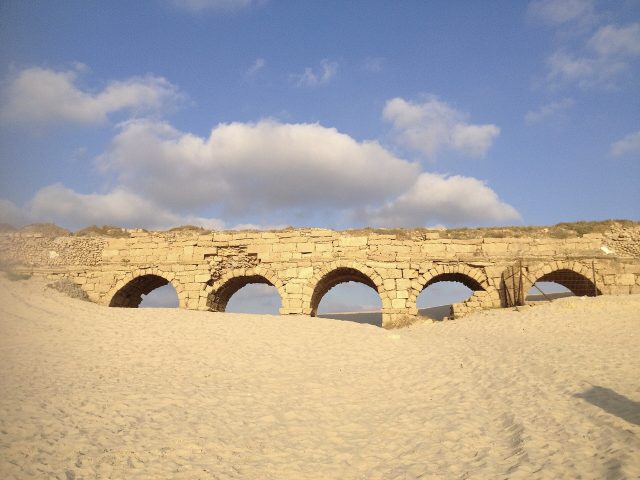
Herod didn’t stop at the harbor. Caesarea was designed to be a jewel of the empire, a city that would reflect his power and sophistication. Aqueducts stretched for miles to bring fresh water from the Carmel Mountains, their arched remains now a striking feature along the coastline. Palaces, temples, and public squares dotted the landscape, though little remains of their former grandeur. The most enduring symbol of Herod’s vision is the temple dedicated to Augustus and Rome, a reminder of the city’s role as a bridge between the Roman world and the East. Even in its ruined state, the temple’s scale hints at the opulence that once defined Caesarea.
The city’s significance evolved over the centuries. After the destruction of Jerusalem in 70 CE, Caesarea became the administrative capital of the Roman province of Judea. It was here that the apostle Peter preached, and where Paul was imprisoned before his journey to Rome. The harbor continued to thrive under Byzantine rule, though its golden age had passed. Earthquakes and shifting sands gradually took their toll, and by the Middle Ages, Caesarea had dwindled to a small settlement, its once-bustling port now silted and forgotten.
What makes Caesarea so compelling today is how seamlessly the past blends with the present. The ruins aren’t cordoned off as relics; they’re part of the landscape, scattered among modern cafes, beach umbrellas, and the laughter of children playing in the sand. The water here is remarkably clear, its turquoise hue revealing the outlines of submerged structures beneath the surface. Archaeologists still work among the stones, uncovering artifacts that piece together the daily lives of those who once walked these streets. Each discovery adds another layer to the city’s story, though much of it remains tantalizingly out of reach.
The atmosphere in Caesarea is anything but static. In the summer, the ancient amphitheater comes alive with concerts, the music drifting over the ruins as the Mediterranean breeze carries it out to sea. Locals and visitors alike gather on the beach, picnicking under the shade of the aqueduct or exploring the remnants of the harbor walls. Winter brings a quieter rhythm, the crowds thinning out, leaving the ruins to those who prefer to wander without distraction. It’s in these moments, with the sound of waves lapping against the stones, that the city’s history feels most tangible.
There’s something deeply human about Caesarea. It doesn’t demand reverence or awe; it simply exists, as it has for millennia. The same stones that once bore the footsteps of Roman soldiers, merchants, and philosophers now support the weight of modern life. You don’t need to strain your imagination to picture the past here—it’s all around you. The horizon is still dotted with boats, just as it was two thousand years ago, and the sea hasn’t changed its color or its mood. The city doesn’t tell its story; it lets you step into it, to feel the weight of time in the cool touch of ancient stone or the salt on your skin.
Caesarea is a place where history isn’t preserved—it’s lived. It’s in the way the light catches the fragments of mosaic on the ground, or how the wind carries the scent of the sea through the ruins. It’s in the way the past and present coexist without conflict, each enhancing the other. Whether you come for the archaeology, the beaches, or simply the chance to stand where empires once converged, Caesarea offers something rare: a sense of continuity, a reminder that the world has always been a place of movement, change, and enduring beauty.