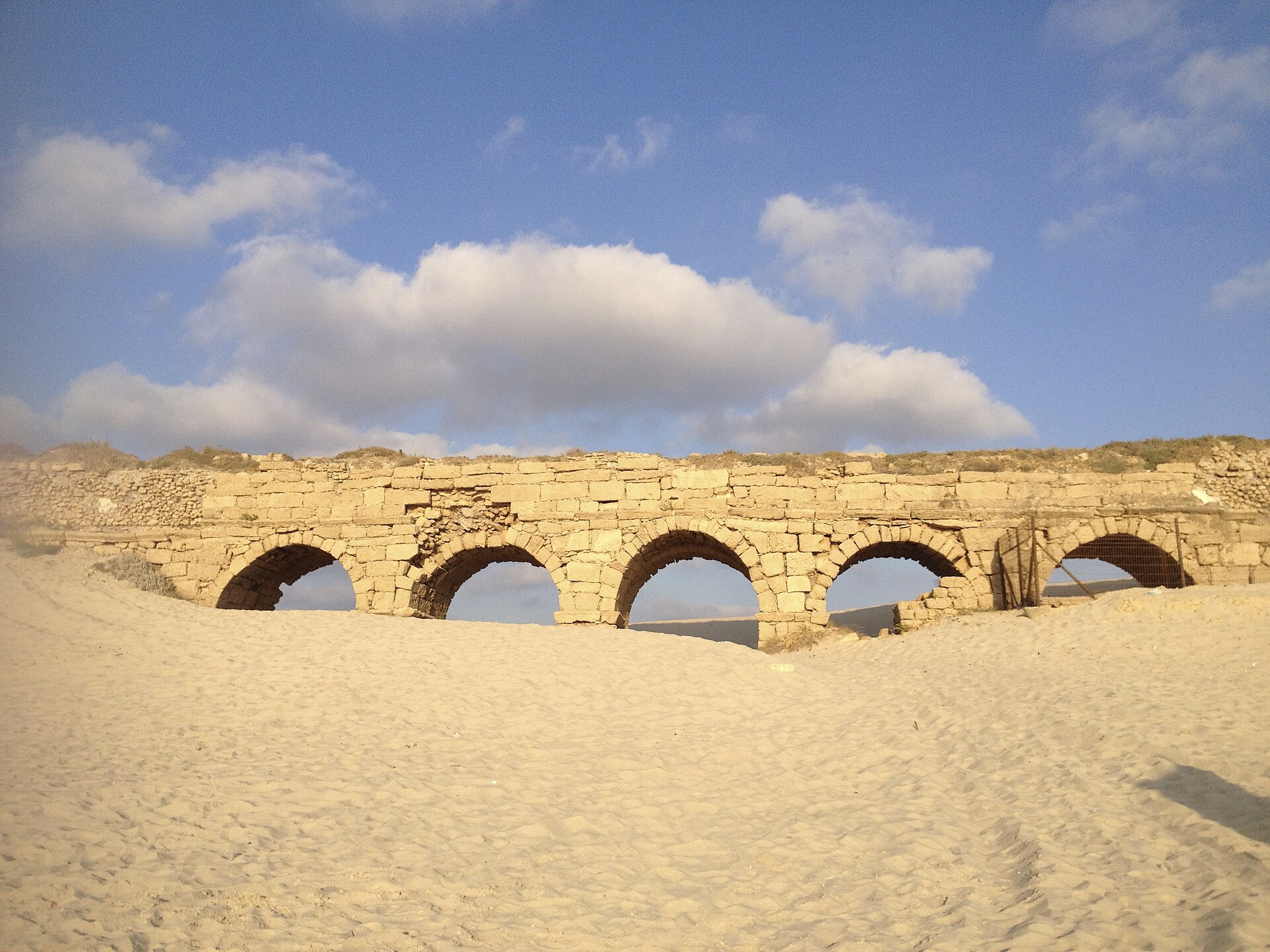
Caesarea’s aqueduct is one of those rare places where history doesn’t just feel close—it feels alive. Stretching along the Mediterranean shore, its weathered arches stand as a quiet testament to the ambitions of empires that once shaped this land. Built to sustain a city that was meant to rival Alexandria, the aqueduct was more than just a feat of engineering; it was a lifeline, carrying water from the springs of Mount Carmel to a bustling port that thrived under Roman and Byzantine rule.
The story of the aqueduct begins with Herod the Great, who envisioned Caesarea as a grand maritime hub. In the first century BCE, he commissioned its construction, and Roman engineers set to work designing a system that would deliver water over dozens of kilometers. The original structure was a single channel, but as the city grew, so did its needs. By the height of Roman rule, a second tier was added, doubling the aqueduct’s capacity. Later, during the Byzantine era, a third channel was incorporated, turning the structure into a layered record of changing technologies and urban expansion. Walking along its length today, you can almost see the different eras stacked upon one another, each layer telling its own part of the story.
What makes the aqueduct remarkable isn’t just its scale but its endurance. Built from local limestone and held together with a mix of lime and volcanic ash, the structure was designed to last. The arches, though simple in form, were engineered with precision, each stone cut to bear the weight of flowing water without the aid of modern machinery. The aqueduct wasn’t a straight line—it curved with the landscape, relying on gravity to keep the water moving. A miscalculation in the slope could have spelled disaster, yet for centuries, it functioned flawlessly, supplying a city that was home to tens of thousands.
Today, the aqueduct runs parallel to the beach, its ancient stones contrasting with the modern shoreline. The sea breeze that sweeps across its arches is the same one that would have brushed past Roman soldiers, Byzantine merchants, and Crusaders who once walked this same path. There’s something humbling about standing here, knowing that for two thousand years, people have looked at these same walls, heard the same waves, and felt the same salt in the air. The aqueduct hasn’t just survived—it has become part of the landscape, as much a feature of Caesarea as the sea itself.
The best time to visit is late afternoon, when the setting sun turns the limestone golden and the shadows of the arches stretch long across the sand. In summer, the path along the aqueduct is a favorite for evening strolls, while in winter, when storms churn the Mediterranean, the structure takes on a different kind of grandeur. It’s easy to imagine how it must have looked in its prime, with water rushing through its channels, sustaining a city that was once one of the most important in the region. Yet despite its historical significance, the aqueduct doesn’t feel like a museum exhibit. There are no crowds pressing in, no guided tours rushing past—just the quiet rhythm of the waves and the occasional visitor pausing to take it all in.
What’s striking about the aqueduct is how unassuming it is. There are no grand plaques explaining its history, no reconstructed sections to give a sense of scale. It simply exists, as it has for centuries, letting the stones speak for themselves. The lack of modern interventions means you’re left to piece together its story from what you see—the way the arches lean slightly with age, the patches where later repairs are visible, the way the structure seems to rise from the sand as if it grew there naturally. It’s a place that rewards curiosity, where the more you look, the more you notice.
In many ways, the aqueduct is a reminder of how fleeting human achievements can be. The city it once served is now a ruin, its harbor long since silted up, its grand buildings reduced to foundations. Yet the aqueduct remains, not as a relic of the past, but as something that still feels alive. It doesn’t demand attention; it doesn’t need to. It’s enough that it’s here, a silent witness to the rise and fall of empires, a bridge between the ancient world and the present. And perhaps that’s why it lingers in the memory long after you’ve left—because it doesn’t just show you history, it lets you touch it.