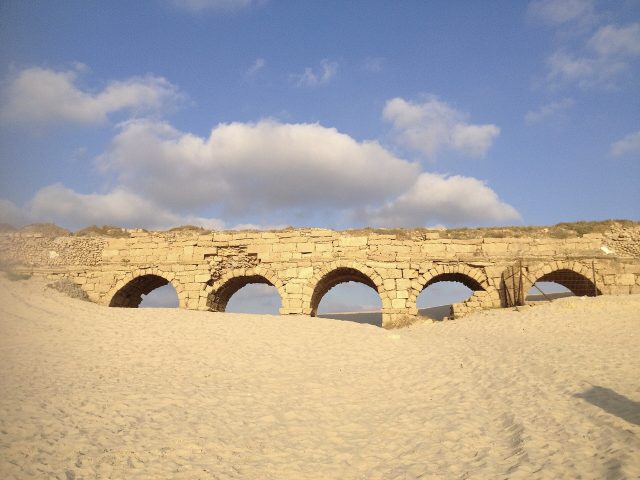
Caesarea is one of those rare places where history isn’t just preserved in stone—it lingers in the air, in the salt spray of the Mediterranean, in the way the light catches the ruins at dusk. Nestled along Israel’s coast between Tel Aviv and Haifa, this ancient city was founded in the 1st century BCE by King Herod the Great, a ruler whose ambition knew few bounds. Named in honor of Rome’s Emperor Augustus, Caesarea was more than a city; it was a statement. Herod, ever the master of spectacle, chose a stretch of barren shoreline and transformed it into a marvel of the ancient world—a port, a palace, a theater, and an aqueduct system that would have rivaled anything in Rome itself. For Herod, Caesarea was proof of his loyalty to the empire, a gateway between East and West, and a legacy carved into the very earth.
The heart of Caesarea was its harbor, a feat of engineering so audacious it still feels improbable today. In an era when natural harbors dictated trade routes, Herod built his own, defying the open sea with massive breakwaters constructed from hydraulic concrete—a Roman innovation that hardened underwater. The port became a bustling hub, funneling goods from Egypt, Syria, and even distant India into the empire’s veins. Ships laden with spices, silk, and grain once docked here, their masts swaying against the same horizon that now frames the skeletal remains of the ancient moles. The water is startlingly clear, and on calm days, you can still make out the submerged outlines of the harbor’s foundations, a ghostly echo of its former grandeur.
The city’s theater, carved into the hillside, is another place where the past feels almost tangible. Built to seat four thousand, it hosted everything from gladiatorial combats to Greek tragedies, its acoustics designed to carry a whisper to the farthest rows. Today, the stage is occasionally brought back to life with concerts and performances, the same stones vibrating with music as they once did with the roar of the crowd. Sitting in the upper tiers, you can look out over the Mediterranean, the view unchanged in two millennia. It’s easy to imagine the audience of Roman officials, merchants, and soldiers, their attention fixed on the spectacle below, the sea breeze carrying the scent of salt and distant lands.
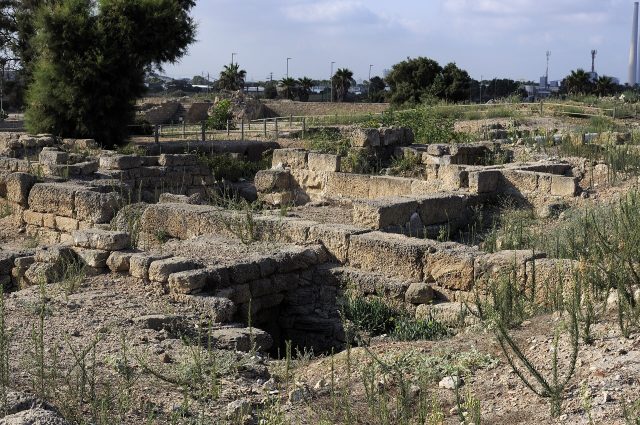
Nearby, the ruins of Herod’s palace cling to a promontory jutting into the sea. Little remains of its former opulence—just the outlines of walls, fragments of mosaic floors, and the occasional column still standing against the wind. Yet even these remnants hint at the palace’s original purpose: a display of power, a place where Herod entertained foreign dignitaries and hosted lavish feasts. Archaeologists have uncovered traces of a freshwater pool, rumored to have been filled with seawater for breeding exotic fish. If true, it’s a small but telling detail—Herod wasn’t just a builder of cities, but a man who bent nature to his will, reshaping the coastline itself to suit his vision.
Caesarea’s story is deeply entwined with the rise of Christianity. According to the New Testament, it was here that Pontius Pilate, the Roman prefect of Judea, passed judgment on Jesus. Centuries later, the city became a center of early Christian scholarship, home to figures like Origen and Eusebius of Caesarea, whose writings shaped the faith’s intellectual foundations. By the Byzantine era, Caesarea had grown into a major religious hub, its bishops playing key roles in church councils. The remnants of Byzantine churches and intricate mosaics scattered across the site are quiet witnesses to this chapter of history, their faded colors still hinting at the devotion they once inspired.
The Middle Ages brought turmoil to Caesarea. After the Arab conquest in the 7th century, the city changed hands repeatedly, its strategic port coveted by empires. The Crusaders, who seized it in the 12th century, fortified its walls and expanded its harbor, turning it into a key stronghold of their kingdom. But in 1265, the Mamluk sultan Baybars laid siege to the city, reducing it to rubble. For centuries afterward, Caesarea was little more than a forgotten ruin, its stones repurposed by local villagers, its harbor silted up and abandoned. It wasn’t until the 19th century that a small Arab settlement took root here, and only in the mid-20th century did large-scale excavations begin to peel back the layers of time.
Today, Caesarea is a place of contrasts. The archaeological park, with its crumbling columns and sun-bleached ruins, sits alongside one of Israel’s most exclusive resort enclaves. Luxury villas, manicured golf courses, and high-end hotels now occupy the land where Roman legions once marched. Yet the past isn’t entirely overshadowed by modernity. Ancient stones are embedded in the walls of new buildings, and the occasional archaeological dig still turns up fragments of pottery or coins, each one a thread in the city’s long tapestry. Walking along the waterfront, you might stumble upon a mosaic floor half-buried in the sand or a stretch of aqueduct still standing after two thousand years, a silent testament to the hands that built it.
What makes Caesarea special isn’t just its history, but the way it feels alive. The ruins aren’t static relics; they’re part of a landscape that breathes. The wind carries the sound of waves crashing against the breakwaters, the same waves that once rocked Roman galleys. The theater still hosts performances, the same sea breeze rustling through the crowd as it did in antiquity. There’s a sense of continuity here, a thread connecting the past to the present. It’s a place where you can sit on the edge of a 2,000-year-old pier and watch the sunset, the same sun that once set over Herod’s kingdom.
Caesarea doesn’t demand your awe—it earns it quietly. There are no grand spectacles here, no over-the-top reconstructions. Instead, it offers something rarer: the chance to step into a story that’s still unfolding. The ruins are just the beginning. The real magic lies in the way the light falls on the stones, in the way the sea has worn them smooth over centuries, in the way the past and present coexist without fanfare. It’s a place where history isn’t just remembered; it’s felt.