Place de la République in Arles is one of those rare spots where a city reveals itself slowly, like the pages of a well-worn book. Tucked in the heart of the historic quarter, it carries none of the hurried energy of tourist hubs. Instead, it feels like a quiet stage where centuries have left their mark—each building, each cobblestone holding stories of merchants, pilgrims, artists, and soldiers who passed through over the ages. There’s something about the way the light falls here, the way the air carries the scent of the Rhône and the distant lavender fields, that makes you pause. It’s not just a square; it’s a place where the past lingers, almost tangible, in the way the shadows stretch across the pavement.
Arles has always been a city of layers, and Place de la République is where many of them converge. Long before it became the square it is today, this was the Roman forum of Arelate, the political and social heart of the colony. Back then, it would have buzzed with debate, trade, and the rituals of daily life—citizens climbing the steps of temples to honor their gods, orators holding forth in the open air. Over time, the forum’s grandeur faded, but the space remained central to the city’s life. In the Middle Ages, it hosted fairs and tournaments, later becoming a stage for public executions and sermons. Each era left its imprint, and if you look closely, you can still sense those shifts in the worn stones beneath your feet.
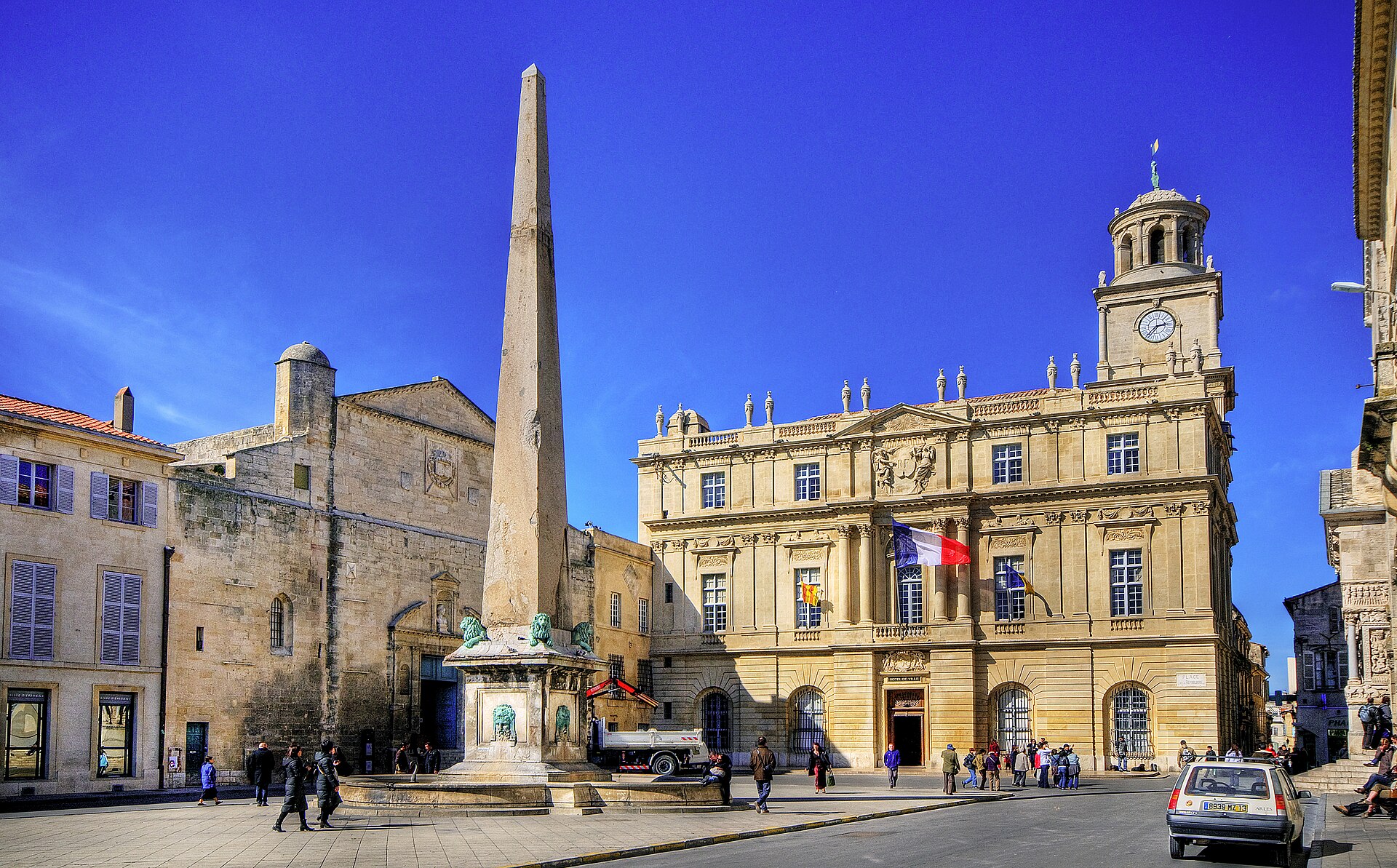
The architecture here tells its own story. The most imposing structure is the 17th-century town hall, its facade stern and symmetrical, with tall windows and the city’s coat of arms above the entrance. Nearby, the bell tower of Saint-Trophime rises above the square, its Romanesque carvings depicting biblical scenes in weathered stone. The church itself is one of the finest examples of the style in Provence, its portal a masterpiece of medieval craftsmanship. Then there are the smaller, more modest buildings—houses with shutters painted in faded blues and greens, their colors softened by the sun. They might not command attention like the grander structures, but they give the square its character, its lived-in warmth.
At the center of it all stands the obelisk, a relic from Arles’ Roman past. Originally part of the ancient theater’s stage decor, it was moved here in the 19th century as a nod to the city’s imperial history. Tourists often gather around it for photos, while locals barely glance its way—it’s just another part of the scenery. But if you stand close enough, you can almost hear the echoes of the past: the murmur of the crowd, the clatter of sandals on stone, the distant sound of a play unfolding in the theater down the hill.
Life on the square moves at its own unhurried pace. In the shade of the plane trees, elderly men play pétanque, their metal balls clicking softly as they land. In the summer, the square transforms into an open-air venue for concerts and art exhibitions; in winter, it hosts a Christmas market, its stalls glowing under strings of lights. The cafés at the edges of the square are where you’ll find artists sketching, writers scribbling in notebooks, or simply visitors soaking in the atmosphere. It’s easy to imagine Van Gogh here, sitting at one of those tables, his eyes tracing the play of light on the buildings.
The square changes with the time of day. In the early morning, the first sunlight slants across the facades, turning the stone golden. By midday, the shadows shrink, and the air fills with the scent of fresh bread from the nearby bakery and the faint, sweet aroma of lavender drifting in from the countryside. As evening falls, the streetlamps flicker to life, casting a warm glow over the cobblestones. It’s then that the square feels most alive—not with noise, but with a quiet, almost meditative energy. Time here doesn’t rush; it settles, like the Rhône flowing just beyond the city’s edge.
For many visitors, Place de la République is the starting point for exploring Arles. From here, the narrow streets of the old town branch out like veins, leading to hidden courtyards, artisan workshops, and tiny boutiques selling Provençal fabrics and ceramics. You could spend hours wandering, or you could do nothing at all—just take a seat on one of the benches and watch the square breathe. Listen to the murmur of conversations in French, the occasional burst of laughter, the distant chime of the church bells. The dialect here is softer than in the north, the pace slower, the people more inclined to linger over a coffee or a glass of wine.
Arles doesn’t try to impress like Paris or dazzle like Marseille. It’s a city that exists on its own terms, unhurried and unpretentious. Place de la République embodies that spirit. It’s not a place of grand monuments or dramatic vistas, but of quiet moments and subtle beauty. The buildings don’t tower over you; they invite you to look closer, to notice the details—the way the light catches the carvings on Saint-Trophime’s portal, the way the shutters on the old houses creak in the wind. Maybe that’s why Van Gogh was drawn here. In Arles, time doesn’t just pass; it lingers, and the square is where you feel it most.