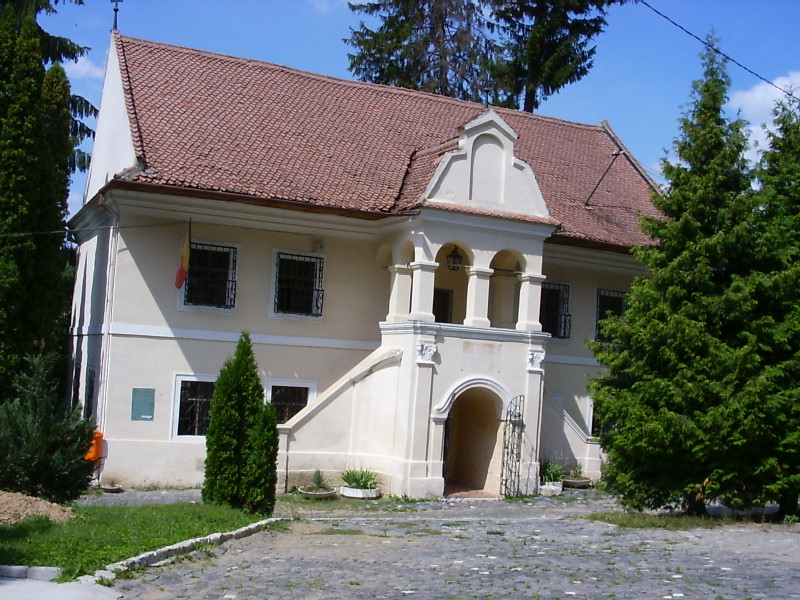
The First Romanian School in Brașov is one of those rare places where time seems to have paused, leaving behind the quiet echoes of a distant past. Tucked within the grounds of St. Nicholas Church in the old Șchei district, it sits among narrow cobblestone streets and stone houses that still carry the weight of medieval life. This was a time when Romania did not yet exist as a unified country, and these lands belonged to Transylvania, then under Hungarian influence. Far from the great cultural centers of Europe, the people here clung to their language and traditions, and the school became a symbol of that quiet resistance.
The building itself is modest, its low ceilings and wooden beams giving it the feel of a place that has always been more about substance than grandeur. The first records of the school date back to 1556, when it began teaching children to read and write in Romanian—a rarity in an era when education was a privilege, and instruction in one’s native tongue even more so. Most schools in the region taught in Latin or Hungarian, making this an act of cultural defiance. Over time, the school grew into a center of learning, where religious texts were translated, books were printed, and knowledge was passed down in a language that might otherwise have faded.
Inside, the school feels less like a museum and more like a living archive. The wooden desks, ink pots, and yellowed books are all original, their worn surfaces telling stories of generations of students. One of the most significant artifacts is the first Romanian printed book, produced right here in Brașov in 1559. A collection of religious texts printed in Cyrillic, it marked a turning point for Romanian culture, proving that the language could thrive even in a region where it was not dominant. The school wasn’t just a place of learning; it was a printing house, a hub of intellectual life in a time when such things were rare.
The connection between the school and St. Nicholas Church is impossible to ignore. The church, one of the oldest Orthodox places of worship in Transylvania, dates back to the 14th century. Its walls have witnessed centuries of change—wars, shifting borders, and the quiet resilience of a community that refused to disappear. Together, the church and school formed the heart of Romanian life in Brașov, a city where Hungarians and Germans were the majority. For the Romanian population here, this was a sanctuary of faith and education, a place where identity could be preserved against the odds.
Today, the First Romanian School remains a place of quiet reflection. There are no crowds, no grand displays—just the simple, unassuming presence of history. Visitors can wander through the rooms, handle old books, and even try their hand at writing with a quill, just as students did centuries ago. The experience is less about spectacle and more about connection, a chance to step into the shoes of those who came before. The school’s courtyard, with its benches and dappled sunlight, invites lingering, a reminder of how education once took place under open skies.
What makes this place truly remarkable is its role in shaping Romanian culture. In an era when many European peoples were fighting for the right to speak and write in their own languages, this school was a beacon. It helped lay the foundations of the Romanian literary language and fostered a sense of national identity long before Romania existed as a country. Its graduates carried what they learned here across Transylvania, spreading literacy and ideas in a time when both were precious.
The building has changed little over the centuries. While it has undergone restorations, the care taken to preserve its original character is evident. The whitewashed walls, the creaking floorboards, the faint scent of old paper—all of it feels authentic, as if the past is still present in the smallest details. It’s not a place that demands attention; rather, it rewards those who take the time to look closely, to imagine the children who once sat at these desks, learning to read in a language that was theirs alone.
Visiting the First Romanian School is a reminder that history isn’t just about grand events or famous names. It’s also about the quiet, persistent efforts of ordinary people to hold onto what matters. This school was never a place of power or wealth, but it was a place of resilience. In its own unassuming way, it helped ensure that a language, a culture, and a way of life would endure. That’s why it still feels alive today—not as a relic, but as a testament to the enduring human need to pass knowledge forward.