St. Nicholas Church in Brașov is one of those rare places where time seems to pause, allowing the past to breathe. Perched on a gentle hill in the Șchei district, it overlooks a neighborhood of narrow, winding streets lined with red-tiled roofs and houses that have stood for centuries. The air here carries the scent of woodsmoke and freshly baked bread, a quiet reminder of the rhythms of life that have endured through generations. Far from the bustle of the city center, Șchei feels like a world apart, where the echoes of history are not just preserved but still alive in the daily lives of those who pass through its streets.
The church’s origins trace back to the 14th century, when a small wooden chapel stood on this site. Brașov was already a vital trading hub, a crossroads between Transylvania and Wallachia, and the local Romanian Orthodox community needed a place of worship to call their own. In 1495, construction began on a stone church to replace the old chapel, though the work stretched over decades. By the mid-16th century, the building had taken on the form that largely remains today—a structure that, while unassuming in appearance, carries the quiet dignity of late Gothic architecture. Its thick walls and arched windows speak of a time when faith and fortitude were intertwined, when every stone laid was a testament to the community’s determination to endure.
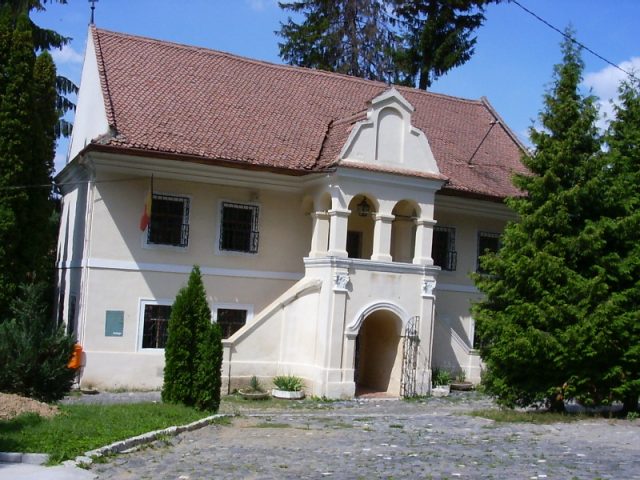
The 17th century marked a turning point for St. Nicholas Church, as it became not only a spiritual center but also a cradle of Romanian culture in the region. At a time when Hungarian and German influences dominated Transylvania, the church established the first Romanian school in the area, where children were taught reading, writing, and the fundamentals of Orthodox liturgy. The school played a crucial role in preserving the Romanian language and identity, offering a counterbalance to the prevailing cultural currents. The original schoolhouse still stands beside the church, its weathered facade bearing a plaque commemorating those who founded it. Walking past it, one can almost hear the murmur of young voices reciting lessons centuries ago.
Inside the church, the contrast between its modest exterior and the richness of its interior is striking. The walls and vaulted ceilings are covered in vibrant frescoes, painted in the traditional Orthodox style but infused with local artistic sensibilities. The scenes depict saints and biblical stories in bold, vivid colors, their details worn by time but still vivid enough to draw the eye. The iconostasis, a masterful example of Baroque woodcarving from the 18th century, separates the altar from the nave. Its intricate designs and gilded accents reflect the devotion of the parishioners who contributed to its creation—merchants, craftsmen, and ordinary townspeople who saw the church as a sacred trust. Each icon, each carved flourish, tells a story of faith and generosity.
Throughout its history, St. Nicholas Church has been more than a place of worship; it has been a symbol of resilience. During periods of oppression, when the Romanian Orthodox Church faced restrictions under Austro-Hungarian rule, the church remained a sanctuary for language, culture, and faith. Priests continued to hold services in secret, and forbidden Romanian books were hidden within its walls. Even under communist rule in the 20th century, when religious institutions were suppressed, the community fought to keep the church open. Today, it still serves as an active parish, and on feast days, the sound of ancient hymns fills the air, sung by voices that have carried on a tradition spanning centuries.
Beside the church, a small museum offers a glimpse into the lives of Brașov’s Romanian community over the ages. The collection includes handwritten Gospels, intricately embroidered priestly vestments, and even the school notebooks of children who once studied at the parish school. Each item, whether a tarnished silver chalice or a yellowed page of scripture, is a fragment of a larger story—one of devotion, struggle, and perseverance. The museum is modest in size, but its exhibits feel deeply personal, as if the people who once used these objects might step back into the room at any moment.
The Șchei district itself is a place worth lingering in. Unlike the more tourist-heavy areas of Brașov, it retains a sense of quiet authenticity. The houses, with their carved shutters and small gardens, seem frozen in time, their facades bearing the marks of generations. The streets wind upward toward an old cemetery, where the graves of priests, teachers, and other notable figures from Brașov’s past lie beneath weathered headstones. The names inscribed in Romanian, Hungarian, and German serve as a reminder of the city’s layered history, where different cultures coexisted, sometimes uneasily, but always leaving their mark.
St. Nicholas Church is not a grand cathedral designed to impress visitors. It does not demand attention, yet its quiet presence is its greatest strength. This is a place where history is not just preserved in stone and paint but lives on in the rituals of daily worship, in the rustle of pages from old books, and in the voices of the faithful who gather here. To truly appreciate it, one should visit without haste—perhaps in the early morning, when the first light spills over the rooftops of Șchei, or in the evening, when the stars begin to appear above the church’s steeple. In those moments, it becomes clear that this is not just a landmark but a living piece of Brașov’s soul.