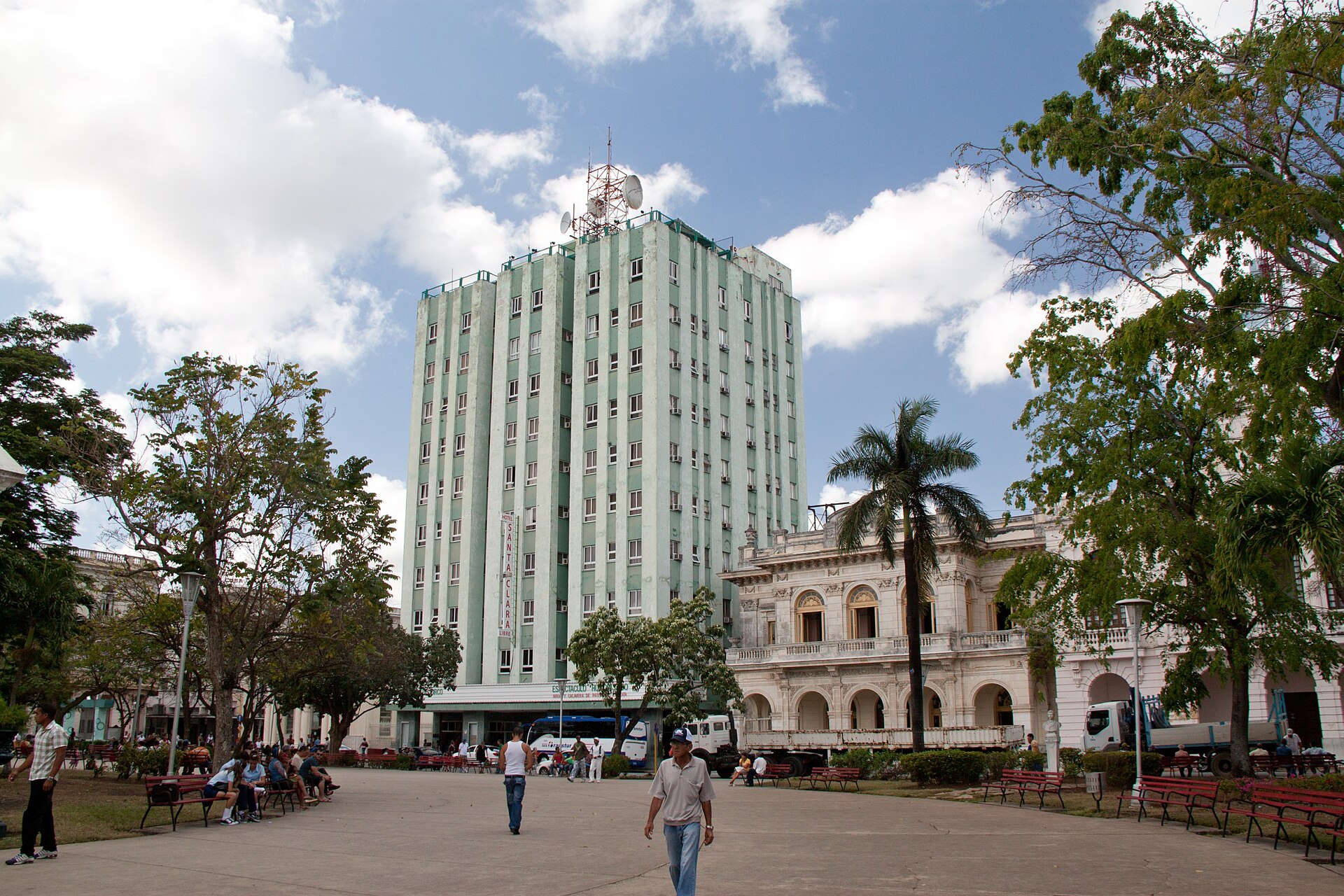
Santa Clara’s Parque Vidal is the kind of place where the city’s rhythm slows to a gentle pulse. It sits at the heart of the town, a broad, leafy square framed by pastel-colored buildings that have watched over generations of Cubans going about their daily lives. Unlike the grand plazas of Havana or Santiago, this one feels lived-in, almost intimate, as if every bench and corner has a story to tell. Locals call it simply *el parque*, as if there were no need for anything more—because for them, there isn’t.
The square’s origins trace back to the late 19th century, when Santa Clara was still a modest provincial town. It was designed as a public space where people could gather, trade, and escape the heat under the shade of royal palms and ceiba trees. Over time, it became the stage for the city’s most important moments—political rallies, festivals, and even the occasional impromptu concert. The architecture around it reflects this history, with buildings that blend Spanish colonial styles with the more ornate touches of early 20th-century Cuban design. The most striking of these is the Teatro La Caridad, a neoclassical theater that still hosts performances today, its white facade and grand columns standing as a reminder of the city’s cultural ambitions.
What makes Parque Vidal special is how it balances history with the present. In the mornings, elderly men gather to play dominoes under the trees, their laughter mixing with the clink of tiles on wooden tables. By afternoon, students from the nearby university sprawl on the grass, books in hand, while children chase each other around the central fountain. The square is a microcosm of Cuban life—unhurried, social, and deeply rooted in community. Even the stray dogs seem to know their place here, napping in patches of sunlight without a care.
The park’s layout is deceptively simple. A wide pedestrian walkway cuts through the center, leading to a small bandstand where, on weekends, musicians sometimes play son or trova, the traditional Cuban folk music. The bandstand itself is a modest structure, but it’s where some of the city’s most beloved performances have taken place. Around it, benches are arranged in neat rows, though no one really sits in them in an orderly fashion. Instead, people cluster in groups, sharing stories or simply watching the world go by.
One of the most enduring features of Parque Vidal is its role as a meeting point. For decades, it’s been where friends arrange to see each other, where lovers steal a moment together, and where families come to unwind after a long week. There’s a sense of continuity here, as if the square has always been the natural center of gravity for Santa Clara. Even the buildings around it seem to lean in slightly, as if drawn to the life unfolding below.
The square also holds a quiet political significance. Santa Clara was a key battleground during the Cuban Revolution, and while Parque Vidal itself wasn’t the site of major clashes, it became a symbol of the city’s revolutionary spirit. Today, a statue of Che Guevara stands just a few blocks away, but the park remains a place where people gather not for grand gestures, but for the small, everyday acts that define a community. It’s where a street vendor might set up a cart selling guarapo, the sweet sugarcane juice, or where a group of musicians might start playing without warning, drawing a crowd.
In the evenings, the square takes on a different character. The heat of the day gives way to a cooler breeze, and the lights from the surrounding buildings cast a warm glow over the pavement. Couples stroll arm in arm, while older men sit on the benches, smoking cigars and debating everything from baseball to politics. The atmosphere is relaxed, almost dreamlike, as if time itself has softened around the edges.
What’s striking about Parque Vidal is how little it has changed over the years. While other Cuban cities have seen modernization or neglect reshape their public spaces, this square has remained remarkably intact. The buildings are well-worn but cared for, the trees still provide ample shade, and the sense of belonging is as strong as ever. It’s not a place for tourists to rush through, snapping photos before moving on. It’s a place to sit, to observe, and to let the rhythm of Santa Clara seep in.
For visitors, the park offers a glimpse into the soul of the city. It’s where you can see Cuba as Cubans do—not as a postcard or a museum exhibit, but as a living, breathing place. Whether you spend an hour or an afternoon here, the square leaves an impression that lingers long after you’ve left. It’s not just a park; it’s the heartbeat of Santa Clara.