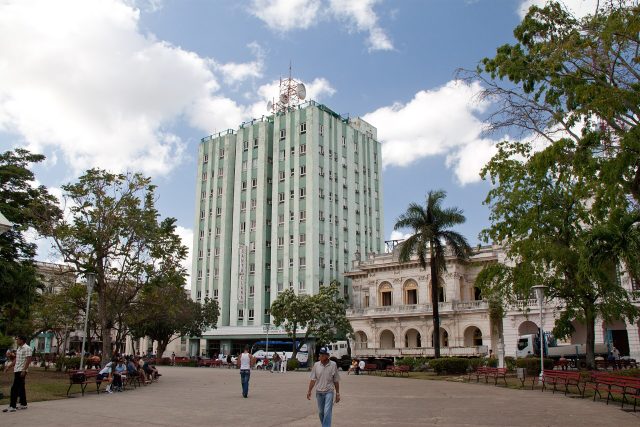
Santa Clara’s Parque Leoncio Vidal is one of those places where the city’s past and present quietly overlap, almost without notice. It sits at the heart of the town, not as a grand monument or a tourist spectacle, but as a living square where locals gather, children play, and the rhythm of daily life unfolds against a backdrop of colonial architecture and revolutionary history. The park has been here for centuries, though its name and appearance have shifted with the times. Originally laid out in the 17th century, it began as a simple plaza, a common feature in Spanish colonial towns, where markets, religious processions, and public gatherings took place. Over the years, it evolved into the social core of Santa Clara, a place where people came to meet, debate, and simply pass the time.
The park’s current name honors Leoncio Vidal, a young Cuban independence fighter who died in 1896 during the struggle against Spanish rule. His statue stands near the center of the square, a modest but enduring reminder of the city’s role in Cuba’s long fight for sovereignty. Vidal was only 23 when he was killed, and his death became a symbol of the sacrifices made by those who fought for an independent Cuba. The statue itself is unassuming—more a quiet tribute than a grand memorial—but it anchors the park in a specific moment of history, one that still resonates in Santa Clara’s identity.
Surrounding the park are some of the city’s most notable buildings, each with its own story. The Teatro La Caridad, a neoclassical theater built in the late 19th century, stands on the eastern side. Funded by a wealthy local widow, Marta Abreu, the theater was intended to serve as both a cultural hub and a charitable institution, with profits supporting education and social programs. Its facade is elegant but understated, with columns and arched windows that hint at the grandeur inside. Nearby, the Museo de Artes Decorativas occupies a former mansion, its rooms filled with period furniture, porcelain, and art that offer a glimpse into the lives of Cuba’s 19th-century elite. The building itself is a fine example of colonial architecture, with high ceilings, intricate woodwork, and a courtyard that once would have been the center of domestic life.
On the opposite side of the park, the Catedral de Santa Clara de Asís rises above the square. Built in the early 20th century, the cathedral is a mix of styles, with a neoclassical exterior and a more ornate interior that includes stained glass and a marble altar. Unlike many Cuban churches, which date back to the colonial era, this one is relatively young, reflecting the city’s growth in the decades after independence. The cathedral’s presence adds a spiritual dimension to the park, though it’s not the only place of worship nearby. Just a short walk away, the Iglesia del Buen Viaje, an older church with a simpler design, stands as a quieter counterpart, its whitewashed walls and modest bell tower blending into the surrounding streets.
What makes Parque Leoncio Vidal feel different from other Cuban plazas is its lack of pretense. There are no tourist stalls selling trinkets, no loud music or staged performances. Instead, the park feels like a natural extension of the city—a place where people come because it’s where they’ve always come. In the mornings, older men gather on the benches to play dominoes, their games accompanied by the clatter of tiles and the occasional burst of laughter. In the afternoons, students from the nearby university cut through the square on their way to class, their backpacks slung over their shoulders. On weekends, families stroll under the shade of the trees, and vendors sell ice cream or roasted peanuts from small carts. The park’s trees—tall, leafy ceibas and royal palms—provide a canopy that softens the tropical sun, making it a pleasant place to linger even in the heat of midday.
The park’s layout is simple: a central walkway lined with benches, surrounded by a perimeter of trees and flowerbeds. At night, the square is illuminated by old-fashioned street lamps, their warm glow casting long shadows across the pavement. The buildings around it take on a different character after dark, their facades lit up in a way that highlights their architectural details. The theater’s columns stand out sharply against the night sky, while the cathedral’s stained glass windows glow from within. It’s a quieter time in the park, when the crowds thin out and the pace slows down. Couples walk arm in arm, and the occasional musician might set up near the statue, playing a guitar or a tres for spare change.
Santa Clara itself is a city that wears its history lightly. Unlike Havana, with its grand boulevards and crumbling palaces, or Trinidad, with its perfectly preserved colonial streets, Santa Clara feels more lived-in, more ordinary. It’s a place where the past isn’t just preserved in museums or monuments but woven into the fabric of everyday life. Parque Leoncio Vidal embodies that quality. It’s not the kind of place that demands attention, but if you sit on one of its benches for a while, you start to notice the layers of history that have accumulated here—the colonial plaza that became a revolutionary landmark, the theater that once hosted opera and now screens Cuban films, the cathedral that still draws worshippers after a century.
The park also serves as a kind of crossroads for the city’s political and cultural identity. Just a few blocks away is the Che Guevara Mausoleum, one of Cuba’s most important revolutionary sites, where the remains of the Argentine-Cuban guerrilla leader are interred. The contrast between the two places is striking: the mausoleum is solemn and monumental, while the park is casual and unassuming. Yet they exist in the same city, part of the same story. Santa Clara was the site of one of the most decisive battles of the Cuban Revolution, when Che Guevara’s forces derailed an armored train carrying Batista’s troops, a victory that helped pave the way for the revolution’s success. The park, though not directly tied to that event, is still part of the city’s revolutionary legacy, a place where the ideals of independence and social change have been debated and celebrated for generations.
For visitors, Parque Leoncio Vidal is often just a stop on the way to somewhere else—a place to rest between sightseeing or grab a coffee at one of the nearby cafés. But if you take the time to look around, it reveals itself as something more. It’s a place where the past isn’t just remembered but still alive, where the stories of the city’s people—its fighters, its artists, its families—are told in the quiet details of daily life. The park doesn’t ask for admiration; it simply exists, as it has for centuries, as a gathering place for those who call Santa Clara home. And in that way, it offers a glimpse into the soul of the city itself.