The armored train monument in Santa Clara isn’t just a memorial—it’s where the Cuban Revolution feels tangible. On the outskirts of the city, where low hills roll into the distance and scattered trees stand against the sky, a battered train sits frozen in time. This isn’t a replica or a carefully restored exhibit. It’s the real thing: the armored train captured by rebel forces in December 1958, a pivotal moment in the fight against Batista’s regime. Under Che Guevara’s command, a small group of revolutionaries derailed the train by tearing up the tracks, then ambushed it from the hills. The victory at Santa Clara wasn’t just another battle—it was the turning point that hastened the dictatorship’s collapse.
The train itself is a relic of war, its steel-plated cars still bearing the scars of that day. Bullet holes pockmark the metal, and patches of rust spread like old wounds. In places, the armor has been torn away, revealing the raw edges beneath. Inside one of the cars, an exhibit tells the story of the battle through photographs, documents, and personal items—rifles, uniforms, and yellowed maps. Portraits of Che and his comrades line the walls, a reminder that this wasn’t just a military triumph but a symbolic one. It proved that determination could outweigh firepower, that a people, no matter how outgunned, could rewrite their fate.
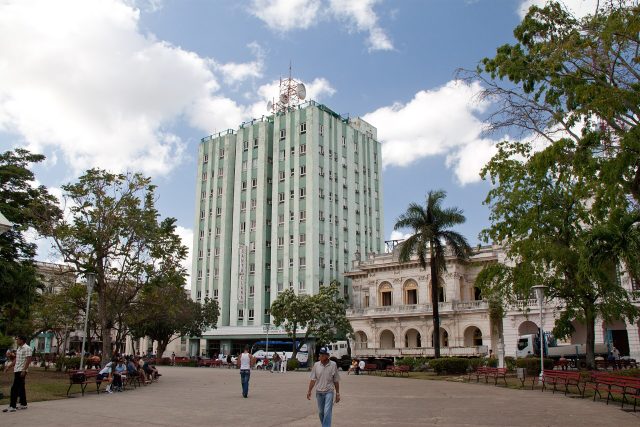
Santa Clara has always been a city of revolution, but nowhere is that legacy more vivid than here. The monument sits in a quiet park, where locals come to sit on benches and visitors wander the paths, trying to reconcile the peaceful present with the violent past. Unlike grand memorials with polished marble and solemn inscriptions, this place feels raw and unvarnished. The train, the earth, the rustling leaves—it all carries the weight of history without pretense. There’s no fanfare, just the quiet hum of a city that has learned to live with its ghosts.
The train’s story began long before it became a symbol of revolution. Built in the U.S. in the early 20th century, it was originally used for troop transport before Batista’s regime repurposed it as a mobile fortress. The plan was to crush the rebellion with overwhelming force, but the revolutionaries had other ideas. Knowing the train’s route, Che Guevara’s forces set a trap. They removed a section of track, and when the train screeched to a halt, they opened fire. After a brief but intense fight, the government soldiers surrendered. The train, once a tool of oppression, became a trophy of the revolution.
Today, the monument serves as both a tribute and a warning—a reminder of how quickly power can unravel when it loses the people’s trust. For Cubans, this place is sacred. Schoolchildren visit on field trips, veterans gather to share stories, and official ceremonies mark the revolution’s anniversaries. For outsiders, it’s a rare chance to step into a defining moment of the 20th century, to understand why Cuba still measures its identity by those events. The train doesn’t just commemorate history; it forces you to confront it.
The atmosphere around the monument is unassuming, almost casual. On weekends, you might find artists sketching the rusted cars at sunset, or elderly men sitting on benches, reminiscing about their youth. Sometimes, someone brings a guitar and plays revolutionary songs, the music blending with the wind in the trees. It’s as if time moves differently here, as if the past isn’t just remembered but still lingers in the air.
Santa Clara itself is a city of contrasts. On one hand, it’s a typical Cuban provincial town—crumbling colonial buildings, bustling markets, streets where life moves at its own unhurried pace. On the other, it’s a place forever tied to revolution, where history isn’t confined to textbooks but spills into the streets. The armored train isn’t the only monument here, but it’s the most visceral. It doesn’t feel like a museum piece; it feels like a living artifact, a piece of the past that refuses to be forgotten.
Visiting the monument is simple. There are no tickets, no guided tours, no rigid rules. You can walk right up to the train, run your fingers over the bullet-riddled metal, peer inside the cars. If you ask, locals might share their own versions of the story—some passed down through families, others shaped by personal experience. That’s part of the place’s charm. It doesn’t offer a single narrative; it invites you to piece together the past for yourself.
For anyone curious about Cuba’s history, the armored train is a must-see. It’s less famous than the Che Guevara Mausoleum in the city center, but that’s precisely why it resonates. There’s no grandeur here, no polished marble or lofty inscriptions. Just rust, earth, and the quiet persistence of memory. It’s not a place for hero worship, but for reflection—for understanding what revolution really meant, in all its grit and humanity.