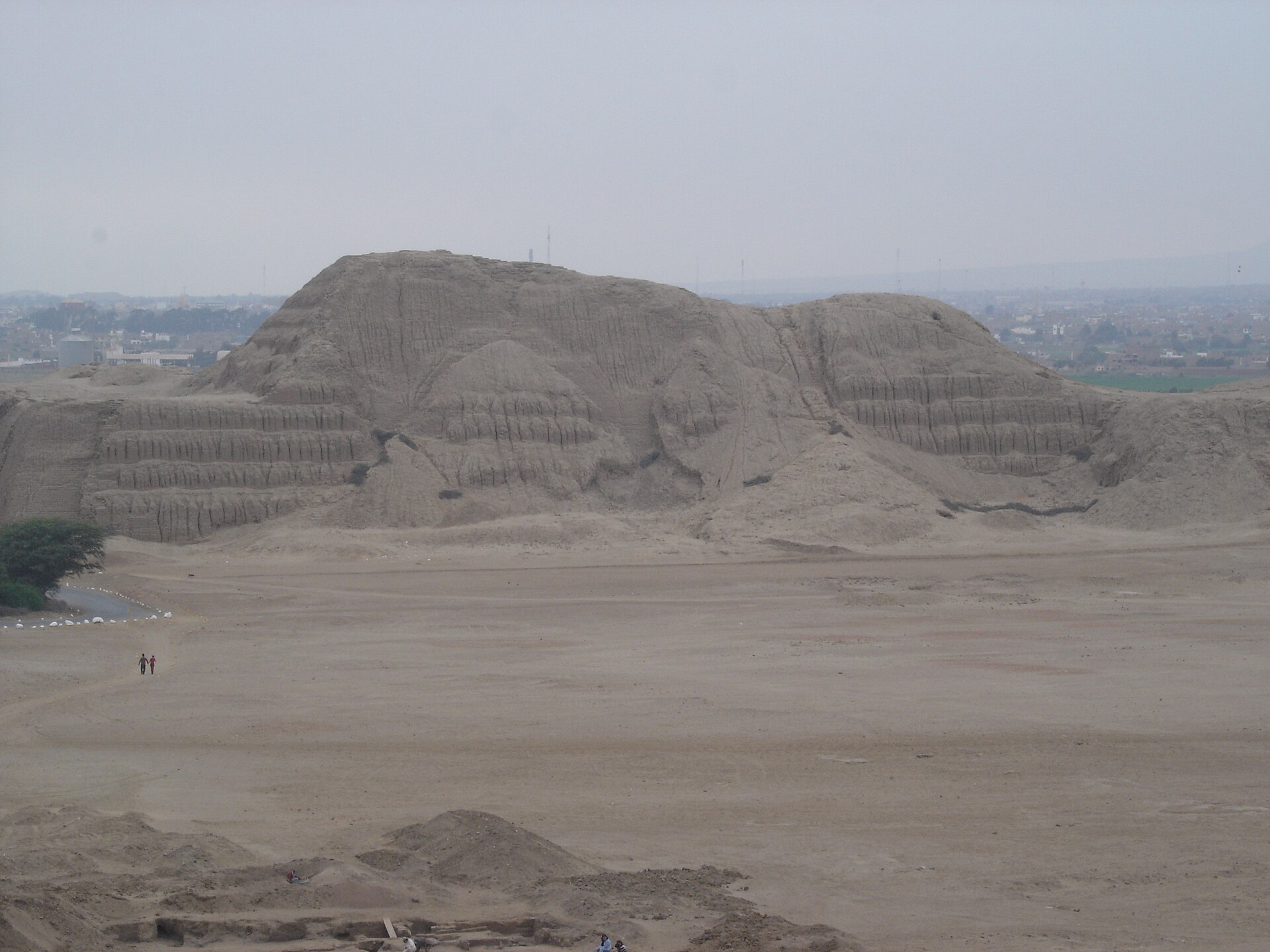
The Huaca del Sol, or Temple of the Sun, is one of those rare places where history isn’t just something you read about—it’s something you can almost touch. Just outside the city of Trujillo, in Peru’s northern desert, this archaeological site preserves the remnants of the Moche civilization, a culture that thrived along the coast long before the Inca rose to power. Here, amid shifting sand dunes and sparse vegetation, two massive adobe pyramids stand as silent witnesses to a society that once shaped this land. The Huaca del Sol is the larger of the two, though time, looters, and the elements have worn it down to a fraction of its former self.
Construction of these pyramids began around the 3rd century AD and continued for several hundred years. The Moche had no wheels, no draft animals, and yet they managed to build these structures using millions of adobe bricks—sun-dried clay blocks, each one marked with the fingerprints or symbols of the workers who made them. The Huaca del Sol alone was built from over 100 million of these bricks, stacked without mortar to create a monument that once towered nearly 40 meters high. Today, only a portion remains, its eroded slopes bearing the scars of centuries: earthquakes, the relentless desert wind, and the greed of Spanish conquistadors who plundered it in the 17th century.
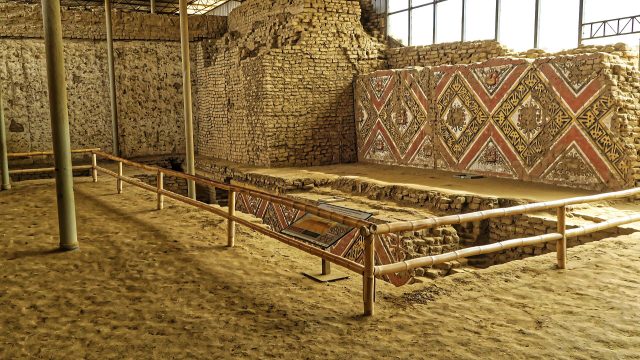
Beside it stands the Huaca de la Luna, the Temple of the Moon, smaller but far better preserved. Its walls are still adorned with intricate reliefs depicting mythological creatures, gods, and scenes of ritual sacrifice. For the Moche, these carvings weren’t mere decoration—they were a language, a way of communicating with the divine. The images tell stories of a people who believed in the power of ceremony, who saw the world as a place where the living and the dead were constantly intertwined. Archaeologists have uncovered elite burials here, filled with gold and silver ornaments, finely crafted pottery, and even the remains of human sacrifices. These finds suggest that the pyramids weren’t just religious centers but political ones, where the fate of an entire civilization was decided.
Walking through the site today, it’s easy to imagine the bustle of life that once filled this place. Priests performing rituals on the high platforms, artisans shaping clay into vessels, traders bartering goods in the shadow of the pyramids. The best time to visit is in the late afternoon, when the setting sun casts a golden glow over the adobe walls and the shadows stretch long across the sand. In that light, the ruins feel almost alive, as if the past is momentarily within reach.
The Huaca del Sol is more than just a ruin—it’s a symbol of the Moche’s sophistication. They were master engineers, building an intricate network of irrigation canals that turned the desert green. They were skilled metallurgists, crafting gold and silver into jewelry and ceremonial objects. Their pottery, some of the finest in pre-Columbian America, captures the details of daily life with striking realism: portraits of rulers, scenes of hunting, even depictions of illness and death. Many of these artifacts are now displayed in museums in Trujillo and Lima, but seeing them in the context of the ruins where they were created adds a layer of meaning that no exhibit can replicate.
Unlike the crowded tourist sites of Machu Picchu or Cusco, the Huaca del Sol offers a quieter experience. There are no long lines or guided tour groups rushing from one spot to the next. Instead, visitors can wander at their own pace, taking in the vastness of the desert and the scale of the pyramids. Local guides, many of whom trace their ancestry back to the Moche, share stories of their people’s traditions, pointing out the hardy desert plants that sustained ancient communities and explaining how the Moche adapted to their harsh environment. Occasionally, small festivals are held here, featuring traditional dances and music that echo the sounds of centuries past.
What remains of the Huaca del Sol is a reminder of how fragile human achievements can be. A monument built with such effort, by so many hands, now stands in ruins, its grandeur diminished by time and human interference. Yet even in its diminished state, it commands respect. The Moche may be gone, but their legacy endures—not just in the artifacts they left behind, but in the land itself, in the stories still told, and in the way their culture continues to shape the identity of northern Peru.
For those who visit Trujillo, the Huaca del Sol is more than just a stop on a tourist itinerary. It’s a place where the past feels present, where the desert wind carries whispers of a civilization that once thrived here. Standing among the ruins, it’s impossible not to reflect on the passage of time, on the rise and fall of empires, and on the enduring power of human creativity. The pyramids may be crumbling, but the history they represent is still very much alive.