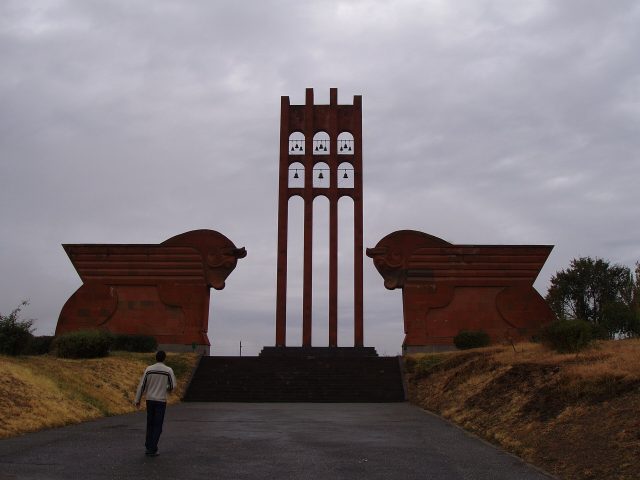
The statue of Aram Manukian in Sardarapat marks where Armenia’s history feels real. Against the open plains of the Ararat Valley, Manukian’s figure shows the nation’s spirit during its most turbulent time. As the first governor of Yerevan under the First Republic of Armenia, he became a symbol of resilience when Armenians fought for survival. The monument reminds us how fragile statehood emerged from war’s chaos, and how one person’s determination could unite scattered efforts into a struggle for the future.
Sardarapat carries heavy history. In May 1918, Armenian forces under General Movses Silikyan won a decisive battle against the Turkish army, stopping their advance and preventing the annihilation of the Armenian population. This victory led to Armenia’s declaration of independence days later. The statue of Manukian stands near the memorial complex for the Sardarapat victory. Together, they tell a story of the past—one honors the military triumph, the other the civilian efforts that followed, building a nation from nothing.
The statue is simple but powerful. Bronze, full-figured, Manukian wears early 20th-century clothes, no grand gestures. He leans slightly forward, as if listening or about to step into conversation. The pedestal bears only his name and life years. This restraint makes the point: impact matters more than grandeur.
Manukian stood out even among his peers. Born in 1879 in Zeyva, Erivan Governorate, he studied in St. Petersburg and joined revolutionary circles. But his path differed. He didn’t seek radical change at any cost—he wanted practical solutions for Armenian survival. After returning home, he organized village self-defense during the 1918 massacres and later ran Yerevan’s administration. During famine, disease, and constant threats, he set up hospitals, schools, and food centers, saving lives.
Manukian’s monument in Sardarapat isn’t just about one man. It shows how history continues. After Sardarapat’s victory, Armenia had a chance at independence—but someone had to take it. Manukian turned military success into nation-building. As Yerevan’s governor, he proved that even in dire times, foundations for the future could be laid. Standing before the statue, you feel the effort it took to build something lasting from ruins.
The location wasn’t chosen by accident.
The plains of Sardarapat, with Mount Ararat on the horizon, create a powerful setting. You can almost see the 1918 scene—volunteers fighting, leaders shouting orders, people gathering after battle, sharing rumors of peace. Manukian’s statue fits here, part of the landscape, not dominating it. It reminds us that history is made by people, not just dates and events.
For Armenians, Sardarapat is sacred. Visitors come to honor ancestors, lay flowers, reflect. Manukian’s monument holds special meaning. It represents not just heroism but the everyday work of preserving identity. Unlike war memorials, his figure shows the teachers, doctors, and administrators who build the future in peacetime.
The monument leaves you with mixed feelings. Pride in those who defended their land and built a nation against impossible odds. Sadness for the lives lost and the fragile peace they fought for. This tension makes such places powerful—they don’t let us forget the past, but they don’t let us drown in it either. History here isn’t a museum exhibit; it’s alive, shaping the present.
Sardarapat and Manukian’s statue aren’t just relics. They’re part of modern Armenian identity. Interest in the First Republic’s history has grown, and figures like Manukian matter again. His pragmatism and humanity inspire those building Armenia’s future today. The monument isn’t just stone and bronze—it’s where eras meet, a reminder that history continues with each new generation.