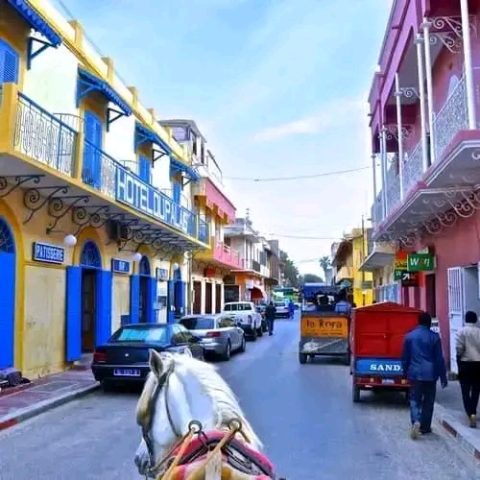
Las Hermanas Mirabal Park in Saint-Louis is one of those quiet places where stillness carries more weight than words ever could. It sits on an island that feels like its own world—narrow streets lined with fading colonial houses, sand shifting underfoot, and the Atlantic wind carrying the scent of salt and distant horizons. Here, among the greenery and low-hanging trees, the city’s hustle fades into the background, even though it’s just around the corner. The park isn’t large, but its size is deceptive; it holds far more than just paths and benches.
The name honors the Mirabal sisters, three women from the Dominican Republic who became symbols of resistance after their deaths in 1960 for opposing the Trujillo dictatorship. Their story is one of courage and sacrifice, and though Senegal is far from the Caribbean, the park pays quiet tribute to their legacy. There are no grand monuments here, just a simple plaque with their names, a few trees planted in their memory, and an atmosphere that invites reflection on what it means to stand for something greater than oneself.
Saint-Louis, once the capital of French West Africa, has always been a crossroads of cultures. African traditions, European influences, and the spirit of trade that connected the continent to the wider world have shaped its identity over centuries. Las Hermanas Mirabal Park is a small but meaningful part of that history. It may not be the most obvious landmark, but it fits into the city’s fabric as if it has always been there. Perhaps because Saint-Louis has a way of preserving memory without fanfare—holding onto it without making a spectacle.
The architecture surrounding the park tells its own story. Crumbling colonial buildings with ornate balconies stand alongside mosques with slender minarets, a reminder of the city’s Islamic roots. Nearby, modest homes where life moves at the unhurried pace of the Senegal River blend into the scene. The park acts as a bridge between these worlds, a place where tourists seeking exotic experiences, locals escaping the midday heat, and children playing in the shade all coexist without intrusion. That unspoken harmony is part of its charm.
Time moves differently here. Mornings are hushed, broken only by birdsong and the occasional passerby. By midday, the sun beats down relentlessly, driving most people indoors, leaving the park to the heat. But as evening approaches, it comes alive again—elders playing checkers at wooden tables, groups of young people gathered by the fountain, others simply watching the sunset from a bench. In those moments, Saint-Louis feels less like a city and more like a living thing, breathing in rhythm with the ocean.
The park makes no claim to being the city’s main attraction, and that’s precisely its appeal. There are no crowds, no souvenir stalls, no pushy guides. You can bring a book, sit on a bench, and lose yourself in the quiet rhythm of life around you. Or wander the paths, studying the old trees whose roots run deep, like the layers of history beneath the city. Sometimes, the park feels like a metaphor for Saint-Louis itself—unassuming yet full of meaning, understated but unforgettable.
Saint-Louis was once one of the most important ports on West Africa’s coast, a hub where ships carried enslaved people, gold, and spices, shaping the fate of empires. Today, it’s a shadow of that past, but that shadow gives it a unique allure. Las Hermanas Mirabal Park is part of that legacy, a quiet reminder that history isn’t always loud—sometimes, it’s just a whisper carried on the wind.
If you find yourself in Saint-Louis, don’t rush. Take a moment to step into the park, even if just for a little while. Sit on a bench, listen to the rustle of leaves in the breeze, watch the people who come here without reason. Maybe then you’ll understand what travel is really about—not just seeing new places, but touching their soul. And the soul of Saint-Louis, like the soul of this park, lives in the small things: the salt in the air, the creak of old trees, the silence that speaks louder than words.