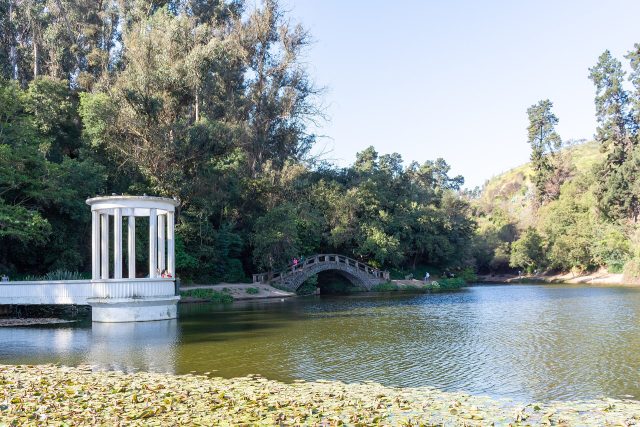
Quilpué Park is one of those places in Viña del Mar where people come not for attractions or entertainment, but for quiet. Perched on the hills overlooking the city and the coastline, it feels as though time moves at its own unhurried pace here. The trees, planted at the turn of the last century, cast dense shade, while winding paths invite leisurely strolls. Unlike the bustling beaches and lively streets below, this is a place to simply sit on a bench, listen to the rustling leaves, and let the city’s hustle fade into the distance.
The park’s history is closely tied to Viña del Mar’s evolution as a resort town. In the late 19th century, as Chile’s elite began building summer estates here, there arose a need for green spaces where people could escape the heat and dust. Quilpué was one of the first public parks designed not as a decorative showcase, but as a living piece of nature. Its landscape was meant to feel organic, and to this day, some of the oldest eucalyptus and pine trees still stand, witnesses to the time when Viña del Mar was just beginning to transform into the popular destination it is today.
There’s nothing grandiose about Quilpué’s design. You won’t find ornate fountains or towering sculptures here. Instead, the park’s charm lies in its understated details—small bridges, stone staircases, and wooden gazebos that blend seamlessly into the surroundings. One of the most notable features is an old viewing platform that frames the sweeping panorama of the ocean and the city below. It’s built to complement the view rather than compete with it. There are no manicured flowerbeds or artificial displays; the focus is on natural beauty, whether it’s wild shrubs or the occasional patch of wildflowers.
Quilpué doesn’t follow a rigid layout. It’s easy to wander off the main paths into bamboo thickets, stumble upon a small pond with ducks, or find a secluded meadow where locals gather for picnics. On weekends, families with children, students with books, and elderly couples all find their way here. In summer, the park offers a cool respite from the city’s heat, while in winter, when Viña del Mar turns damp and windy, it becomes a shelter from the elements. Unlike more tourist-heavy spots, Quilpué never feels crowded, and that’s perhaps its greatest appeal.
Beyond being a place of rest, the park holds a special place in the city’s cultural memory. Over the years, it has drawn Chilean writers and artists seeking inspiration in its quiet and natural setting. Locals share stories of first dates held here, of wedding photos taken among its trees, of children playing on paths older than their grandparents. Occasionally, small concerts or poetry readings take place, but they feel organic, as if people have simply gathered in the home of an old friend.
Viña del Mar is a city of contrasts—lively beaches, casinos, and nightlife on one side, and quiet neighborhoods where life moves at a slower pace on the other. Quilpué belongs to the latter. It doesn’t exist to attract crowds; it feels almost self-contained, as if it’s there for its own sake. There are no signs, billboards, or souvenir shops. Even a map is hard to come by—you’re meant to discover the park gradually, one winding path at a time. That might be why it resonates so deeply with those tired of over-commercialized spaces and craving a moment of solitude in nature.
In recent years, Chile has placed greater emphasis on preserving green spaces, and Quilpué stands as an example of how a public park can endure for decades without losing its essence. It hasn’t been redesigned to fit passing trends or cluttered with cafes and attractions. There are still corners where few have set foot, where leaves crunch underfoot and the air carries the scent of the sea and pine. For Viña del Mar, this is rare—a place that hasn’t bent to the pressures of time but has instead grown more serene and welcoming with age.
If you find yourself in this city, don’t limit your visit to the beaches and waterfront. Take an hour to climb up to Quilpué, if only to understand why locals cherish it. There’s nothing extraordinary about it, and that’s precisely its charm. The park doesn’t try to impress or entertain; it simply exists—quiet, green, and alive. Sometimes, that’s enough.