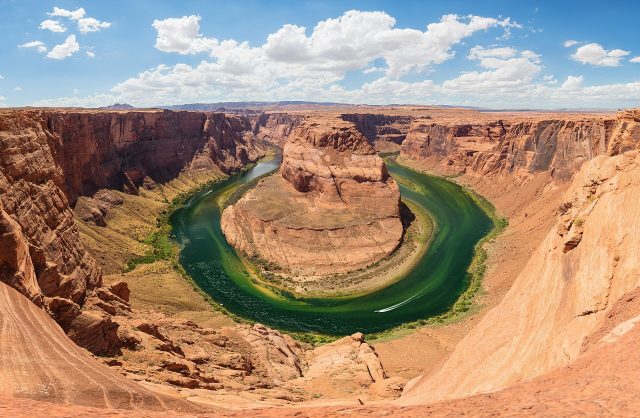
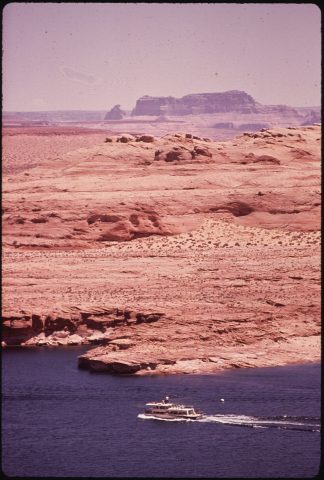
John Wesley Powell Memorial Park in Page, Arizona, is the kind of place that doesn’t announce itself. There are no crowds, no flashy signs, no grand attractions—just the quiet presence of wind moving through the rocks and the slow, steady flow of the Colorado River carving its way through the canyons below. The park is named for a man who never actually set foot here, at least not that anyone can prove. Yet Powell’s legacy lingers in the air, a ghost of the American West’s mythic past. He was an explorer, a scientist, a one-armed Civil War veteran who led the first recorded expedition through the Grand Canyon in 1869, a journey that nearly killed him but revealed the raw, untamed beauty of the Southwest to the world.
The park sits on a small rise, offering a sweeping view of Page and the surrounding desert. It’s not the kind of vista that stops you in your tracks at first glance, but if you stay awhile, you’ll notice how the light transforms the rocks—soft pinks at dawn, deep reds at dusk, the colors shifting like a slow-burning fire. The land here is sparse: hardy shrubs, brittle grass, and the occasional lizard darting between the stones. The sky, though, is vast and unbroken, so clear on some days that the horizon feels close enough to touch.
Page itself is a young town, born in the 1950s as a temporary camp for workers building the Glen Canyon Dam. It sprang up in the middle of nowhere, a cluster of buildings in a landscape of red rock and empty space, and even now it retains the feel of a place where time moves differently. The park is one of the few public spaces in town where you can simply sit on a bench, watch the birds—hawks circling overhead, small songbirds flitting to the artificial pond—and let the silence settle in.
At the heart of the park stands a bronze bust of Powell, mounted on a stone pedestal. He faces the distance, as if still mid-expedition, his gaze fixed on the canyons beyond. A plaque beside him recounts his journey, but the real story is in the land itself. Powell was an unlikely hero for his time—a geologist, a soldier, a man who lost an arm in the Civil War but never lost his hunger for discovery. His 1869 expedition down the Colorado was a brutal three-month ordeal, a fight against rapids, starvation, and despair. Some of his men didn’t make it back, but those who did brought back tales of a landscape so grand it defied belief.
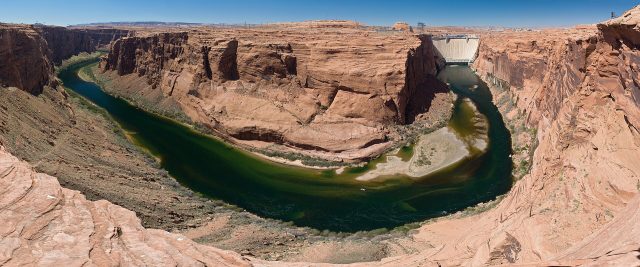
The park is small, but it has a quiet logic to its layout. A winding path leads from the monument down to a viewpoint overlooking the Glen Canyon Dam. Built in the 1960s, the dam tamed the Colorado River, creating Lake Powell, one of the largest man-made reservoirs in the country. It’s a marvel of engineering, but also a point of contention—environmentalists still debate its impact on the region’s ecology. From the overlook, though, the arguments fade. The water stretches out like a mirror, reflecting the sky, the cliffs rising in layers of red and gold. It’s a view that makes you feel small in the best way, a reminder of how vast and untamed this corner of the world still is.
There are no museums here, no interactive exhibits, but the history of the place seeps through the ground. Walk the paths and you can almost sense the layers of human presence—Native peoples who lived here for centuries, explorers like Powell who mapped the unknown, the workers who built the dam and turned the desert into a place where people could settle. Occasionally, the park hosts small gatherings—talks on local wildlife, conversations with longtime residents sharing stories of life in the Arizona desert. Most of the time, though, it’s just quiet. That’s its greatest gift.
Come early in the morning and you’ll see the sun rise over the canyons, painting the rocks in soft gold. By evening, the park is nearly empty—locals come to escape the heat, while tourists rush off to more famous sights. But that’s part of the appeal. Here, you can feel the rhythm of the desert, the slow pulse of a place that has seen countless sunrises and sunsets. It’s a landscape that doesn’t give up its secrets easily, but if you’re patient, it rewards you with something deeper than a postcard view.
This isn’t a place to check off a list. It’s for those who understand that some of the best experiences come when you slow down, when you let the land speak to you. There’s nothing extraneous here—just rock, sky, river, and the faint echo of a man who once set out into the unknown and changed the way the world saw this corner of the earth.