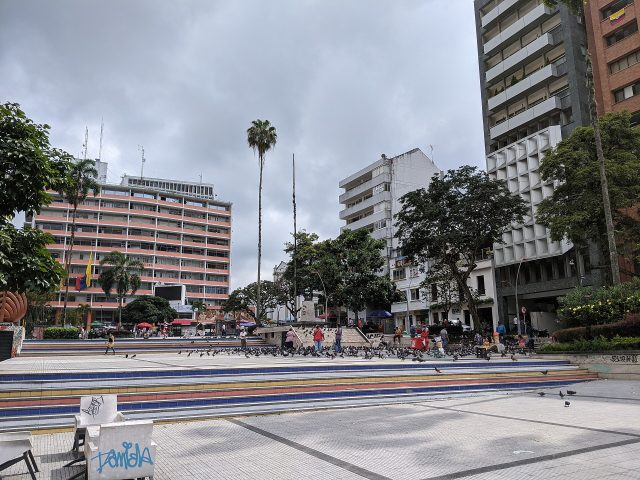
Andrés López de Galarza Park is one of those quiet corners in Ibagué where the city’s usual hum fades into the rustle of leaves and the murmur of everyday life. Tucked in the heart of the city, it isn’t large, but its modest size makes it feel intimate—somewhere you can slip away for a moment of solitude or a slow, unhurried walk. The park takes its name from a local figure whose legacy is woven into the region’s history, though today, most visitors know little about him beyond the plaque that bears his name. For them, the park is simply a place to escape the heat, sink onto a bench beneath the shade of sprawling trees, or watch the city go by at its own unhurried pace.
Ibagué isn’t the kind of place that draws crowds of tourists. Nestled in a valley between the Central and Eastern Cordilleras, the city enjoys a mild, almost spring-like climate year-round, which makes wandering through the park all the more pleasant. There’s no sense of urgency here, no tourist traps or grand monuments vying for attention. The park doesn’t try to impress with manicured gardens or exotic flora; it just exists, quietly, as part of the city’s daily rhythm. That lack of pretension is part of its charm.
The park’s design is simple but thoughtful. A central walkway, paved with tiles, cuts through the space, flanked by tall palms and other tropical trees that cast dappled shade over the paths. Benches line the edges, many of them claimed by regulars—elderly men reading newspapers, students debating their latest assignments, or young mothers keeping an eye on their children. At the heart of the park, a small fountain trickles softly, its sound blending into the background of city life. Occasionally, a street musician sets up nearby, filling the air with the strains of a guitar or the lively rhythms of traditional Colombian music.
The park’s history mirrors the evolution of Ibagué itself. In colonial times, this was the site of the town square, the nucleus around which the city grew. Over the centuries, it transformed from a marketplace and gathering spot—where everything from fairs to public executions took place—into a more tranquil public space. By the 19th century, as Colombia gained independence, cities like Ibagué began reimagining their communal areas, and the park became a place for leisurely strolls and socializing. Its current name was bestowed in the 20th century, a nod to a local figure whose contributions to the region are now mostly remembered by historians.
Today, Andrés López de Galarza Park is more than just a green space; it’s a small but vibrant cultural hub. On weekends, you might stumble upon an impromptu art exhibition, a local band playing under the trees, or even a spontaneous dance gathering where people of all ages move to the beats of salsa or cumbia. For visitors, it’s one of the best ways to experience Colombian life not as a spectacle, but as it unfolds naturally—unscripted, unfiltered, and deeply human.
What makes the park special is its refusal to be anything other than what it is. There are no elaborate flowerbeds or artificial ponds, just a space that feels lived-in and slightly worn, as any place should after decades of use. The trees, planted long ago, now tower overhead, their canopies offering respite from the midday sun. On any given afternoon, you might see locals unpacking thermoses of coffee or homemade snacks, turning a patch of grass into a makeshift picnic spot. It’s the kind of place where time seems to slow down, where the small rituals of daily life take center stage.
Ibagué moves at its own pace, unhurried and unpretentious. There’s no subway here, traffic jams are rare, and even the rhythm of life feels gentler than in Bogotá or Medellín. The park reflects that same unhurried spirit. There’s no need to buy a ticket, follow a set path, or pose for photos at designated landmarks. You can simply arrive, find a bench, and watch the world go by—children chasing each other, old men feeding pigeons, or couples lingering over conversation. That ease, that lack of expectation, is what makes the park so appealing.
Of course, it isn’t perfect. Some corners feel a little neglected, and in the evenings, the lighting can be uneven, making certain paths feel less inviting. There are moments when the park’s rough edges show—perhaps a stray dog wandering through or a bench in need of repair. But those imperfections don’t detract from its character; if anything, they reinforce the sense that this is a real place, not some sanitized tourist attraction. For anyone spending more than a day in Ibagué, the park offers a chance to feel the city’s pulse, to understand its rhythms, and maybe even strike up a conversation with a stranger.
Parks aren’t meant to be photographed or checked off a list. They exist so people can breathe, wander, meet, and part ways. Andrés López de Galarza Park is that kind of place—a small, unassuming corner of Ibagué where life unfolds without fanfare. It won’t make headlines or draw crowds from around the world, but for those who spend time there, it becomes a quiet refuge, a reminder that sometimes the most meaningful places are the ones that ask nothing of you at all.