Panam City is a quiet relic of a time when this corner of Bengal hummed with life. Tucked away in the lush greenery near Sonargaon, it was once a thriving hub where merchants traded silk and spices, artisans filled the streets with the sounds of their craft, and wealthy families built grand homes that gleamed under the tropical sun. Today, the city stands in ruins, its crumbling walls and overgrown courtyards offering a glimpse into a past that feels both distant and strangely alive. It’s not a place of grand monuments or polished restorations, but rather a fragile echo of history, where the passage of time is written in moss-covered bricks and the silence between the trees.
The story of Panam City begins in the 15th and 16th centuries, when Sonargaon served as the capital of the independent Bengal Sultanate. By the time Mughal governors took control, the city had become a vital trading post, drawing goods from India, China, and even Europe. Wealthy merchants and craftsmen settled here, constructing homes from fired brick and wood, their facades adorned with intricate balconies and latticework. The architecture blended local traditions with Persian and Mughal influences, creating a style that still lingers in the surviving structures. The layout of the houses, with their inner courtyards, was practical too—designed to offer respite from the heat and a private space for family life.
The main street of Panam City stretches for several hundred meters, its once-busy path now cracked and overgrown with wild grasses. Walking along it, you can almost hear the echoes of the past—the clatter of carts, the murmur of traders, the soft footsteps of people going about their day. The houses stand close together, their facades weathered but still standing. Some are still inhabited by locals, while others have succumbed to time, their walls crumbling, their windows empty. The most striking are the two- and three-story mansions, built around central courtyards where every room opened inward. This design wasn’t just about aesthetics; it was a way to keep cool in the sweltering climate and maintain privacy in a crowded city.
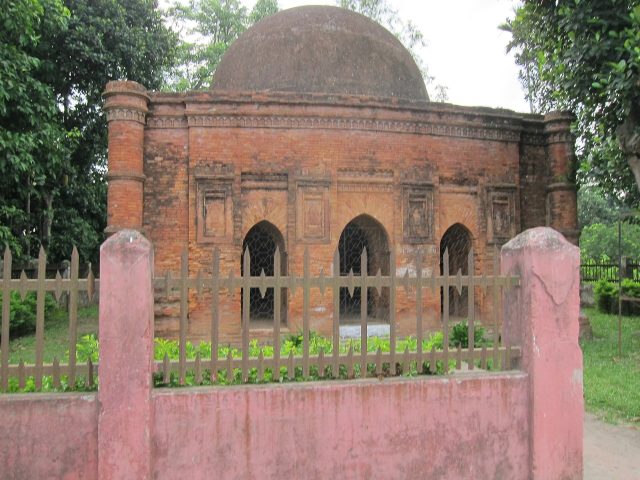
One of the most intriguing buildings is the Andar Mahal, or Inner Palace. A large structure with a spacious central hall, it’s surrounded by galleries on the upper floor, suggesting it may have been used for gatherings or receptions. Now, the halls are empty, save for fragments of wall paintings and carved wooden panels that hint at its former grandeur. Outside, the gardens that once bloomed with fruit trees and flowers have been reclaimed by nature, with bamboo and wild shrubs taking over. Nearby, the Goaldi Mosque stands as a testament to the city’s spiritual life. Built in the 17th century, this small but elegant structure features three domes and a minaret, its walls decorated with terracotta patterns. Unlike many of the other buildings, the mosque is still in use, a quiet place where locals come to pray. Beside it lies an old cemetery, its gravestones inscribed with Arabic script, marking the resting places of the city’s elite.
No one knows for certain why Panam City was abandoned. Historians speculate that shifting trade routes, the encroachment of the jungle, and possibly disease played a role. By the 19th century, the city was largely deserted, its residents moving to more prosperous areas. Today, the ruins sit in a hush broken only by birdsong and the rustle of leaves. For the people who live nearby, the place is not a romanticized relic but a quiet part of their history, slowly being erased by time. There’s no sense of tragedy here, just a gentle acceptance of the past’s inevitable fading.
What makes Panam City special is its atmosphere. Despite its state of decay, it doesn’t feel oppressive. Instead, there’s a sense of peace, as if the city has finally found rest after centuries of bustling activity. The shade of ancient trees offers relief from the heat, and in the late afternoon, the setting sun bathes the ruins in a warm, golden light. Few tourists venture here—most are drawn to Bangladesh’s more famous landmarks—and that only adds to the sense of stepping into a forgotten world. It’s a place where you can wander without hurry, peering into empty houses and listening to the sounds of nature.
If you visit, take your time. Walk the length of the main street, pause in the courtyards, and let your imagination fill in the gaps. You might catch fragments of the past—the hum of a marketplace, the laughter of children, the rhythmic tap of a craftsman’s tools. Panam City doesn’t tell its story in words, nor does it need to. Its silence speaks volumes, a quiet reminder of the lives that once thrived here and the slow, inevitable march of time.