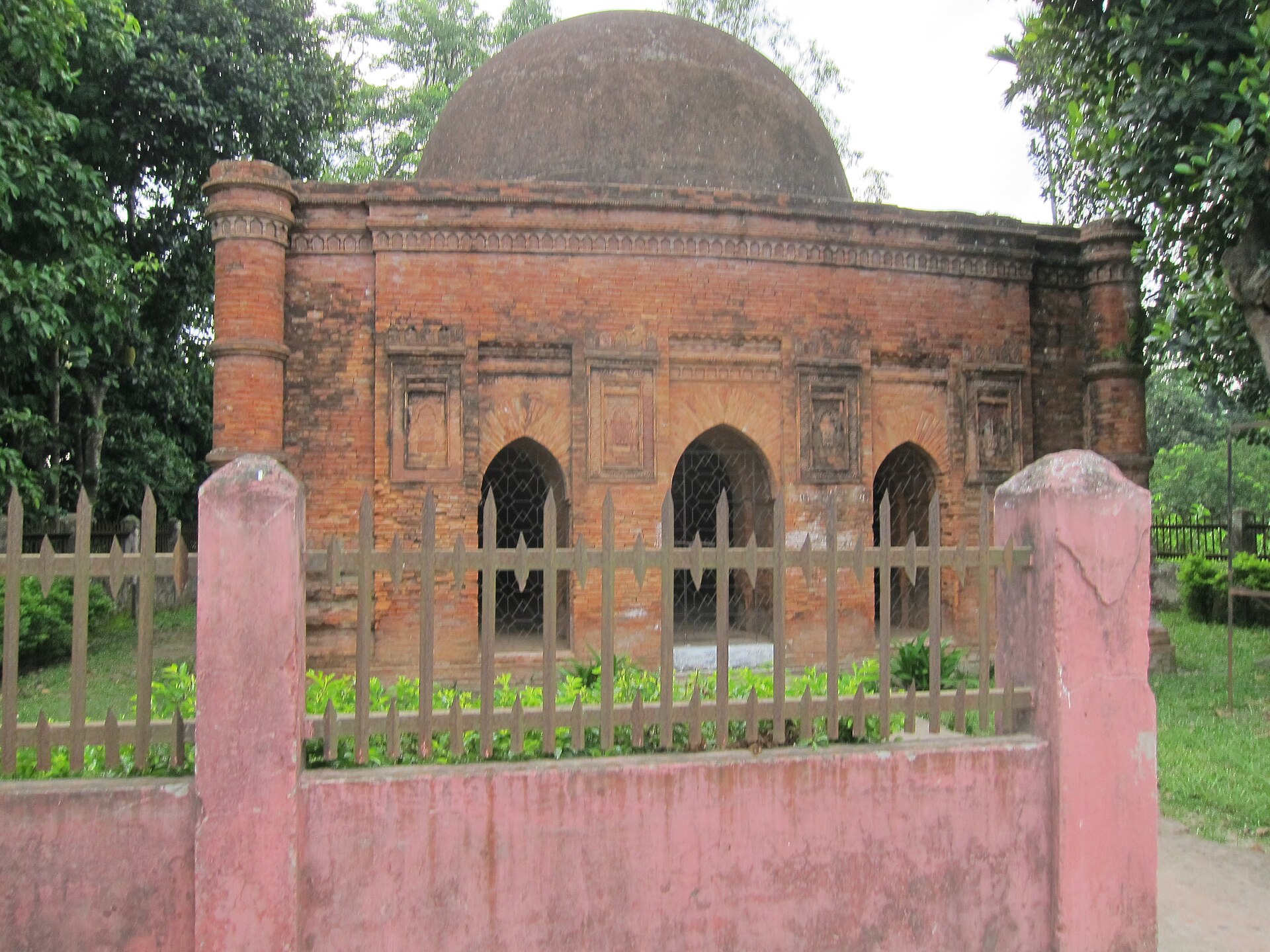
Sonargaon’s quiet edges hold a piece of history that refuses to fade. The Goyaldi Mosque, built in the early 1500s, is one of the few structures still standing from a time when this city was the beating heart of Bengal. Back then, Sonargaon was a hub of power, trade, and culture, its streets alive with merchants from Delhi, Burma, and beyond. Now, the grandeur is gone—replaced by overgrown paths and the hum of rural life—but the mosque remains, a silent witness to the rise and fall of kingdoms.
The building itself is modest, a small rectangle of weathered brick topped with three domes and four corner towers. Its design is classic for the period, blending Islamic architectural traditions with local influences. The entrance is framed by carved niches and faded patterns, once vibrant with color, while the interior is bare, stripped down to the essentials: plain walls and a mihrab pointing toward Mecca. There’s a quiet dignity in its simplicity, a sense of purpose that hasn’t been lost to time.
Goyaldi was commissioned during the reign of Sultan Alauddin Husain Shah, a ruler who left his mark on Bengal’s history. Under his leadership, Sonargaon flourished as a center of commerce and governance, and the mosque served as both a place of worship and a symbol of the sultan’s authority. Today, the city is a shadow of its former self, but the mosque endures, a reminder of how even the most powerful places can fade into the background of history.
Around the mosque, a small park offers shade and a place to rest. Locals come here to escape the heat, sitting under the trees while the sounds of the countryside drift by—motorbikes on the nearby road, children playing, the occasional call to prayer from a distant minaret. Tourists rarely make the journey, and the mosque isn’t the kind of place that draws crowds. But for those who do find it, Goyaldi feels like a discovery, a quiet corner where history isn’t performed for visitors but simply exists, waiting to be noticed.
Time has left its mark on the mosque. The brickwork is cracked, the domes streaked with moss, and the once-bright decorations have faded. A restoration effort in the last century helped stabilize the structure, and now it’s under state protection. Access inside is sometimes restricted, but the exterior is always visible. For the people of Sonargaon, it’s more than just an old building—it’s a place of quiet reflection, a connection to a past that still lingers in the present.
Sonargaon itself is a place of contradictions. Once the capital of an independent sultanate, it later fell under Mughal and then British rule, each era leaving its own imprint. Today, it’s a village of narrow lanes, mud-brick houses, and rice fields stretching to the horizon. The mosque stands on a slight rise, as if keeping watch over the changing landscape, a fixed point in a world that has moved on.
Visiting Goyaldi is a slow experience. There are no cafes or souvenir stalls nearby, so it’s best to bring water and come prepared. The journey from Dhaka takes time, and the last stretch is a walk along a dusty path. But those who make the effort are rewarded with a glimpse of Bangladesh as it really is—a country where the past and present exist side by side, not as a spectacle, but as part of everyday life.
The best time to come is early morning or late afternoon, when the sun isn’t as harsh. The light softens the worn brick, and the quiet makes it easier to imagine the voices that once filled this space. There’s no grand narrative here, no polished story for tourists. Just a building that has stood for centuries, holding onto the memories of those who built it, prayed here, and walked these paths long before the modern world arrived.