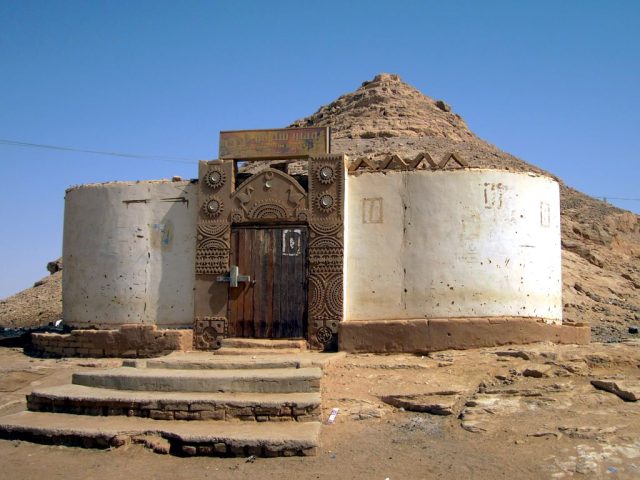
Wadi Halfa is a town where the past lingers in the quiet corners, where the weight of history isn’t confined to museums or grand monuments but seeps into the very air. On its outskirts, where the Nubian Desert bleeds into the edges of human settlement, stands a modest stone marker dedicated to Muhammad Ahmad, better known as the Mahdi. It’s not a place that demands attention—no towering statues or polished plaques announce its significance. Instead, it waits patiently, as if knowing that those who seek it out will understand why it matters.
The monument itself is unassuming: a simple stele carved with the figure of the Mahdi, his hand raised in a gesture that could be a call to action or a moment of quiet resolve. The relief is straightforward, almost understated, depicting him in traditional dress without the trappings of power. There are no manicured gardens or crowds here, just the occasional passerby and the ever-present wind shaping the dunes around it. The lack of fanfare feels deliberate, as if the place itself is saying that some stories don’t need embellishment to be remembered.
For many Sudanese, the Mahdi remains a complicated figure. In the late 19th century, he led a rebellion against the Anglo-Egyptian rule that had tightened its grip on Sudan, rallying followers with promises of liberation and a return to Islamic principles. His movement was both a religious and political uprising, one that briefly established an independent state before being crushed by British forces. To some, he is a symbol of resistance, a man who dared to challenge foreign domination. To others, his legacy is more ambiguous, tied to a turbulent period that reshaped the country in ways still felt today. The monument in Wadi Halfa doesn’t take sides—it simply stands as a reminder of a moment when ordinary people believed change was possible.
Wadi Halfa was no stranger to the upheavals of that era. During the Mahdist War, it served as a strategic point along the route to Khartoum, where some of the conflict’s most decisive battles unfolded. The town has long since shed its role as a military stronghold, but traces of that past remain in the stories passed down through generations. Locals speak of caravans that once crossed these sands, of the Mahdi himself pausing here before pressing onward. Whether these tales are entirely accurate is less important than the fact that they endure, woven into the fabric of the town’s identity. History here isn’t just recorded in books; it’s lived, whispered in the spaces between the present and the past.
The architecture of the monument reflects its purpose. The stone is likely local, the same kind used in the older buildings of Wadi Halfa, grounding the structure in the landscape. There’s no grandiosity in its design, no attempt to elevate the Mahdi beyond the man he was—a preacher who became a leader not through wealth or title, but through conviction. That simplicity is what makes it resonate. It doesn’t glorify war or power; it acknowledges a moment when people came together under a shared belief, even if that belief was fleeting.
Sudan’s history is one of fractures and resilience, of borders redrawn and identities reshaped. The Mahdist uprising was one of the first major challenges to foreign rule, and though it ultimately failed, its echoes never fully faded. The country’s later struggles—colonialism, civil wars, the split with South Sudan—all carry shadows of that earlier defiance. The monument in Wadi Halfa isn’t just a tribute to a single man; it’s a quiet testament to the idea that resistance, in whatever form it takes, leaves a mark. That’s why it hasn’t been forgotten. Locals tend to it, sometimes leaving flowers or sitting nearby in silent reflection. It’s not a tourist attraction in the conventional sense, but a place where history feels immediate, almost tangible.
Wadi Halfa isn’t a destination for those seeking bustling markets or modern comforts. It’s a town where time moves differently, where the rhythm of life is dictated by the desert and the Nile rather than the demands of the outside world. The monument to the Mahdi fits seamlessly into this pace. It’s not something you visit with a guidebook in hand; it’s something you stumble upon while going about daily life—on the way to the market, or while walking home at dusk. For outsiders, it might seem insignificant, just another marker in a landscape full of them. But for those who know what it represents, it’s a place where the past isn’t just remembered; it’s felt.
The Mahdi’s legacy is still debated in Sudan. Was he a visionary or a zealot? A unifier or a divider? The monument doesn’t answer those questions, nor does it try to. Instead, it serves as a focal point for memory, a place where people can grapple with the complexities of their history. In a country where narratives have often been shaped by political agendas, such spaces are rare. They allow for reflection without prescription, for remembrance without revision.
If you ever find yourself in Wadi Halfa, take a moment to stop at the monument. There’s no need to force a reaction—just stand there, listen to the wind, and let the weight of the place settle in. The desert has a way of making time feel both vast and immediate, and the story of the Mahdi is just one thread in a much larger tapestry. But sometimes, a single thread is enough to remind you that history isn’t just something that happened. It’s something that lives on, in the quiet corners and the unassuming places, waiting for those who are willing to look.