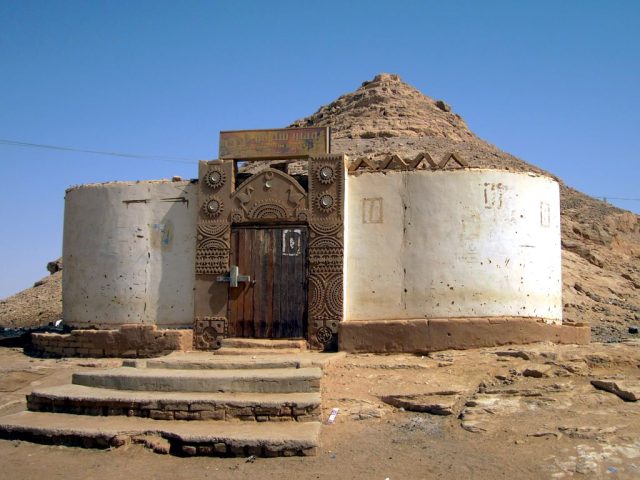
Wadi Halfa’s mosque sits where the Nile bends gently around the town, its waters curling against the shore like a slow, deliberate breath. This isn’t the kind of place you’d find in guidebooks or postcards—no grand domes, no crowds of visitors, no sense of performance. Instead, it feels like somewhere time has settled into its own rhythm, moving to the pace of the river rather than the clock. The mosque is small, unassuming, but its minaret rises just enough to be seen from a distance, slender against the sky, its surface marked with the same geometric patterns that repeat across the walls inside. The interior is open and bright, the floor covered in woven palm mats that carry the faint, earthy scent of dried leaves.
The mosque’s history is woven into the story of Wadi Halfa itself. Long before it became a quiet border town, this stretch of the Nile was a crossroads, a place where traders, pilgrims, and travelers paused on their way between Egypt and Sudan. The river was the highway, and the mosque was the resting point—a place to pray, to share news, to catch one’s breath before moving on. The town has seen its share of upheaval, changing hands more than once, but the mosque has always been there, a steady presence. Even when the old part of Wadi Halfa was flooded during the construction of the Aswan Dam in the mid-20th century, the mosque was carefully dismantled and rebuilt on higher ground, its form preserved as if to prove that some things endure.
The architecture here is simple but deliberate. The walls are made of mud bricks, mixed with straw and shaped by hand, a technique that keeps the interior cool during the day and warm at night. The roof is flat, with just enough of a slope to let rainwater run off. The minaret is the tallest structure for miles, and from its top, you can see the Nile stretching out below, wide and unhurried, with the town clinging to its banks. Inside, there are no lavish decorations, just carved wood and plasterwork—stars, crescents, and repeating patterns that feel more like a quiet conversation than a display.
For the people of Wadi Halfa, the mosque is more than a place of worship. It’s where the community gathers for festivals, weddings, and funerals. On Fridays, after midday prayers, men often linger in the courtyard, talking about crops, the river, the latest news from Khartoum. Women come less frequently, but during Ramadan or Eid, the mosque fills with families, children running between the pillars while elders sit in the shade. For the youngest, it’s where they first learn to recite the Quran, their voices soft and hesitant under the guidance of the imam.
The atmosphere around the mosque shifts with the day. In the early morning, when the sun is still low, the air smells of damp earth and fresh bread from nearby ovens. People drift toward the mosque—some for prayer, others just passing through on their way to the market or the river. By evening, when the heat lifts, the courtyard fills with older men sitting on low benches, sipping tea and talking in slow, measured tones. The call to prayer echoes across the town, and for a moment, everything pauses—the market stalls, the conversations, even the breeze seems to still.
Wadi Halfa isn’t a place people visit for landmarks or attractions. There are no museums here, no luxury hotels, no grand spectacles. That’s why the mosque doesn’t feel like a tourist site—it’s just part of the fabric of life, as ordinary and essential as the Nile or the desert sand. It doesn’t try to impress or entertain; it simply exists, a quiet witness to the passing of days. For those who do find their way here, it offers a glimpse of Sudan as it is lived, not as it’s packaged for outsiders.
If you step inside, don’t expect ceremony. The space is modest—plain mats on the floor, wooden stands holding copies of the Quran, the soft rustle of pages turning. The imam might greet you with a nod and offer tea if you stay awhile. The locals are used to the occasional visitor, and while they’re welcoming, they won’t press you for your story unless you choose to share it. There’s a quiet wisdom in that—no rush, no small talk, just the unspoken understanding that some things don’t need explaining.
The Nile is always close, its presence a constant hum in the background. Sometimes the wind carries the scent of water and fish; other times, you can hear the cry of gulls or the dip of oars in the current. The mosque stands so near the river that during the annual flood, the water almost reaches its steps. The people here say it’s a sign—the Nile gives life, and the mosque stands as a reminder of what matters. There’s something comforting in that, in knowing these same walls have watched generations come and go, yet remain unchanged, just like the river.
As the sun sets, the mosque takes on a golden hue, its outlines softening in the fading light. The air cools, and the town begins to quiet. This is the time when it’s easiest to sit by the river, watching the water and listening to the day wind down. The mosque doesn’t ask for admiration or photographs. It doesn’t need to. It’s enough that it’s there, waiting for those who notice, who might understand its quiet language and, perhaps, want to return.