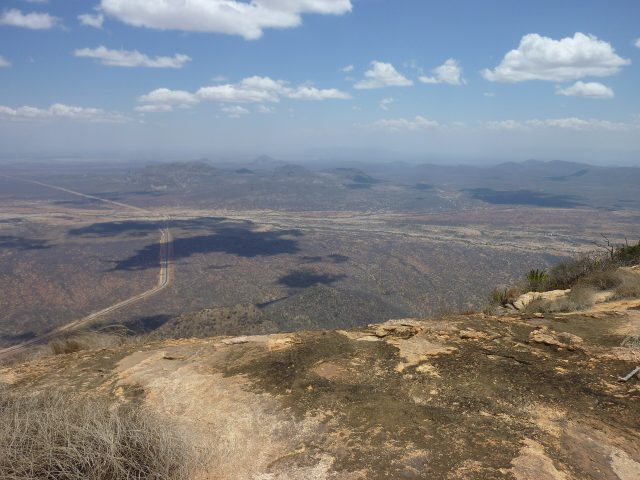
Marsabit National Park lies in the arid north of Kenya, where the landscape shifts between mirage and reality with every rare rainfall. The park spans roughly a thousand square kilometers of sunbaked plains and rocky hills, a palette of ochres and browns that suddenly gives way to something unexpected. Here, pockets of dense forest rise like green islands from the dry savanna, and rain-fed lakes glint between the trees, offering refuge to wildlife even in the harshest months. It’s a place of stark contrasts, where life persists against the odds.
The region takes its name from a British colonial administrator and naturalist who once oversaw these lands. In the early 20th century, Marsabit was a favored hunting ground for European travelers drawn by its abundant wildlife. As attitudes toward conservation evolved, the area transitioned from a loosely regulated hunting reserve to a protected national park. Today, it remains a delicate balance between preserving wild spaces and supporting the communities that have long relied on them for survival. For the local Samburu and Rendille people, the land is more than just a resource—it’s woven into their traditions, stories, and daily existence.
There are no grand buildings or man-made monuments here. Instead, the park’s most striking feature is Mount Marsabit itself, a near-1,500-meter peak that dominates the horizon. Its slopes are draped in thick forest, a lush anomaly in the surrounding desert. Within the woodland lie the remnants of ancient volcanoes, their craters now holding small lakes ringed by papyrus. The mountain is sacred to the local communities, believed to be home to ancestral spirits. Visitors might sense the reverence in the air, especially in the quiet moments when the wind rustles through the trees and the water reflects the sky.
Wildlife in Marsabit is less concentrated than in Kenya’s more famous parks, but that’s part of its appeal. There are no crowds, no predictable game drives—just the occasional thrill of an unscripted encounter. Elephants gather at the lakes, their massive forms moving silently between the trees. Giraffes browse the higher branches, while zebras and gazelles graze on the open plains. Lions are here too, though sightings are rare, their presence more often felt than seen. Birds, however, are everywhere: flamingos wade in the shallows, eagles circle overhead, and the calls of unseen species fill the forest.
This isn’t a place for ticking off a checklist of attractions. The roads are rough, often impassable after rain, and the nearest proper lodging is a long drive away. The best time to visit is during the dry season, when the savanna is firm underfoot but not yet choked with dust. Days begin with the sunrise and end under a sky dense with stars, the rhythm of life dictated by the land itself. There’s no schedule, no script—just the slow unfolding of time in a place where nature sets the pace.
On the park’s edges, the Samburu and Rendille communities live much as they have for generations. They herd livestock, gather wild fruits, and use traditional medicines from the forest. Hunting is strictly controlled, and in recent years, ecotourism has offered an alternative way to sustain both the land and its people. Some villages welcome visitors, offering simple homestays where you can share a meal of maize and goat meat, listen to stories by the fire, or learn about the spirits said to dwell in the mountain’s depths.
The atmosphere in Marsabit is one of quiet intensity. One moment, you might be watching elephants drink from a lake; the next, the distant roar of a lion or the snap of a branch in the undergrowth sends a jolt of awareness through you. There’s no luxury here, no handholding—just the raw, unfiltered experience of a landscape that operates on its own terms. Nights are particularly vivid, the temperature dropping sharply as the stars emerge in a sky so clear it feels like you could reach out and touch them. It’s in these moments that the park’s magic becomes undeniable.
Marsabit isn’t for everyone. The journey is long, the roads unforgiving, and the comforts minimal. But for those willing to embrace its challenges, the park reveals itself slowly, in layers. The stillness of the lakes, the whispers of the forest, the vastness of the savanna—it’s a place where time feels different, where the past and present coexist in the rustle of leaves and the distant call of a bird. Here, you’re not just a visitor; you’re a brief participant in a story that began long before you arrived and will continue long after you’ve gone.