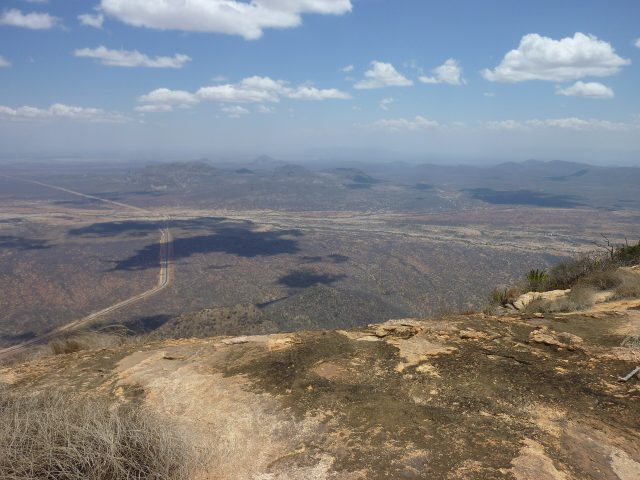
Marsabit is a mountain that rises unexpectedly from the arid plains of northern Kenya, a green sanctuary where dense forests and cool air defy the harsh realities of the surrounding landscape. At around fifteen hundred meters above sea level, the climate softens, and the usual rules of East Africa’s dry savannas seem suspended. Here, life thrives in ways that feel almost out of place—lush vegetation, hidden streams, and a quiet that contrasts sharply with the scorched earth beyond.
The mountain is an ancient volcanic formation, its slopes shaped by forces that worked millions of years ago. What makes Marsabit remarkable is its isolation. Even now, with roads improving, reaching it requires effort. The forests that cloak its sides are fed by underground springs and rare rivers, creating an ecosystem that supports elephants, buffalo, leopards, and countless bird species. The national park surrounding the mountain is one of Kenya’s lesser-known reserves, a place where wildlife moves freely but few travelers venture.
For generations, the mountain has held deep significance for the local communities. The Samburu, Borana, and Rendille people have long considered Marsabit sacred, a place where the spirits of ancestors reside. Elders speak of rituals performed to call for rain or protection, traditions that persist even as modernity creeps in. Some beliefs remain unchanged—many still approach the mountain with reverence, seeing it as a living entity rather than just a landmark.
The architecture here is unassuming but tells its own story. In the mid-20th century, colonial administrators and missionaries built settlements on the slopes, constructing homes from local stone and timber. A few of these buildings still stand, their weathered walls blending into the landscape, while others have been reclaimed by the forest. Today, the mountain is home to park rangers, researchers, and the occasional traveler, all drawn by its quiet allure.
There are no grand attractions or well-trodden paths. Instead, Marsabit offers something simpler: the chance to walk through forests where elephants might cross your path or to sit by a fire listening to stories from those who know the land best. The trails are quiet, often leading to viewpoints where the vastness of the surrounding desert becomes apparent. From the summit, the view stretches endlessly—forest giving way to savanna, then to the distant shimmer of Lake Turkana, hundreds of kilometers away.
The climate here is gentler than in the lowlands. Days are warm but rarely oppressive, and nights bring a coolness that feels almost crisp. The rainy seasons, from March to May and October to December, transform the landscape, turning streams into rushing torrents and the forests into a vibrant green. The dry months see the land settle into stillness, with only the hardiest plants holding on. The best time to visit is just after the rains, when the air is fresh, the roads are passable, and the wildlife is most active.
Reaching Marsabit is not easy. The journey from Isiolo, the nearest major town, takes hours along rough, unpaved roads. Dust storms can swallow the landscape in minutes, and herds of camels or goats often block the way. Local drivers know the route well, but even they take their time, navigating potholes and dry riverbeds. For those accustomed to smooth travel, the trip can feel like an adventure in itself.
What makes Marsabit special is its lack of pretense. There are no crowds, no rigid itineraries, no pressure to see or do anything in particular. It’s a place where time slows down, where the rhythm of life is dictated by the land rather than by schedules. Some come for the wildlife, others for the solitude, but most leave with the sense that they’ve experienced something rare—a corner of Kenya that remains untamed, where nature still sets the rules.