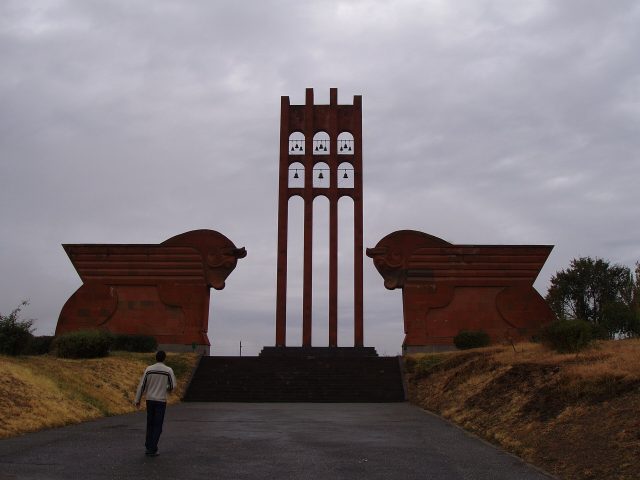
The Sardarapat Ethnographic Museum is one of those rare places where time seems to soften, where the noise of the modern world fades into the background. Tucked away in the heart of the Ararat Valley, it isn’t a typical museum with glass cases and curated displays. Instead, it’s an open-air collection of life as it once was—houses, tools, and everyday objects brought here from villages across Armenia, each piece telling a quiet story of survival, skill, and tradition. There’s no rush here, no crowds, just the slow rhythm of a way of life that shaped the country long before the battles and political shifts that often dominate its history.
Sardarapat itself carries deep historical weight. It was here, in 1918, that a pivotal battle became a symbol of Armenian resilience, a moment when the nation stood its ground against overwhelming odds. But the museum doesn’t dwell on war or grand narratives. Instead, it focuses on the unremarkable, everyday existence of the people who lived here before and after that fight—the farmers, artisans, and families who worked the land, raised livestock, and passed down their knowledge through generations. The exhibits span from the 18th to the early 20th century, a time when life in rural Armenia was defined by the land itself: the rocky soil of the Ararat Valley, the changing seasons, and the constant, patient labor required to coax a living from both.
The houses here are built from local stone and clay, their thick walls designed to keep out the summer heat and winter cold. Inside, the space is arranged with practicality in mind—low wooden beds covered in handwoven blankets, clay pots stacked neatly in corners, copper kettles and samovars that once held endless rounds of strong tea. The most striking feature is how little has changed in some of these homes. The same tools, the same furniture, the same way of organizing a household to make the most of limited space. A loom stands in one corner, its threads still taut, as if the weaver had just stepped away. Nearby, a wooden plow leans against a wall, its blade worn smooth by years of use. These weren’t just objects; they were extensions of the people who used them, shaped by necessity and handed down through families.
The museum also recreates the workshops where crafts once thrived. Blacksmiths, potters, carpenters, and weavers—each trade had its place in the village economy, and each left behind tools and products that speak to a deep, almost instinctive understanding of materials. Armenian pottery, for instance, has roots stretching back centuries, and the pieces on display here are decorated with patterns that have been repeated for generations. The blacksmith’s forge, meanwhile, produced more than just tools; it made the locks that secured doors, the knives that prepared meals, the horseshoes that kept carts moving. Everything was done by hand, with simple instruments, yet the results were often works of quiet beauty. Nearby, wooden carts and wagons stand ready, their wheels still sturdy despite decades of use. They were the lifeline of the village, carrying goods to market, hay from the fields, and families on their way to church or celebrations.
What makes this place feel alive, though, isn’t just the objects themselves, but the way they’re presented. There are no barriers, no "do not touch" signs—just the sense that the people who lived here have momentarily stepped away. In one house, a table is set with clay dishes, as if waiting for a meal. In another, a fire is laid in the hearth, ready to be lit. Old photographs hang on the walls, their edges yellowed with time, and embroidered towels drape over chairs, their stitches still precise. The museum doesn’t just preserve these items; it preserves the atmosphere of a village, the way the air might have smelled of fresh bread and woodsmoke, the way the light would have slanted through small windows in the late afternoon. In warmer months, the effect is even stronger, with gardens in bloom and the faint scent of herbs drifting from the fields.
Some of the traditions on display here aren’t entirely relics of the past. In remote villages, you might still find handwoven rugs like the ones in the museum, their patterns as vibrant as they were a century ago. The same goes for certain foods—lavash baked in tonirs, or the slow-cooked stews that once simmered over open fires. The museum occasionally hosts workshops where visitors can try their hand at these crafts: weaving a basket, shaping clay, or even baking bread in the traditional way. It’s a reminder that while the world has changed, some skills and tastes endure, passed down not through museums, but through families and communities.
This isn’t a place that tries to impress with grandeur or spectacle. There’s no attempt to romanticize the past, no glossy presentation of a simpler time. Instead, it feels like an honest tribute to the people who built and sustained these villages—their ingenuity, their patience, and their ability to find beauty in the everyday. For anyone tired of history told only through wars and kings, this museum offers something different: a glimpse into the lives of ordinary people whose stories are just as important, if not more so. It’s a place that makes you pause, not just to look, but to imagine—to picture the hands that shaped these tools, the voices that filled these rooms, the quiet routines that once made up a life.
The Ararat Valley has always been a crossroads, a place where empires rose and fell, where trade routes intersected, and where cultures mixed. But the museum in Sardarapat reminds you that beneath all that history, there was always the land itself—the fields, the rivers, the villages where people woke before dawn to tend their crops and went to bed with the sunset. It’s easy to forget, in the rush of modern life, how much of our world was shaped by those quiet, daily rhythms. This museum doesn’t let you forget. Instead, it invites you to step into that rhythm, if only for a little while, and to see history not as a series of dates and battles, but as something lived, breathed, and passed down through generations.