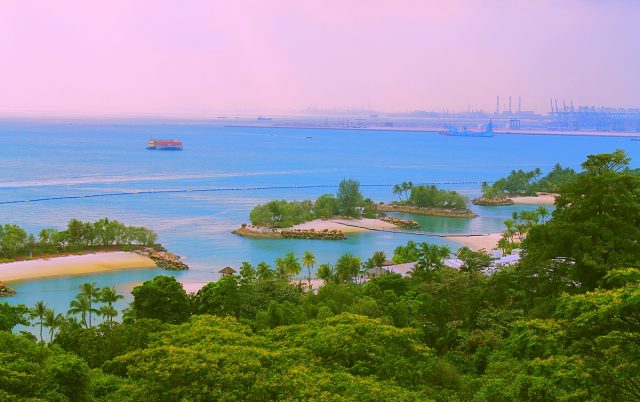
The bridge to Sentosa isn’t just a piece of infrastructure—it’s a thread woven into the fabric of everyday life in Singapore, stitching together the city’s relentless energy with the quiet escape of an island retreat. Its existence feels inevitable, almost organic, as if it were always meant to be there. Sentosa itself has lived many lives: once a military stronghold, then a colonial outpost, and now a playground for both locals and visitors. The bridge spans the waters of the strait, linking the mainland to this pocket of calm, and every day it carries a stream of people—some rushing to work, others heading to the beach, and a few simply pausing to take in the view of the bay.
Completed in the late 1990s, the bridge arrived at a time when Singapore was reimagining its relationship with tourism. Before its construction, reaching Sentosa meant relying on ferries or a cable car, both charming in their own way but not exactly convenient. The new bridge didn’t just solve a logistical problem; it marked a shift in the island’s identity. Sentosa, long associated with its military past and colonial echoes, was transforming into a modern leisure destination. Today, the bridge accommodates a road for cars, a dedicated path for pedestrians and cyclists, and even a monorail that whisks passengers straight to the island’s attractions and hotels.
There’s a quiet elegance to the bridge’s design, though it doesn’t announce itself with grand gestures. Unlike the Helix Bridge in downtown Singapore, with its futuristic DNA-inspired curves, the Sentosa bridge prioritizes function over spectacle. Its wide spans keep traffic flowing smoothly, while its slender supports don’t clutter the view of the strait. At night, the bridge comes alive with soft lighting, its reflections dancing on the water below. The effect is almost magical, especially when seen from the waterfront at VivoCity, where the entire length of the bridge stretches across the horizon.
For many Singaporeans, the bridge is part of the weekend ritual. On Saturdays and Sundays, it hums with activity—families making their way to the aquarium or Palawan Beach, cyclists exploring the island’s trails, and thrill-seekers heading to Universal Studios. The bridge acts as a threshold between the city’s hustle and the island’s slower pace. Even those who don’t plan to stay on Sentosa often linger on the pedestrian path, snapping photos or simply watching the boats glide by. It’s a place where the rhythm of the city softens, if only for a moment.
What makes the bridge interesting is how it divides two worlds. On the mainland side, the air is thick with the buzz of shopping malls and business districts. Cross the bridge, and the atmosphere shifts—green hills, palm-lined paths, secluded coves, and even patches of wild vegetation take over. It’s easy to forget you’re minutes away from skyscrapers and traffic jams. This juxtaposition is quintessentially Singaporean, where modernity and nature coexist in close quarters.
From the bridge, the views of Singapore’s southern coast are some of the best in the city. On clear days, the port—one of the busiest in the world—comes into sharp focus, with ships loading and unloading around the clock. In the distance, the outlines of Pulau Brani and Pulau Bukom emerge, while closer to shore, beaches and jetties dot the coastline. As evening falls, the sky turns shades of orange and pink, and the lights from ships and waterfront restaurants begin to twinkle like stars. It’s a scene that draws both tourists and locals, especially photographers hunting for the perfect shot.
The bridge isn’t just a way to get from one place to another—it’s a place where the city’s pulse is palpable. Here, different lives intersect: businesspeople hurrying to meetings, students heading home, backpackers exploring, and families out for a stroll. During rush hour, the traffic can crawl, but even then, there’s something oddly satisfying about the slowdown, a chance to look around and take it all in. In the early morning, when the bridge is nearly empty, the sound of waves and the cries of seagulls remind you that Singapore, for all its urban density, is still an island nation.
Over time, the bridge has become part of the city’s collective memory. It turns up in guidebooks and travel blogs, appears in films and advertisements, and even inspires local legends. Some say that if you make a wish while crossing the bridge for the first time, it’s bound to come true. Others joke that it’s the only place in Singapore where you can see skyscrapers, monkeys, and the ocean all at once. The details might be exaggerated, but the sentiment isn’t—this bridge really does bring together the many faces of the city.
It’s hard to imagine Singapore without the Sentosa bridge now. It didn’t just make the island more accessible; it made Sentosa feel like a natural extension of the city. There’s no grand monument here, no over-the-top spectacle—just a quiet, unassuming significance. The bridge is where the past meets the present, where work gives way to leisure, and where the city yields to nature. Maybe that’s the real magic of it: not in what it is, but in what it connects.