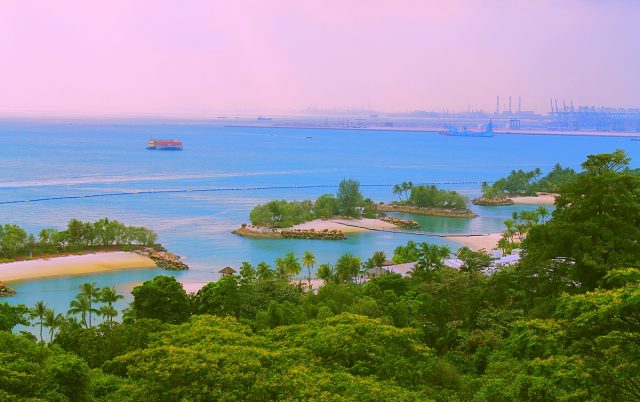
Singapore’s Marine Life Park isn’t just an aquarium—it’s where the city meets the ocean in a way that feels both deliberate and unexpected. Tucked away on Sentosa Island, a place that long ago shed its identity as a mere speck of land off the mainland, the park sits among manicured palms and artificial beaches, a quiet counterpoint to the skyscrapers just across the water. Here, the relentless pace of urban development slows just enough to make room for something else: an attempt to capture the complexity of marine ecosystems, from fragile coral reefs to tangled mangrove roots, and to show how easily they can unravel.
The story of this place is short but telling. Sentosa itself has reinvented itself multiple times—first as a military outpost, then as a retreat for factory workers, and finally as a polished tourist destination. The aquarium arrived in 2012, not as a flashy attraction but as an educational space, a decision that shapes everything from the layout of the exhibits to the way information is presented. There’s no grand spectacle here, no gimmicks designed to dazzle. Instead, the focus is on explanation, on making the case for why these ecosystems matter, especially in a region where the ocean has always been part of daily life.
The building itself is a study in contrasts. From the outside, it resembles a wave frozen mid-crest, a design that blends into the island’s landscape without disappearing into it. Inside, the architecture dissolves entirely, replaced by a network of tunnels and galleries that pull visitors deeper into an underwater world. The centerpiece is a massive tank with a walk-through tunnel, where sharks and rays glide overhead as if gravity has no claim on them. The effect is achieved through thick acrylic panels, strong enough to withstand immense water pressure yet so clear they seem to vanish, leaving only the illusion of being submerged.
What you’ll find inside isn’t just a collection of tanks but a series of carefully reconstructed habitats. There are over ten thousand marine creatures here, from tiny seahorses to lumbering groupers, but the real draw is how they’re presented. One exhibit recreates the mangrove swamps that once lined much of Singapore’s coastline, now mostly lost to land reclamation. Walking through it, you begin to understand how these tangled roots act as natural barriers, protecting shorelines from erosion and storms. Another section simulates the crushing darkness of the deep sea, where creatures adapted to extreme pressure and perpetual night drift in eerie silence. It’s a reminder of how little we still know about the ocean, even as we rely on it.
The coral reef exhibit is particularly striking. It doesn’t just display corals and the fish that dart among them; it explains how reefs form, how they sustain entire ecosystems, and why they’re so vulnerable to warming waters and pollution. Singapore sits in a part of the world where coral reefs are vital to coastal communities, and the aquarium makes that connection clear. Occasionally, staff demonstrate coral restoration techniques, showing how damaged fragments can be nursed back to health—a small but tangible way to engage visitors in the larger conversation about conservation.
For those who want more than passive observation, there are interactive experiences, though they’re less about entertainment and more about education. You can feed stingrays under supervision, watching how they glide toward the surface with surprising grace, or observe dolphin training sessions that double as lessons in animal behavior. There’s even a virtual reality experience that lets you see the ocean from the perspective of its inhabitants, though it feels more like an add-on than a core attraction. The real value lies in the quieter moments—watching a school of fish move as one, or standing in front of a tank where a moray eel peers out from its crevice with unsettling stillness.
The aquarium isn’t just for tourists. It’s a resource for locals, too, especially school groups. Field trips here are common, designed to spark an early interest in marine biology and environmental science. For Singapore, this matters more than it might elsewhere. The city-state’s survival has always been tied to the sea, not just economically but ecologically. The aquarium plays a role in that awareness, framing conservation not as an abstract ideal but as a practical necessity. It’s a place where children can see firsthand what’s at stake, and where adults can be reminded of how much has already been lost.
Visiting Marine Life Park is less about spectacle and more about immersion. There are no flashing lights or over-the-top displays, just the steady hum of water pumps and the occasional ripple of movement in the tanks. It’s a place where you can stand in front of a jellyfish exhibit and watch them pulse in the dim light, or linger in the mangrove section, listening to the recorded sounds of birds and insects that once filled these now-vanished wetlands. The experience is meditative in a way that feels rare in a city known for its relentless energy.
What stays with you isn’t just the sight of a shark gliding overhead or the delicate fan of a sea anemone. It’s the sense of connection—to a part of the world most people only glimpse from the surface, and to the idea that even in a place as engineered as Singapore, nature still has a voice. The aquarium doesn’t preach, but it doesn’t have to. The message is there in the way the exhibits are arranged, in the quiet insistence that these ecosystems are worth understanding, worth protecting. In a city that’s always looking forward, Marine Life Park is a reminder that progress doesn’t have to come at the expense of the natural world—it can, and should, include it.