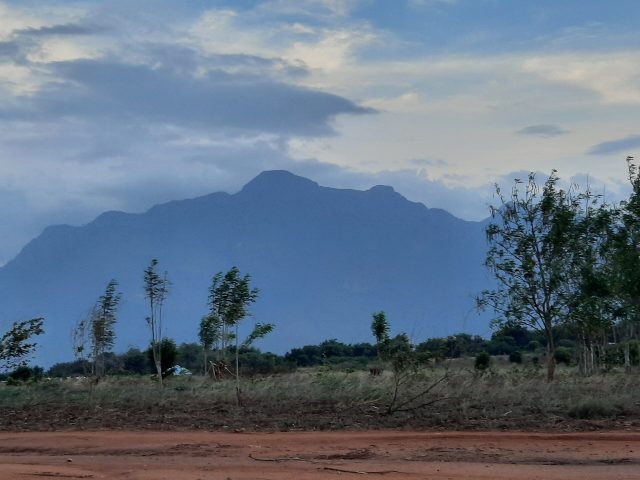
Mikumi is one of those places in Tanzania where the savanna reveals itself in its raw, untamed power. Tucked away a few hours’ drive from Morogoro, it sits along the route between Dar es Salaam and the country’s interior, acting as a natural corridor that connects the coast to the heart of Africa. Unlike the crowded trails of Serengeti or Ngorongoro, Mikumi offers something quieter—wide-open spaces, a sense of stillness, and the feeling that you’ve stepped into a world where humans are merely passing through.
The park stretches over three thousand square kilometers, encompassing valleys, rolling hills, and patches of woodland. Its landscape is classic African savanna: endless grassy plains dotted with acacia trees and baobabs, their gnarled trunks standing like ancient sentinels. During the rainy season, the land turns lush and green, while in the dry months, the grass fades to golden hues, creating a stark contrast with the dark bark of the trees. The Mkata River, winding through the park, draws animals to its banks, especially in the dry season when water becomes scarce.
Often called the little brother of Serengeti, Mikumi lives up to the comparison. Here, you’ll find the same iconic wildlife—lions lounging on sun-warmed rocks, elephants moving slowly through the brush, giraffes reaching for the highest branches, and zebras whose stripes blend into the shifting light and shadow. Antelopes are everywhere, from the graceful impalas to the sturdy elands, grazing in herds and lifting their heads at the slightest disturbance. Predators are less visible than in more famous reserves, but with luck, you might spot a leopard resting in a tree or a cheetah poised for a sprint.
Mikumi’s history as a protected area began in the mid-20th century, when Tanzania was still under colonial rule. After gaining independence in 1964, the park was officially established as part of the country’s national park system. Its creation wasn’t just about preserving the ecosystem; it was also about safeguarding the migration routes that connect eastern Tanzania to the central regions. Today, Mikumi plays a crucial role in maintaining the region’s biodiversity, offering a refuge for species struggling to find safe habitats elsewhere.
There are no grand buildings or paved roads here—just the land itself, shaped by time and nature. The Uluguru Mountains rise on the horizon like the walls of an ancient fortress, enclosing the park in a world where time moves differently. At dusk, their slopes take on violet and pink hues, while in the morning, a soft mist lingers over them, slowly burning away under the rising sun. The park’s roads are rough tracks winding between termite mounds and thickets, turning every drive into a small adventure.
For many travelers, Mikumi is their first real encounter with wild Africa. There are no luxury lodges or multilingual guides here—just simple campsites where you can sleep in a tent under a sky full of stars, listening to the distant roar of a lion or the eerie whoop of hyenas. Safaris start at dawn, when the air is cool and the animals are most active. Jeeps move slowly through the park, stopping at watering holes where elephants wallow in the mud or under trees where leopards nap in the branches.
What makes Mikumi special is its closeness to human settlements. Unlike reserves completely cut off from civilization, here the line between wilderness and village life is blurred. On the way to the park, you might see herders with their cattle or women carrying baskets of fruit on their heads. Sometimes, children wave from the roadside, a reminder that people and wildlife coexist here, side by side. The future of places like Mikumi depends on how well that balance is maintained.
Mikumi isn’t trying to be the most spectacular or famous park in Tanzania, and that’s part of its charm. There’s no pressure to chase the perfect photo or stick to a rigid itinerary. You can just sit in the jeep, watching the savanna go about its day, or climb one of the lookout points for a view of the endless plains. When the sun sets, painting the sky in shades of orange and red, it’s easy to understand why places like Mikumi stay with you—not because of the pictures you take, but because of the quiet sense of connection to the world that feels so rare in everyday life.